

SCATOLOQICAL STUDIES OF THE BIVALVIA (MOLLUSCA)
361
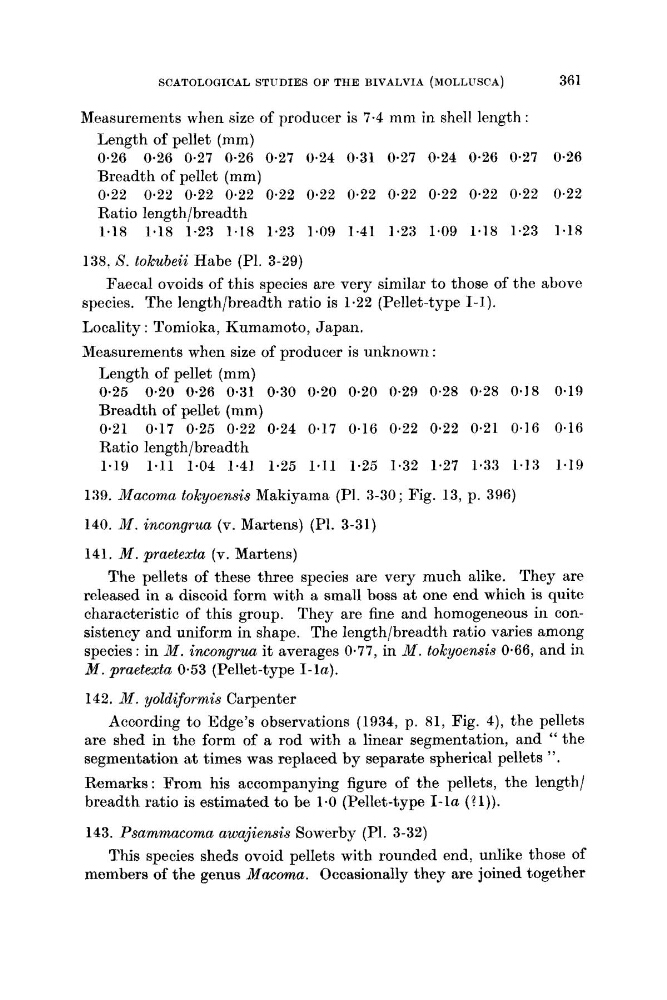
Measurements when size of producer is 7 4 mm in shell length :
Length of pellet (mm)
0.26 0.26 0.27 0-26 0-27 0.24 0.31 0.27 0-24 0.26 0.27 0-26
Breadth of pellet (mm)
0.22 0.22 0-22 0.22 0-22 0.22 0.22 0.22 0-22 0.22 0.22 0.22
Ratio lengthlbreadth
1.18 1.18 1.23 1.18 1.23 1.09 1.41 1.23 1.09 1.18 1.23 1.18
138. 8. tokubeii Habe (Pl. 3-29)
species. The length/breadth ratio is 1.22 (Pellet-type 1-1).
Locality : Tomioka, Kumamoto, Japan.
Measurements when size of producer is unknown :
Faecal ovoids of this species are very similar to those of the above
Length of pellet (mm)
Breadth of pellet (mm)
Ratio lengthlbreadth
0.25 0.20 0.26 0.32 0.30 0-20 0.20 0.29 0.28 0.28 0.18 0.19
0.21 0.17 0.25 0.22 0.24 0.17 0.16 0.22 0.22 0.21 0.16 0.16
1.19 1.11 1.04 1.41 1.25 1.11 1.25 1.32 1.27 1.33 1.13 1.19
139. Macoma tokyoensis Makiyama (Pl. 3-30; Fig. 13, p. 396)
140. M. incongrua (v. Martens) (PI. 3-31)
141. M. praetexta (v. Martens)
The pellets of these three species are very much alike. They are
released in a discoid form with a small boss a t one end which is quite
characteristic of this group. They are fine and homogeneous in consistency and uniform in shape. The lengthlbreadth ratio varies among
species : in M . incongrua it averages 0.77, in M. tokyoensis 0.66, and in
M . praetexta 0.53 (Pellet-type 1-la).
142. M. yoldiformis Carpenter
According to Edge’s observations (1934, p. 81, Fig. 4), the pellets
are shed in the form of a rod with a linear segmentation, and “ the
segmentation a t times was replaced by separate spherical pellets ”.
Remarks: From his accompanying figure of the pellets, the length/
breadth ratio is estimated to be 1.0 (Pellet-type I-la (? 1)).
143. Psammacoma awajiensis Sowerby (Pl. 3-32)
This species sheds ovoid pellets with rounded end, unlike those of
members of the genus Macoma. Occasionally they are joined together
361
Measurements when size of producer is 7 4 mm in shell length :
Length of pellet (mm)
0.26 0.26 0.27 0-26 0-27 0.24 0.31 0.27 0-24 0.26 0.27 0-26
Breadth of pellet (mm)
0.22 0.22 0-22 0.22 0-22 0.22 0.22 0.22 0-22 0.22 0.22 0.22
Ratio lengthlbreadth
1.18 1.18 1.23 1.18 1.23 1.09 1.41 1.23 1.09 1.18 1.23 1.18
138. 8. tokubeii Habe (Pl. 3-29)
species. The length/breadth ratio is 1.22 (Pellet-type 1-1).
Locality : Tomioka, Kumamoto, Japan.
Measurements when size of producer is unknown :
Faecal ovoids of this species are very similar to those of the above
Length of pellet (mm)
Breadth of pellet (mm)
Ratio lengthlbreadth
0.25 0.20 0.26 0.32 0.30 0-20 0.20 0.29 0.28 0.28 0.18 0.19
0.21 0.17 0.25 0.22 0.24 0.17 0.16 0.22 0.22 0.21 0.16 0.16
1.19 1.11 1.04 1.41 1.25 1.11 1.25 1.32 1.27 1.33 1.13 1.19
139. Macoma tokyoensis Makiyama (Pl. 3-30; Fig. 13, p. 396)
140. M. incongrua (v. Martens) (PI. 3-31)
141. M. praetexta (v. Martens)
The pellets of these three species are very much alike. They are
released in a discoid form with a small boss a t one end which is quite
characteristic of this group. They are fine and homogeneous in consistency and uniform in shape. The lengthlbreadth ratio varies among
species : in M . incongrua it averages 0.77, in M. tokyoensis 0.66, and in
M . praetexta 0.53 (Pellet-type 1-la).
142. M. yoldiformis Carpenter
According to Edge’s observations (1934, p. 81, Fig. 4), the pellets
are shed in the form of a rod with a linear segmentation, and “ the
segmentation a t times was replaced by separate spherical pellets ”.
Remarks: From his accompanying figure of the pellets, the length/
breadth ratio is estimated to be 1.0 (Pellet-type I-la (? 1)).
143. Psammacoma awajiensis Sowerby (Pl. 3-32)
This species sheds ovoid pellets with rounded end, unlike those of
members of the genus Macoma. Occasionally they are joined together