

354
KOHMAN Y. ARAKAWA
Psammobiidae
The representatives of this family produce ovoid faeces of compact
detritus which belong either to Pellet-type 1-1 or to 2. The specific
difference may be found in the ratio of length to breadth of the pellets.
122. Gari hosoyai (Habe) (PI. 2-21)
The pellets of this species usually take the form of an ovoid with
flattened ends, but occasionally they vary : some are discoidal ; others
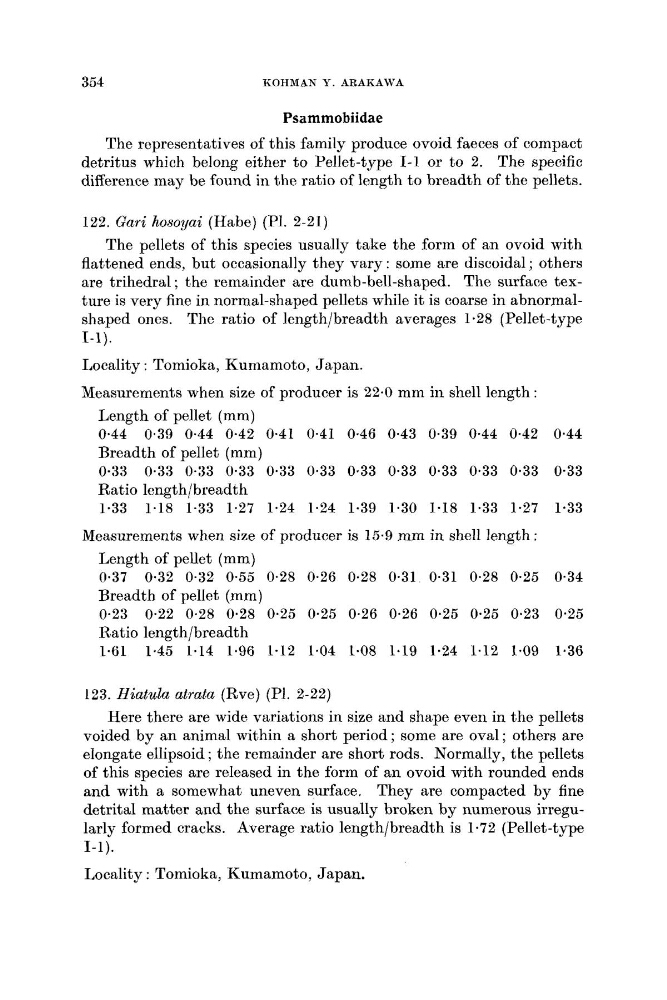
are trihedral ; the remainder are dumb-bell-shaped. The surface texture is very fine in normal-shaped pellets while it is coarse in abnormalshaped ones. The ratio of length/breadth averages 1.28 (Pellet-type
Locality : Tomioka, Kumamoto, Japan.
Measurements when size of producer is 22.0 mm in shell length :
1-1).
Length of pellet (mm)
Breadth of pellet (mm)
Ratio length/breadth
0.44 0.39 0.44 0-42 0.41 0.41 0.46 0.43 0-39 0.44 0.42 0.44
0.33 0.33 0-33 0.33 0.33 0.33 0.33 0.33 0.33 0.33 0.33 0.33
1.33 1.18 1-33 1.27 1.24 1.24 1.39 1.30 1.18 1.33 1.27 1.33
Measurements when size of producer is 15.9 mm in shell length :
Length of pellet (mm)
Breadth of pellet (mm)
Ratio length/breadth
0.37 0.32 0.32 0.55 0.28 0.26 0-28 0.31 0.31 0.28 0.25 0.34
0.23 0.22 0.28 0.28 0.25 0.25 0.26 0.26 0.25 0.25 0.23 0.25
1.61 1.45 1.14 1.96 1.12 1.04 1.08 1-19 1.24 1.12 1.09 1.36
123. HiatuZu atratu (Rve) (P1. 2-22)
Here there are wide variations in size and shape even in the pellets
voided by an animal within a short period ; some are oval ; others are
elongate ellipsoid ; the remainder are short rods. Normally, the pellets
of this species are released in the form of an ovoid with rounded ends
and with a somewhat uneven surface. They are compacted by fine
detrital matter and the surface is usually broken by numerous irregularly formed cracks. Average ratio length/breadth is 1.72 (Pellet-type
Locality : Tomioka, Kumamoto, Japan.
1-1).
KOHMAN Y. ARAKAWA
Psammobiidae
The representatives of this family produce ovoid faeces of compact
detritus which belong either to Pellet-type 1-1 or to 2. The specific
difference may be found in the ratio of length to breadth of the pellets.
122. Gari hosoyai (Habe) (PI. 2-21)
The pellets of this species usually take the form of an ovoid with
flattened ends, but occasionally they vary : some are discoidal ; others
are trihedral ; the remainder are dumb-bell-shaped. The surface texture is very fine in normal-shaped pellets while it is coarse in abnormalshaped ones. The ratio of length/breadth averages 1.28 (Pellet-type
Locality : Tomioka, Kumamoto, Japan.
Measurements when size of producer is 22.0 mm in shell length :
1-1).
Length of pellet (mm)
Breadth of pellet (mm)
Ratio length/breadth
0.44 0.39 0.44 0-42 0.41 0.41 0.46 0.43 0-39 0.44 0.42 0.44
0.33 0.33 0-33 0.33 0.33 0.33 0.33 0.33 0.33 0.33 0.33 0.33
1.33 1.18 1-33 1.27 1.24 1.24 1.39 1.30 1.18 1.33 1.27 1.33
Measurements when size of producer is 15.9 mm in shell length :
Length of pellet (mm)
Breadth of pellet (mm)
Ratio length/breadth
0.37 0.32 0.32 0.55 0.28 0.26 0-28 0.31 0.31 0.28 0.25 0.34
0.23 0.22 0.28 0.28 0.25 0.25 0.26 0.26 0.25 0.25 0.23 0.25
1.61 1.45 1.14 1.96 1.12 1.04 1.08 1-19 1.24 1.12 1.09 1.36
123. HiatuZu atratu (Rve) (P1. 2-22)
Here there are wide variations in size and shape even in the pellets
voided by an animal within a short period ; some are oval ; others are
elongate ellipsoid ; the remainder are short rods. Normally, the pellets
of this species are released in the form of an ovoid with rounded ends
and with a somewhat uneven surface. They are compacted by fine
detrital matter and the surface is usually broken by numerous irregularly formed cracks. Average ratio length/breadth is 1.72 (Pellet-type
Locality : Tomioka, Kumamoto, Japan.
1-1).