

SCATOLOGICAL STUDIES OF TIIE BIVALVIA (MOLLUSCA)
32 1
to 10a according to whether the surface grooves are present or not.
More than 60% of the representatives have pellets of the latter type.
Arcidae
Almost all the representatives of the Arcidae, so far as is known,
produce ungrooved ribbons (Pellet-type 10).
14. Arca umbonata Lamarck
" 1 animal. This specimen, 42.0 mm in length, produced a wide,
slightly curved ribbon 0-43 mm in width and 0.05 mm thick. The ribbon was smooth in consistency and broken into pieces varying in length
from 0.2 to 0.6 mm." (Manning and Kumpf, 1959, p. 299, Figs. lb, 4f.)
(Pellet-type 111-10.)
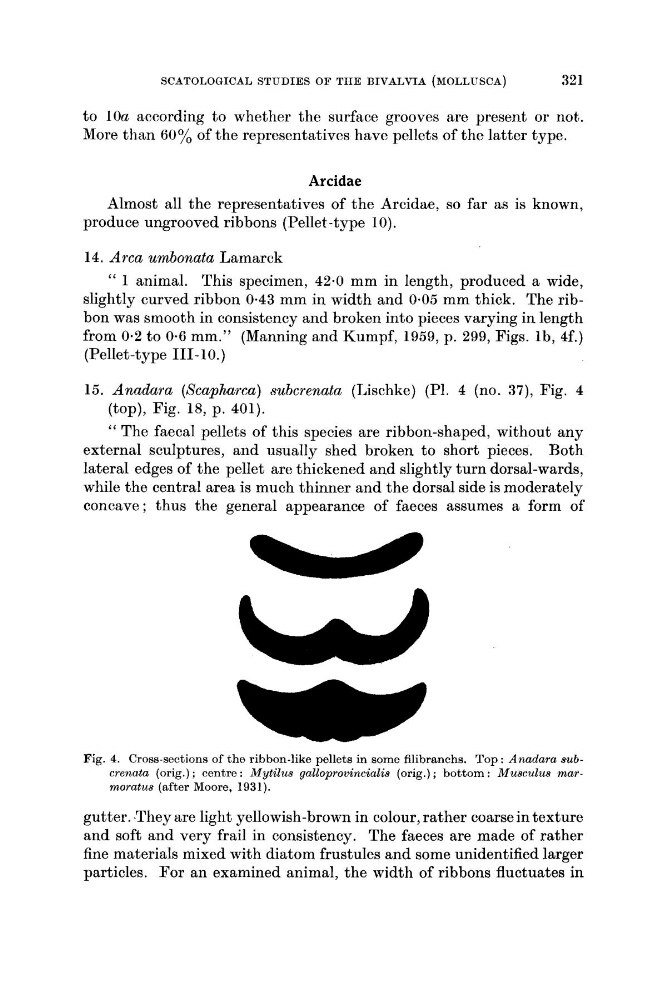
15. Anadara (Scapharca) subcrenata (Lischke) (Pl. 4 (no. 37), Fig. 4
(top), Fig. 18, p. 401).
" The faecal pellets of this species are ribbon-shaped, without any
external sculptures, and usually shed broken to short pieces. Both
lateral edges of the pellet are thickened and slightly turn dorsal-wards,
while the central area is much thinner and the dorsal side is moderately
concave; thus the general appearance of faeces assumes a form of
Fig. 4. Cross-sections of the ribbon-like pellets in some filibranchs. Top : Anadara subcrenata (orig.) ; centre : Mytilus galloprovincialis (orig.) ; bottom : Musculus marmoratus (after Moore, 1931).
gutter. m they are light yellowish-brown in colour, rather coarse in texture
and soft and very frail in consistency. The faeces are made of rather
fine materials mixed with diatom frustules and some unidentified larger
particles. For an examined animal, the width of ribbons fluctuates in
32 1
to 10a according to whether the surface grooves are present or not.
More than 60% of the representatives have pellets of the latter type.
Arcidae
Almost all the representatives of the Arcidae, so far as is known,
produce ungrooved ribbons (Pellet-type 10).
14. Arca umbonata Lamarck
" 1 animal. This specimen, 42.0 mm in length, produced a wide,
slightly curved ribbon 0-43 mm in width and 0.05 mm thick. The ribbon was smooth in consistency and broken into pieces varying in length
from 0.2 to 0.6 mm." (Manning and Kumpf, 1959, p. 299, Figs. lb, 4f.)
(Pellet-type 111-10.)
15. Anadara (Scapharca) subcrenata (Lischke) (Pl. 4 (no. 37), Fig. 4
(top), Fig. 18, p. 401).
" The faecal pellets of this species are ribbon-shaped, without any
external sculptures, and usually shed broken to short pieces. Both
lateral edges of the pellet are thickened and slightly turn dorsal-wards,
while the central area is much thinner and the dorsal side is moderately
concave; thus the general appearance of faeces assumes a form of
Fig. 4. Cross-sections of the ribbon-like pellets in some filibranchs. Top : Anadara subcrenata (orig.) ; centre : Mytilus galloprovincialis (orig.) ; bottom : Musculus marmoratus (after Moore, 1931).
gutter. m they are light yellowish-brown in colour, rather coarse in texture
and soft and very frail in consistency. The faeces are made of rather
fine materials mixed with diatom frustules and some unidentified larger
particles. For an examined animal, the width of ribbons fluctuates in