

288
A. NELSON-SMITH
by several orders of magnitude. Spooner (1968a) found that concentrations at least up t o 1 000 p.p.m. are safe for mussels Mytilus edulis.
Griffith (1969) reported that the median toxicity for limpets Patella
vulgata is 1 000 p.p.m, while for the winkles Littorina littorea and L.
obtusata it lies between 1000 and 10 000 p.p.m. (0-1-1.0%). I n its
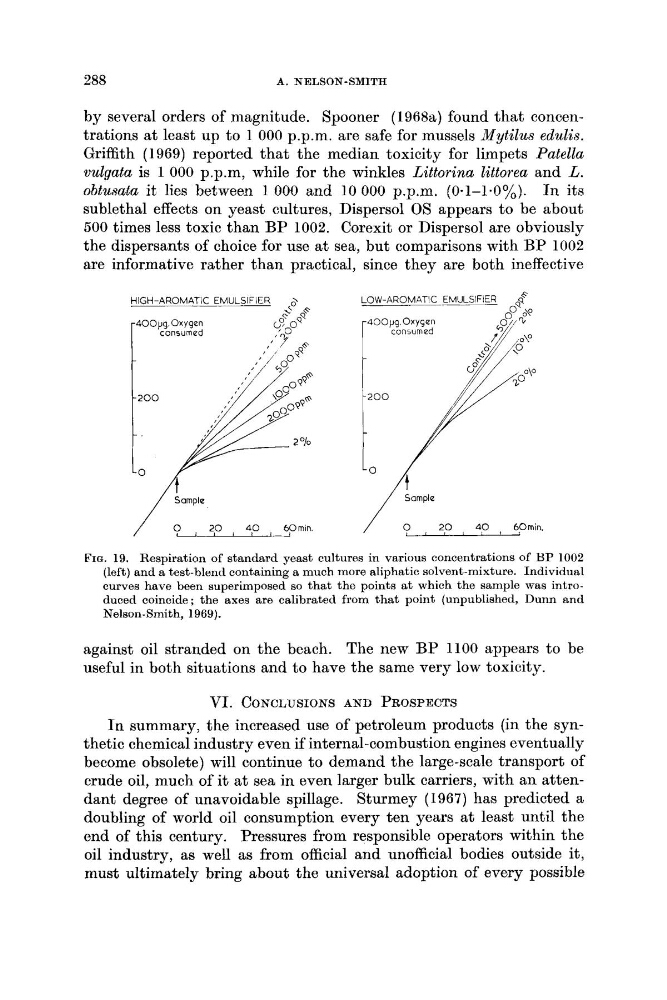
sublethal effects on yeast cultures, Dispersol 0s appears to be about
500 times less toxic than B P 1002. Corexit or Dispersol are obviously
the dispersants of choice for use at sea, but comparisons with B P 1002
a're informative rather than practical, since they are both ineffective
HIGH-AROMATIC EMULSIFIER
LOW-AROMATIC EMULSIFIER -Q~e
4 0 0 p g . Oxygen
consumed
4 0 0 p g Oxygen
consumed
2 0 0
0
0
2 0
40
60min.
,/
, 2 0 ~ 4,O ~ 6Prnin.
FIG. 19. Respiration of standard yeast cultures in vnrious concentrations of BP 1002
(left) and a test-blend containing a much more aliphatic solvent-mixture. Individual
curves have been superimposed so that the points a t which the sample wns introduced coincide; the axes are calibrated from that point (unpublished, Dunn and
Nelson-Smith, 1969).
against oil stranded on the beach. The new B P 1100 appears to be
useful in both situations and to have the same very low toxicity.
VI. CONCLUSIONS AND PROSPECTS
I n summary, the increased use of petroleum products (in the synthetic chemical industry even if internal-combustion engines eventually
become obsolete) will continue to demand the large-scale transport of
crude oil, much of it a t sea in even larger bulk carriers, with an attendant degree of unavoidable spillage. Sturmey (1967) has predicted a
doubling of world oil consumption every ten years at least until the
end of this century. Pressures from responsible operators within the
oil industry, as well as from official and unofficial bodies outside it,
must ultimately bring about the universal adoption of every possible
A. NELSON-SMITH
by several orders of magnitude. Spooner (1968a) found that concentrations at least up t o 1 000 p.p.m. are safe for mussels Mytilus edulis.
Griffith (1969) reported that the median toxicity for limpets Patella
vulgata is 1 000 p.p.m, while for the winkles Littorina littorea and L.
obtusata it lies between 1000 and 10 000 p.p.m. (0-1-1.0%). I n its
sublethal effects on yeast cultures, Dispersol 0s appears to be about
500 times less toxic than B P 1002. Corexit or Dispersol are obviously
the dispersants of choice for use at sea, but comparisons with B P 1002
a're informative rather than practical, since they are both ineffective
HIGH-AROMATIC EMULSIFIER
LOW-AROMATIC EMULSIFIER -Q~e
4 0 0 p g . Oxygen
consumed
4 0 0 p g Oxygen
consumed
2 0 0
0
0
2 0
40
60min.
,/
, 2 0 ~ 4,O ~ 6Prnin.
FIG. 19. Respiration of standard yeast cultures in vnrious concentrations of BP 1002
(left) and a test-blend containing a much more aliphatic solvent-mixture. Individual
curves have been superimposed so that the points a t which the sample wns introduced coincide; the axes are calibrated from that point (unpublished, Dunn and
Nelson-Smith, 1969).
against oil stranded on the beach. The new B P 1100 appears to be
useful in both situations and to have the same very low toxicity.
VI. CONCLUSIONS AND PROSPECTS
I n summary, the increased use of petroleum products (in the synthetic chemical industry even if internal-combustion engines eventually
become obsolete) will continue to demand the large-scale transport of
crude oil, much of it a t sea in even larger bulk carriers, with an attendant degree of unavoidable spillage. Sturmey (1967) has predicted a
doubling of world oil consumption every ten years at least until the
end of this century. Pressures from responsible operators within the
oil industry, as well as from official and unofficial bodies outside it,
must ultimately bring about the universal adoption of every possible