

THE PROBLEM OF OIL POLLUTION OF THE SEA
273
slick in some form of net. Straw, for example, can remove up to thirty
times its own weight of oil and is readily burnt afterwards. Siliconized
sawdust or peat, india-rubber dust (Saugolit), expanded mica or
vermiculite and volcanic glass (Ekoperl) have been used in Europe
and are relatively inert (Sturz and Klein, 1964; Mann, 1966). They
are also light and finely divided, presenting problems in spreading and
recovery in open-sea conditions. Although it has the same limitations,
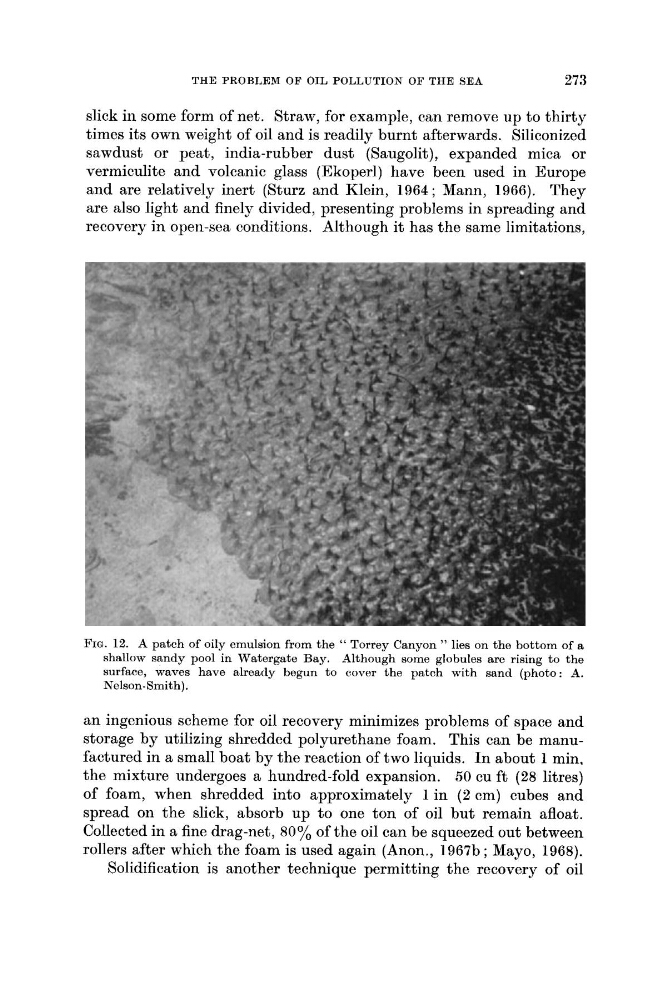
FIG. 12. A patch of oily emulsion from the ‘‘ Torrey Canyon ” lies on the bottom of a
shallow sandy pool in Watergate Bay. Although some globules are rising to the
surface, waves have already begun to cover the patch with sand (photo: A.
Nelson-Smith).
an ingenious scheme for oil recovery minimizes problems of space and
storage by utilizing shredded polyurethane foam. This can be manufactured in a small boat by the reaction of two liquids. I n about 1 min,
the mixture undergoes a hundred-fold expansion. 50 cu ft (28 litres)
of foam, when shredded into approximately 1 in (2 cm) cubes and
spread on the slick, absorb up to one ton of oil but remain afloat.
Collected in a fine drag-net, 80% of the oil can be squeezed out between
rollers after which the foam is used again (Anon., 196713; Mayo, 1968).
Solidification is another technique permitting the recovery of oil
273
slick in some form of net. Straw, for example, can remove up to thirty
times its own weight of oil and is readily burnt afterwards. Siliconized
sawdust or peat, india-rubber dust (Saugolit), expanded mica or
vermiculite and volcanic glass (Ekoperl) have been used in Europe
and are relatively inert (Sturz and Klein, 1964; Mann, 1966). They
are also light and finely divided, presenting problems in spreading and
recovery in open-sea conditions. Although it has the same limitations,
FIG. 12. A patch of oily emulsion from the ‘‘ Torrey Canyon ” lies on the bottom of a
shallow sandy pool in Watergate Bay. Although some globules are rising to the
surface, waves have already begun to cover the patch with sand (photo: A.
Nelson-Smith).
an ingenious scheme for oil recovery minimizes problems of space and
storage by utilizing shredded polyurethane foam. This can be manufactured in a small boat by the reaction of two liquids. I n about 1 min,
the mixture undergoes a hundred-fold expansion. 50 cu ft (28 litres)
of foam, when shredded into approximately 1 in (2 cm) cubes and
spread on the slick, absorb up to one ton of oil but remain afloat.
Collected in a fine drag-net, 80% of the oil can be squeezed out between
rollers after which the foam is used again (Anon., 196713; Mayo, 1968).
Solidification is another technique permitting the recovery of oil