

248
A. NELSON-SMITH
the flesh, resulting from contact with oil which has had little effect on
the fish, is nevertheless damaging to fisheries and has been recorded
on many occasions (Surber et al., 1962 ; Reichenbach-Klinke, 1962 ;
Zahner, 1962; Mann, 1964; Nitta et al., 1965).
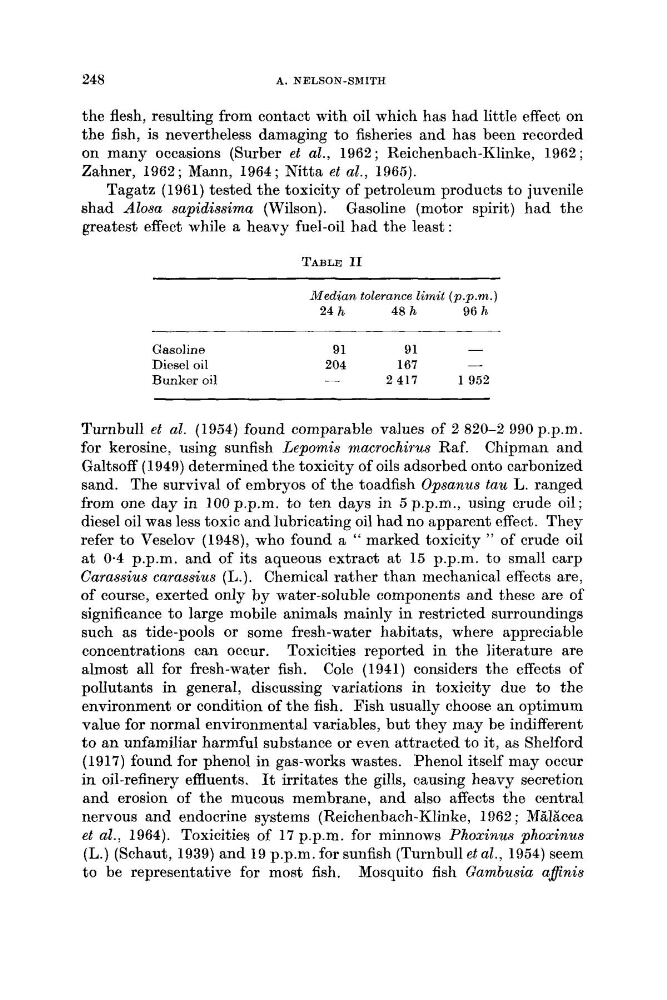
Tagatz (1961) tested the toxicity of petroleum products to juvenile
shad Alosa sapidissima (Wilson). Gasoline (motor spirit) had the
greatest effect while a heavy fuel-oil had the least :
TABLE I1
Median tolerance limit (p.p.m.)
24 h
48 h
96 h
Gasoline
Diesel oil
Bunker oil
-
91
91
204
167
-
2 417
1 9 5 2
-
Turnbull et al. (1954) found comparable values of 2 820-2 990 p.p.m.
for kerosine, using sunfish Lepomis macrochirus Raf. Chipman and
Galtsoff (1 949) determined the toxicity of oils adsorbed onto carbonized
sand. The survival of embryos of the toadfish Opsanus tau L. ranged
from one day in 100p.p.m. to ten days in 5p.p.m., using crude oil;
diesel oil was less toxic and lubricating oil had no apparent effect. They
refer to Veselov (1948), who found a " marked toxicity " of crude oil
at 0.4 p.p.m. and of its aqueous extract at 15 p.p.m. to small carp
Carassius carassius (L.). Chemical rather than mechanical effects are,
of course, exerted only by water-soluble components and these are of
significance to large mobile animals mainly in restricted surroundings
such as tide-pools or some fresh-water habitats, where appreciable
concentrations can occur. Toxicities reported in the literature are
almost all for fresh-water fish. Cole (1941) considers the effects of
pollutants in general, discussing variations in toxicity due to the
environment or condition of the fish. Fish usually choose an optimum
value for normal environmental variables, but they may be indifferent
to an unfamiliar harmful substance or even attracted t o it, as Shelford
(1917) found for phenol in gas-works wastes. Phenol itself may occur
in oil-refinery effluents, It irritates the gills, causing heavy secretion
and erosion of the mucous membrane, and also affects the central
nervous and endocrine systems (Reichenbach-Klinke, 1962 ; M&licea
et al., 1964). Toxicities of 17 p.p.m. for minnows Phoxinus phoxinus
(L.) (Schaut, 1939) and 19 p.p.m. for sunfish (Turnbull et al., 1954) seem
to be representative for most fish. Mosquito fish Gambusia afJinis
A. NELSON-SMITH
the flesh, resulting from contact with oil which has had little effect on
the fish, is nevertheless damaging to fisheries and has been recorded
on many occasions (Surber et al., 1962 ; Reichenbach-Klinke, 1962 ;
Zahner, 1962; Mann, 1964; Nitta et al., 1965).
Tagatz (1961) tested the toxicity of petroleum products to juvenile
shad Alosa sapidissima (Wilson). Gasoline (motor spirit) had the
greatest effect while a heavy fuel-oil had the least :
TABLE I1
Median tolerance limit (p.p.m.)
24 h
48 h
96 h
Gasoline
Diesel oil
Bunker oil
-
91
91
204
167
-
2 417
1 9 5 2
-
Turnbull et al. (1954) found comparable values of 2 820-2 990 p.p.m.
for kerosine, using sunfish Lepomis macrochirus Raf. Chipman and
Galtsoff (1 949) determined the toxicity of oils adsorbed onto carbonized
sand. The survival of embryos of the toadfish Opsanus tau L. ranged
from one day in 100p.p.m. to ten days in 5p.p.m., using crude oil;
diesel oil was less toxic and lubricating oil had no apparent effect. They
refer to Veselov (1948), who found a " marked toxicity " of crude oil
at 0.4 p.p.m. and of its aqueous extract at 15 p.p.m. to small carp
Carassius carassius (L.). Chemical rather than mechanical effects are,
of course, exerted only by water-soluble components and these are of
significance to large mobile animals mainly in restricted surroundings
such as tide-pools or some fresh-water habitats, where appreciable
concentrations can occur. Toxicities reported in the literature are
almost all for fresh-water fish. Cole (1941) considers the effects of
pollutants in general, discussing variations in toxicity due to the
environment or condition of the fish. Fish usually choose an optimum
value for normal environmental variables, but they may be indifferent
to an unfamiliar harmful substance or even attracted t o it, as Shelford
(1917) found for phenol in gas-works wastes. Phenol itself may occur
in oil-refinery effluents, It irritates the gills, causing heavy secretion
and erosion of the mucous membrane, and also affects the central
nervous and endocrine systems (Reichenbach-Klinke, 1962 ; M&licea
et al., 1964). Toxicities of 17 p.p.m. for minnows Phoxinus phoxinus
(L.) (Schaut, 1939) and 19 p.p.m. for sunfish (Turnbull et al., 1954) seem
to be representative for most fish. Mosquito fish Gambusia afJinis