

THE PROBLEM O F OIL POLLUTION O F THE SEA
235
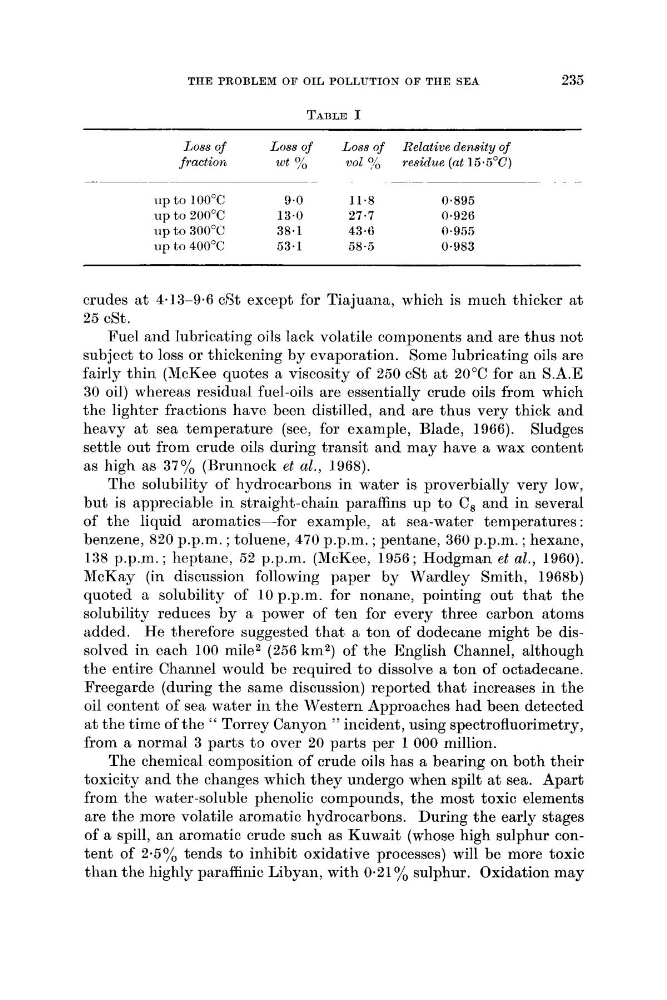
TABLE I
Loss of
Loss of
Loss of
Relative density of
f r a c t i o n
wt :h
voi l/o residue (at 15.5'17)
up to 100°C
9.0
1 1 . 8
0.895
up t o 200°C
13.0
27.7
0.926
up t o 400°C
53.1
58.5
0.983
up t o 300°C
38.1
43.6
0.955
crudes at 4.13-9.6 cRt except €or Tiajuana, which is much thicker at
25 cSt.
Fuel and lubricating oils lack volatile components and are thus not
subject to loss or thickening by evaporation. Some lubricating oils are
fairly thin (McKee quotes a viscosity of 250 cSt a t 20°C for an S.A.E
30 oil) whereas residual fuel-oils are essentially crude oils from which
the lighter fractions have been distilled, and are thus very thick and
heavy at sea temperature (see, for example, Blade, 1966). Sludges
settle out from crude oils during transit and may have a wax content
as high as 37% (Brunnock et al., 1968).
The solubility of hydrocarbons in water is proverbially very low,
but is appreciable in straight-chain paraffins up to C, and in several
of the liquid aromatics-for
example, at sea-water temperatures :
benzene, 820 p.p.m. ; toluene, 470 p.p.m. ; pentane, 360 p.p.ni. ; hexane,
138 p.p.m.; heptane, 52 p.p.m. (McKee, 1956; Hodgman et al., 1960).
McKay (in discussion following paper by Wardley Smith, 1968b)
quoted a solubility of 1Op.p.m. for nonane, pointing out that the
solubility reduces by a power of ten for every three carbon atoms
added. He therefore suggested that a ton of dodecane might be dissolved in each 100 mile2 (256 km2) of the English Channel, although
the entire Channel would be required to dissolve a ton of octadecane.
Freegarde (during the same discussion) reported that increases in the
oil content of sea water in the Western Approaches had been detected
at the time of the " Torrey Canyon " incident, using spectrofluorimetry,
from a normal 3 parts to over 20 parts per 1 000 million.
The chemical composition of crude oils has a bearing on both their
toxicity and the changes which they undergo when spilt at sea. Apart
from the water-soluble phenolic compounds, the most toxic elements
are the more volatile aromatic hydrocarbons. During the early stages
of a spill, an aromatic crude such as Kuwait (whose high sulphur content of 2.5 yo tends to inhibit oxidative processes) will be more toxic
than the highly paraffinic Libyan, with 0.21% sulphur. Oxidation may
235
TABLE I
Loss of
Loss of
Loss of
Relative density of
f r a c t i o n
wt :h
voi l/o residue (at 15.5'17)
up to 100°C
9.0
1 1 . 8
0.895
up t o 200°C
13.0
27.7
0.926
up t o 400°C
53.1
58.5
0.983
up t o 300°C
38.1
43.6
0.955
crudes at 4.13-9.6 cRt except €or Tiajuana, which is much thicker at
25 cSt.
Fuel and lubricating oils lack volatile components and are thus not
subject to loss or thickening by evaporation. Some lubricating oils are
fairly thin (McKee quotes a viscosity of 250 cSt a t 20°C for an S.A.E
30 oil) whereas residual fuel-oils are essentially crude oils from which
the lighter fractions have been distilled, and are thus very thick and
heavy at sea temperature (see, for example, Blade, 1966). Sludges
settle out from crude oils during transit and may have a wax content
as high as 37% (Brunnock et al., 1968).
The solubility of hydrocarbons in water is proverbially very low,
but is appreciable in straight-chain paraffins up to C, and in several
of the liquid aromatics-for
example, at sea-water temperatures :
benzene, 820 p.p.m. ; toluene, 470 p.p.m. ; pentane, 360 p.p.ni. ; hexane,
138 p.p.m.; heptane, 52 p.p.m. (McKee, 1956; Hodgman et al., 1960).
McKay (in discussion following paper by Wardley Smith, 1968b)
quoted a solubility of 1Op.p.m. for nonane, pointing out that the
solubility reduces by a power of ten for every three carbon atoms
added. He therefore suggested that a ton of dodecane might be dissolved in each 100 mile2 (256 km2) of the English Channel, although
the entire Channel would be required to dissolve a ton of octadecane.
Freegarde (during the same discussion) reported that increases in the
oil content of sea water in the Western Approaches had been detected
at the time of the " Torrey Canyon " incident, using spectrofluorimetry,
from a normal 3 parts to over 20 parts per 1 000 million.
The chemical composition of crude oils has a bearing on both their
toxicity and the changes which they undergo when spilt at sea. Apart
from the water-soluble phenolic compounds, the most toxic elements
are the more volatile aromatic hydrocarbons. During the early stages
of a spill, an aromatic crude such as Kuwait (whose high sulphur content of 2.5 yo tends to inhibit oxidative processes) will be more toxic
than the highly paraffinic Libyan, with 0.21% sulphur. Oxidation may