

THE PROBLEM O F OIL POLLUTION O F THE SEA
221
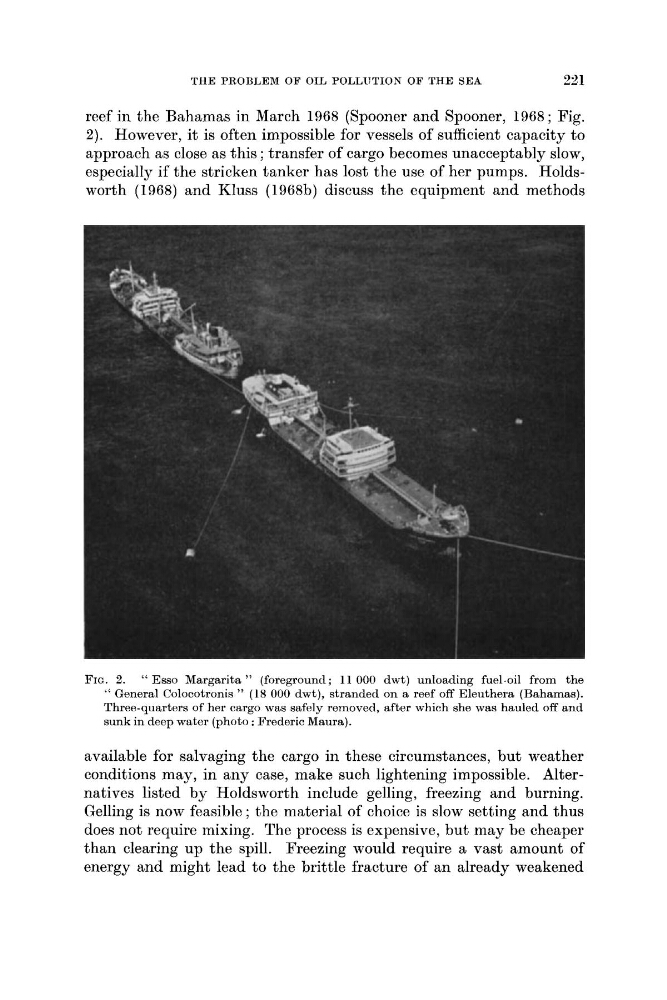
reef in the Bahamas in March 1968 (Spooner and Spooner, 1968; Fig.
2). However, it is often impossible for vessels of suficient capacity to
approach as close as this ; transfer of cargo becomes unacceptably slow,
especially if the stricken tanker has lost the use of her pumps. Holdsworth (1968) and Kluss (1968b) discuss the equipment and methods
FIG. 2. “ Esso Margarita ” (foreground; 11 000 dwt) unloading fuel-oil from the
*‘ General Colocotronis ” (18 000 dwt), stranded on a reef off Eleuthera (Bahamas).
Three-quarters of her cargo was safely removed, after which she was hauled off and
sunk in deep water (photo : Frederic Maura).
available for salvaging the cargo in these circumstances, but weather
conditions may, in any case, make such lightening impossible. Alternatives listed by Holdsworth include gelling, freezing and burning.
Gelling is now feasible ; the material of choice is slow setting and thus
does not require mixing. The process is expensive, but may be cheaper
than clearing up the spill. Freezing would require a vast amount of
energy and might lead to the brittle fracture of an already weakened
221
reef in the Bahamas in March 1968 (Spooner and Spooner, 1968; Fig.
2). However, it is often impossible for vessels of suficient capacity to
approach as close as this ; transfer of cargo becomes unacceptably slow,
especially if the stricken tanker has lost the use of her pumps. Holdsworth (1968) and Kluss (1968b) discuss the equipment and methods
FIG. 2. “ Esso Margarita ” (foreground; 11 000 dwt) unloading fuel-oil from the
*‘ General Colocotronis ” (18 000 dwt), stranded on a reef off Eleuthera (Bahamas).
Three-quarters of her cargo was safely removed, after which she was hauled off and
sunk in deep water (photo : Frederic Maura).
available for salvaging the cargo in these circumstances, but weather
conditions may, in any case, make such lightening impossible. Alternatives listed by Holdsworth include gelling, freezing and burning.
Gelling is now feasible ; the material of choice is slow setting and thus
does not require mixing. The process is expensive, but may be cheaper
than clearing up the spill. Freezing would require a vast amount of
energy and might lead to the brittle fracture of an already weakened