

ESTUARINE FISH FARMING
195
I n Taiwan, Chanos are cultivated on the warm soutli-west coast, but
farther north on the west coast the winter temperature falls too low,
so the more temperature tolerant Mugil cephalus takes its place. A
further advantage of grey mullet over Chanos is that the former will
soon be bred in captivity, whereas the latter cannot, as yet.
Lin (1968) gives an up-to-date account of the farming of Chanos
in Taiwan, which has frequently been quoted in this chapter. He
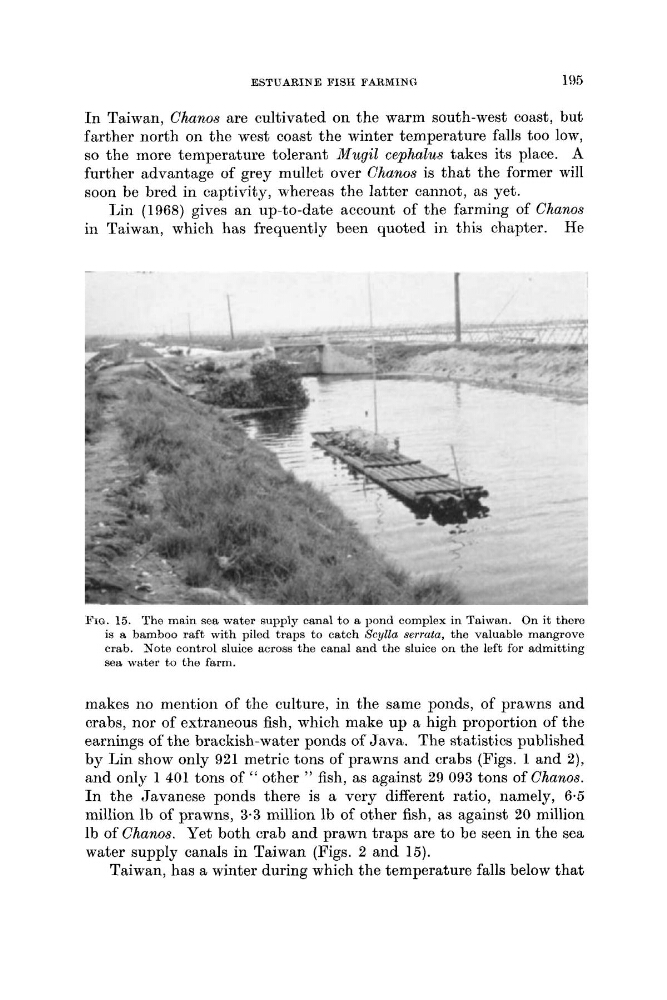
FIG. 15. The main sea water supply canal to a pond complex in Taiwan. On it there
is a bamboo raft with piled traps to catch ScyZZa serrata, the valuable mangrove
crab. Note control sluice across the canal and the sluice on the left for admitting
sea water to the farm.
makes no mention of the culture, in the same ponds, of prawns and
crabs, nor of extraneous fish, which make up a high proportion of the
earnings of the brackish-water ponds of Java. The statistics published
by Lin show only 921 metric tons of prawns and crabs (Figs. 1 and 2),
and only 1 401 tons of " other " fish, as against 29 093 tons of Chanos.
I n the Javanese ponds there is a very different ratio, namely, 6.5
million lb of prawns, 3-3 million lb of other fish, as against 20 million
lb of Chanos. Yet both crab and prawn traps are to be seen in the sea
water supply canals in Taiwan (Figs. 2 and 15).
Taiwan, has a winter during which the temperature falls below that
195
I n Taiwan, Chanos are cultivated on the warm soutli-west coast, but
farther north on the west coast the winter temperature falls too low,
so the more temperature tolerant Mugil cephalus takes its place. A
further advantage of grey mullet over Chanos is that the former will
soon be bred in captivity, whereas the latter cannot, as yet.
Lin (1968) gives an up-to-date account of the farming of Chanos
in Taiwan, which has frequently been quoted in this chapter. He
FIG. 15. The main sea water supply canal to a pond complex in Taiwan. On it there
is a bamboo raft with piled traps to catch ScyZZa serrata, the valuable mangrove
crab. Note control sluice across the canal and the sluice on the left for admitting
sea water to the farm.
makes no mention of the culture, in the same ponds, of prawns and
crabs, nor of extraneous fish, which make up a high proportion of the
earnings of the brackish-water ponds of Java. The statistics published
by Lin show only 921 metric tons of prawns and crabs (Figs. 1 and 2),
and only 1 401 tons of " other " fish, as against 29 093 tons of Chanos.
I n the Javanese ponds there is a very different ratio, namely, 6.5
million lb of prawns, 3-3 million lb of other fish, as against 20 million
lb of Chanos. Yet both crab and prawn traps are to be seen in the sea
water supply canals in Taiwan (Figs. 2 and 15).
Taiwan, has a winter during which the temperature falls below that