

ESTUARXNE FISH FARMINU
187
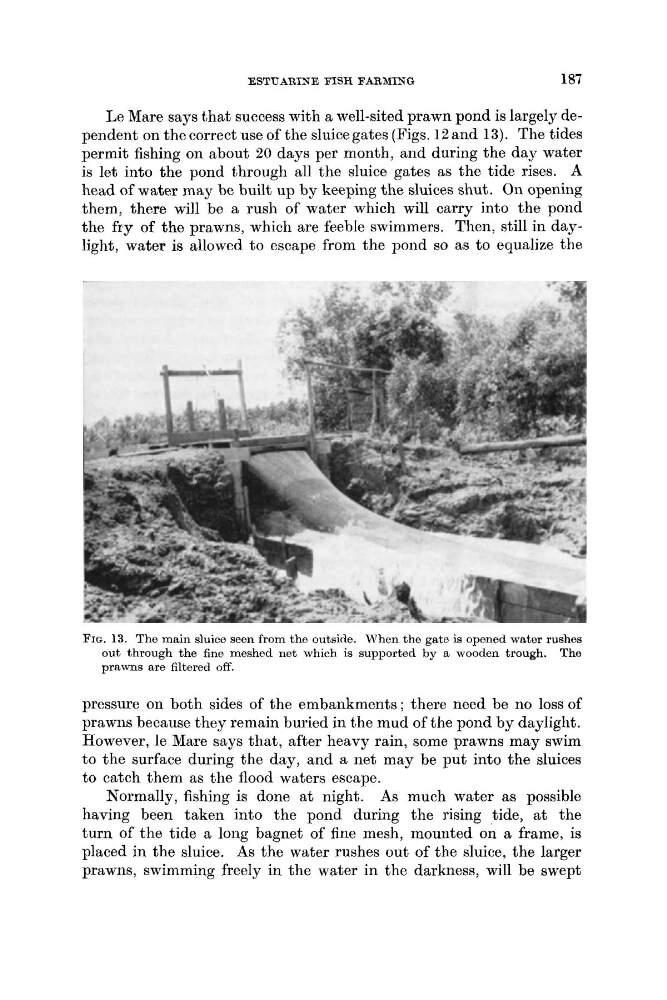
Le Mare says that success with a well-sited prawn pond is largely dependent on the correct use of the sluicegates (Figs. 12 and 13). The tides
permit fishing on about, 20 days per month, and during the day water
is let into the pond through all the sluice gates as the tide rises. A
head of water may be built up by keeping the sluices shut. On opening
them, there will be a rush of water which will carry into the pond
the fry of the prawns, which are feeble swimmers. Then, still in daylight, water is allowed to escape from the pond so as to equalize the
FIG. 13. The main sluice seen from the outside. When the gate is opened water rushes
The
out through the fine meshed net which is supported by 8 wooden trough.
prawns are filtered off.
pressure on both sides of the embankments ; there need be no loss of
prawns because they remain buried in the mud of the pond by daylight.
However, le Mare says that, after heavy rain, some prawns may swim
to the surface during the day, and a net may be put into the sluices
to catch them as the flood waters escape.
Normally, fishing is done at night. As much water as possible
having been taken into the pond during the rising tide, at the
turn of the tide a long bagnet of fine mesh, mounted on a frame, is
placed in the sluice. As the water rushes out of the sluice, the larger
prawns, swimming freely in the water in the darkness, will be swept
187
Le Mare says that success with a well-sited prawn pond is largely dependent on the correct use of the sluicegates (Figs. 12 and 13). The tides
permit fishing on about, 20 days per month, and during the day water
is let into the pond through all the sluice gates as the tide rises. A
head of water may be built up by keeping the sluices shut. On opening
them, there will be a rush of water which will carry into the pond
the fry of the prawns, which are feeble swimmers. Then, still in daylight, water is allowed to escape from the pond so as to equalize the
FIG. 13. The main sluice seen from the outside. When the gate is opened water rushes
The
out through the fine meshed net which is supported by 8 wooden trough.
prawns are filtered off.
pressure on both sides of the embankments ; there need be no loss of
prawns because they remain buried in the mud of the pond by daylight.
However, le Mare says that, after heavy rain, some prawns may swim
to the surface during the day, and a net may be put into the sluices
to catch them as the flood waters escape.
Normally, fishing is done at night. As much water as possible
having been taken into the pond during the rising tide, at the
turn of the tide a long bagnet of fine mesh, mounted on a frame, is
placed in the sluice. As the water rushes out of the sluice, the larger
prawns, swimming freely in the water in the darkness, will be swept