

164
C. F. HICKLING
V. THE FOOD OF CULTIVATED FISH AND PRAWNS
A. Chanos, grey mullet, eels, Tilapia and prawns
I n their very early stages, both Chanos and the grey mullet tend
to feed on plankton and even zooplankton, but by the time they have
grown to the size at which they are stocked in ponds, namely, at about
1-5-2.5 em, they feed on an algal felt of blue-green algae with its
associated epiphytic flora and fauna.
Though artificial foods are expensive, they can be economical in
certain circumstances, as when valuable young have to be overwintered
or when a crop of fish has exhausted the natural food supply. Zambribortch (1962) states that the small grey mullet in the Russian wintering
ponds may be fed on bloodworm (presumably chironomid larvae) and
Daphnia; Lin (1968) mentions peanut cake as supplementary food in
the wintering ponds for Chanos on Taiwan ; Yashouv and Ben-Shachar
(1969) used food pellets (wheat, fish meal, and soya flour, with a 21%
protein content) successfully with young grey mullet ; and Schuster
mentions yolk of egg and rice flour as supplementary foods for Chanos
fry. Ronquillo et al. (1957) tried rice bran and corn meal, enriched
with Terramycin and a proprietary product “Vigofac”. But Lin
quotes Yamamoto, who found that Chanos fry of 1.5-2.3 cm absolutely
require blue-green algae and diatoms as food. There was a high rate
of mortality when artificial foods such as flour, soybean meal, rice bran,
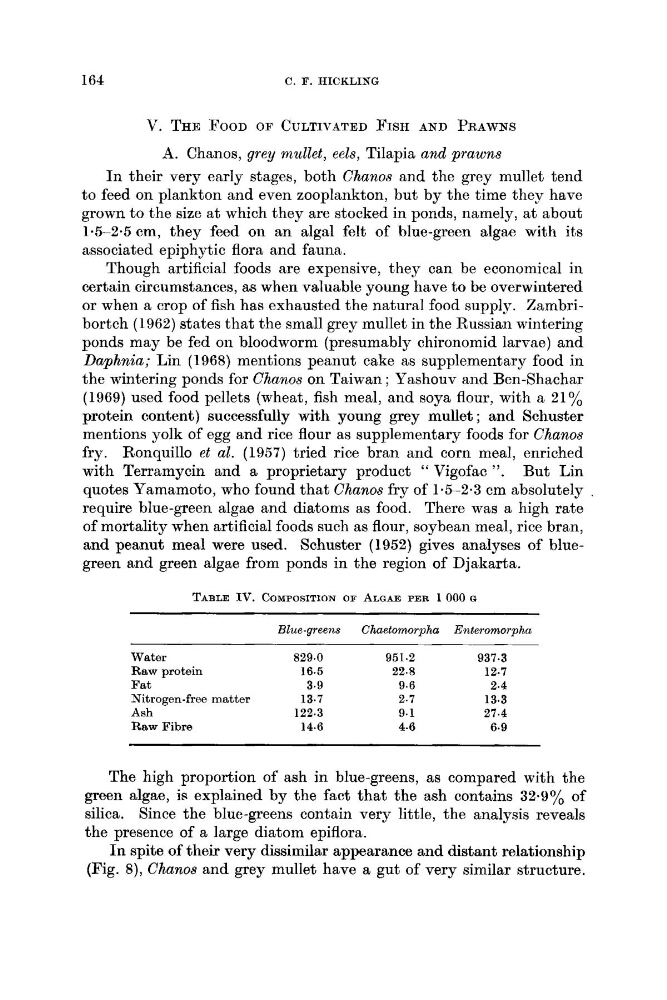
and peanut meal were used. Schuster (1952) gives analyses of bluegreen and green algae from ponds in the region of Djakarta.
TABLE SV. COMPOSITION OF ALGAE PER 1000 G
Blue-greens
Chaetomorpha Enteromorpha
Water
829.0
951.2
937.3
Raw protein
16.5
22.8
12.7
Fat
3.9
9.6
2.4
Nitrogen-free matter
13.7
2.7
13.3
Raw Fibre
14.6
4.6
6.9
Ash
122.3
9.1
21.4
The high proportion of ash in blue-greens, as compared with the
green algae, is explained by the fact that the ash contains 32.9% of
silica. Since the blue-greens contain very little, the analysis reveals
the presence of a large diatom epiflora.
I n spite of their very dissimilar appearance and distant relationship
(Fig. 8), Chanos and grey mullet have a gut of very similar structure.
C. F. HICKLING
V. THE FOOD OF CULTIVATED FISH AND PRAWNS
A. Chanos, grey mullet, eels, Tilapia and prawns
I n their very early stages, both Chanos and the grey mullet tend
to feed on plankton and even zooplankton, but by the time they have
grown to the size at which they are stocked in ponds, namely, at about
1-5-2.5 em, they feed on an algal felt of blue-green algae with its
associated epiphytic flora and fauna.
Though artificial foods are expensive, they can be economical in
certain circumstances, as when valuable young have to be overwintered
or when a crop of fish has exhausted the natural food supply. Zambribortch (1962) states that the small grey mullet in the Russian wintering
ponds may be fed on bloodworm (presumably chironomid larvae) and
Daphnia; Lin (1968) mentions peanut cake as supplementary food in
the wintering ponds for Chanos on Taiwan ; Yashouv and Ben-Shachar
(1969) used food pellets (wheat, fish meal, and soya flour, with a 21%
protein content) successfully with young grey mullet ; and Schuster
mentions yolk of egg and rice flour as supplementary foods for Chanos
fry. Ronquillo et al. (1957) tried rice bran and corn meal, enriched
with Terramycin and a proprietary product “Vigofac”. But Lin
quotes Yamamoto, who found that Chanos fry of 1.5-2.3 cm absolutely
require blue-green algae and diatoms as food. There was a high rate
of mortality when artificial foods such as flour, soybean meal, rice bran,
and peanut meal were used. Schuster (1952) gives analyses of bluegreen and green algae from ponds in the region of Djakarta.
TABLE SV. COMPOSITION OF ALGAE PER 1000 G
Blue-greens
Chaetomorpha Enteromorpha
Water
829.0
951.2
937.3
Raw protein
16.5
22.8
12.7
Fat
3.9
9.6
2.4
Nitrogen-free matter
13.7
2.7
13.3
Raw Fibre
14.6
4.6
6.9
Ash
122.3
9.1
21.4
The high proportion of ash in blue-greens, as compared with the
green algae, is explained by the fact that the ash contains 32.9% of
silica. Since the blue-greens contain very little, the analysis reveals
the presence of a large diatom epiflora.
I n spite of their very dissimilar appearance and distant relationship
(Fig. 8), Chanos and grey mullet have a gut of very similar structure.