

ESTUARINE FISH FARMINQ
123
could extend far out to sea, depending on the strength of the river
outflow.
In this wider definition, the word estuary can be applied to the
lagoons of the Adriatic, now the site of an important fish culture
industry, and to many Mediterranean lagoons in France, Spain, and
Tunis, and in fact to almost any kind of coastal water-bodies in permanent or intermittent communication with the sea. I n the Black Sea
are the Russian limans, a word translated in the dictionaries as " estuary " though liman refers to a wide range of inlets mostly cut off by
sand bars. Some have a permanent connection with the sea, others
had such connections in historical times and were in use as seaports
(Ilin, 1954) but are now in direct communication with the sea only
when flood or spring melt-water breaks through the bar, or when the
bar is breached by storms or changes of water level caused by the wind.
Still other limans may be connected with the sea only through seepage
through the sand, and in these tha salinity rises so high in summer that
salt will crystallize out. Such limans can only be kept at a range of
salinity suitable for fish culture by making and maintaining a permanent artificial connection with the sea. Even so, their salinity may rise
t o 50%, which is nearing the limit for fish life.
It should still be possible to speak of an estuary even when the
volume of fresh water is small in comparison with that of sea water.
Small as this may be, it may still attract migrating fish such as the
salmon, and would justify those who hold that the estuary should
even include areas of continental shelf affected by estuarine waters.
Estuaries, in this wide sense, are the actual or potential sites for
fish farms, both because of their topography and of their fertility.
These will be discussed in turn.
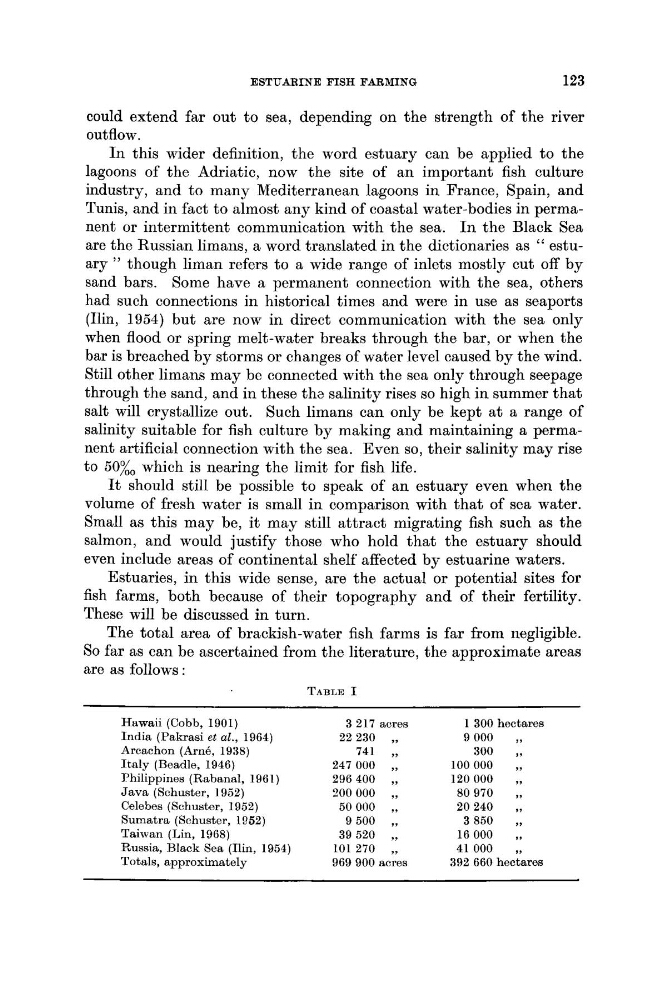
The total area of brackish-water fish farms is far from negligible.
SO far as can be ascertained from the literature, the approximate areas
are as follows:
TABLE I
Hawaii (Cobb, 1901)
India (Pakrasi et al., 1964)
Arcachon (Arn6, 1938)
Italy (Beadle, 1946)
Philippines (Rabanal, 1961)
Java (Schuster, 1952)
Celebes (Schuster, 1952)
Sumatra (Schuster, 1952)
Taiwan (Lin, 1968)
Elussia, Black Sea (Ilin, 1954)
Totals, approximately
3 217 acres
22230 ,,
741 ,,
247000 ,,
296400 ,,
200000 ,,
50 000 ,,
9 5 0 0 ,,
39 520 ,,
101 270 ,,
969 900 acres
1 300 hectares
9 0 0 0
,,
300
,,
100000
,,
120000
,,
80970
,,
2 0 2 4 0
,,
3 850
,,
16000
,,
41 000
,,
392 660 hectares
123
could extend far out to sea, depending on the strength of the river
outflow.
In this wider definition, the word estuary can be applied to the
lagoons of the Adriatic, now the site of an important fish culture
industry, and to many Mediterranean lagoons in France, Spain, and
Tunis, and in fact to almost any kind of coastal water-bodies in permanent or intermittent communication with the sea. I n the Black Sea
are the Russian limans, a word translated in the dictionaries as " estuary " though liman refers to a wide range of inlets mostly cut off by
sand bars. Some have a permanent connection with the sea, others
had such connections in historical times and were in use as seaports
(Ilin, 1954) but are now in direct communication with the sea only
when flood or spring melt-water breaks through the bar, or when the
bar is breached by storms or changes of water level caused by the wind.
Still other limans may be connected with the sea only through seepage
through the sand, and in these tha salinity rises so high in summer that
salt will crystallize out. Such limans can only be kept at a range of
salinity suitable for fish culture by making and maintaining a permanent artificial connection with the sea. Even so, their salinity may rise
t o 50%, which is nearing the limit for fish life.
It should still be possible to speak of an estuary even when the
volume of fresh water is small in comparison with that of sea water.
Small as this may be, it may still attract migrating fish such as the
salmon, and would justify those who hold that the estuary should
even include areas of continental shelf affected by estuarine waters.
Estuaries, in this wide sense, are the actual or potential sites for
fish farms, both because of their topography and of their fertility.
These will be discussed in turn.
The total area of brackish-water fish farms is far from negligible.
SO far as can be ascertained from the literature, the approximate areas
are as follows:
TABLE I
Hawaii (Cobb, 1901)
India (Pakrasi et al., 1964)
Arcachon (Arn6, 1938)
Italy (Beadle, 1946)
Philippines (Rabanal, 1961)
Java (Schuster, 1952)
Celebes (Schuster, 1952)
Sumatra (Schuster, 1952)
Taiwan (Lin, 1968)
Elussia, Black Sea (Ilin, 1954)
Totals, approximately
3 217 acres
22230 ,,
741 ,,
247000 ,,
296400 ,,
200000 ,,
50 000 ,,
9 5 0 0 ,,
39 520 ,,
101 270 ,,
969 900 acres
1 300 hectares
9 0 0 0
,,
300
,,
100000
,,
120000
,,
80970
,,
2 0 2 4 0
,,
3 850
,,
16000
,,
41 000
,,
392 660 hectares