

13. EUPHAUSIIDS I N THE MARINE ECONOMY
381
layers. These faecal pellets are often eaten by organisms such as
copepods, subjected to treatment within their guts, and once again
released into the water and so accessible to further degradation by
bacteria. This must have the effect of speedier release over a wider
range of the water column of potential nutrients Ohan if the original
detrital material had remained resident on the sea bed. Marr (1962)
argues that freshly fractured surfaces of mineral silicates can readily
produce soluble silica when in contact with water and " that in the
sea much the commonest way of exposing fresh silica surfaces by
fracturing would occur in the guts of herbivores, such as Euphausia
superba, which grind or triturate their food. It would appear distinctly
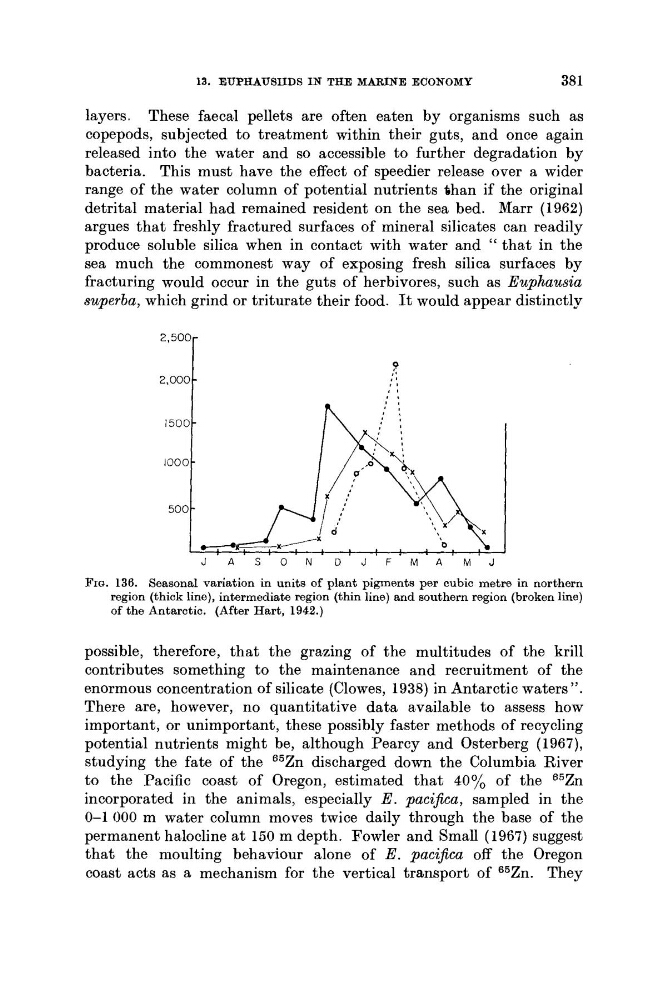
FIG. 136. Seasonal variation in units of plant pigments per cubic metre in northern
region (thick line), intermediate region (thin line) and southern region (broken line)
of the Antarctic. (After Hart, 1942.)
possible, therefore, that the grazing of the multitudes of the krill
contributes something to the maintenance and recruitment of the
enormous concentration of silicate (Clowes, 1938) in Antarctic waters ".
There are, however, no quantitative data available to assess how
important, or unimportant, these possibly faster methods of recycling
potential nutrients might be, although Pearcy and Osterberg (1967),
studying the fate of the "Zn discharged down the Columbia River
to the Pacific coast of Oregon, estimated that 40% of the 65Zn
incorporated in the animals, especially E. paciJica, sampled in the
0-1 000 m water column moves twice daily through the base of the
permanent halocline a t 150 m depth. Fowler and Small (1967) suggest
that the moulting behaviour alone of E . pacijka off the Oregon
coast acts as a mechanism for the vertical transport of 65Zn. They
381
layers. These faecal pellets are often eaten by organisms such as
copepods, subjected to treatment within their guts, and once again
released into the water and so accessible to further degradation by
bacteria. This must have the effect of speedier release over a wider
range of the water column of potential nutrients Ohan if the original
detrital material had remained resident on the sea bed. Marr (1962)
argues that freshly fractured surfaces of mineral silicates can readily
produce soluble silica when in contact with water and " that in the
sea much the commonest way of exposing fresh silica surfaces by
fracturing would occur in the guts of herbivores, such as Euphausia
superba, which grind or triturate their food. It would appear distinctly
FIG. 136. Seasonal variation in units of plant pigments per cubic metre in northern
region (thick line), intermediate region (thin line) and southern region (broken line)
of the Antarctic. (After Hart, 1942.)
possible, therefore, that the grazing of the multitudes of the krill
contributes something to the maintenance and recruitment of the
enormous concentration of silicate (Clowes, 1938) in Antarctic waters ".
There are, however, no quantitative data available to assess how
important, or unimportant, these possibly faster methods of recycling
potential nutrients might be, although Pearcy and Osterberg (1967),
studying the fate of the "Zn discharged down the Columbia River
to the Pacific coast of Oregon, estimated that 40% of the 65Zn
incorporated in the animals, especially E. paciJica, sampled in the
0-1 000 m water column moves twice daily through the base of the
permanent halocline a t 150 m depth. Fowler and Small (1967) suggest
that the moulting behaviour alone of E . pacijka off the Oregon
coast acts as a mechanism for the vertical transport of 65Zn. They