

378
THE BIOLOGY OF EUPHAUSIIDS
Also, there seems to be a latitudinal band of higher standing crops in
equatorial regions, higher, that is, than in subequatorial regions, a
feature of the quantitative distribution of euphausiids in the Pacific
(Fig. 133).
The distribution, geographically, of species that form swarms is not
arbitrary but most of these occur in higher latitudes. Further, neglecting
the deep water species (e.g. Thysanopoda spp.), the average body size
of individuals of species in higher latitudes-Euphausia superba, E.
crystallorophias, and Meganyctiphanes norvegica-is
usually greater
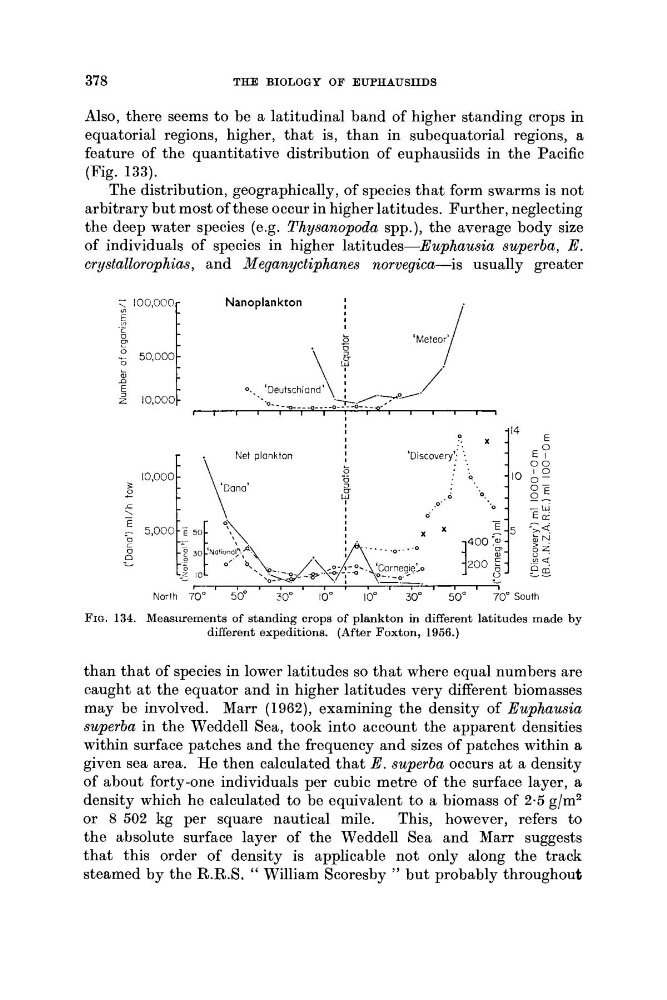
FIQ. 134. Measurements of standing crops of plankton in different latitudes made by
different expeditions. (After Foxton, 1966.)
than that of species in lower latitudes so that where equal numbers are
caught at the equator and in higher latitudes very different biomasses
may be involved. Marr (1962), examining the density of Euphausia
superba in the Weddell Sea, took into account the apparent densities
within surface patches and the frequency and sizes of patches within a
given sea area. He then calculated that E. superba occurs at a density
of about forty-one individuals per cubic metre of the surface layer, a
density which he calculated to be equivalent to a biomass of 2.5 g/m2
or 8 502 kg per square nautical mile. This, however, refers to
the absolute surface layer of the Weddell Sea and Man suggests
that this order of density is applicable not only along the track
steamed by the R.R.S. " William Scoresby " but probably throughout
THE BIOLOGY OF EUPHAUSIIDS
Also, there seems to be a latitudinal band of higher standing crops in
equatorial regions, higher, that is, than in subequatorial regions, a
feature of the quantitative distribution of euphausiids in the Pacific
(Fig. 133).
The distribution, geographically, of species that form swarms is not
arbitrary but most of these occur in higher latitudes. Further, neglecting
the deep water species (e.g. Thysanopoda spp.), the average body size
of individuals of species in higher latitudes-Euphausia superba, E.
crystallorophias, and Meganyctiphanes norvegica-is
usually greater
FIQ. 134. Measurements of standing crops of plankton in different latitudes made by
different expeditions. (After Foxton, 1966.)
than that of species in lower latitudes so that where equal numbers are
caught at the equator and in higher latitudes very different biomasses
may be involved. Marr (1962), examining the density of Euphausia
superba in the Weddell Sea, took into account the apparent densities
within surface patches and the frequency and sizes of patches within a
given sea area. He then calculated that E. superba occurs at a density
of about forty-one individuals per cubic metre of the surface layer, a
density which he calculated to be equivalent to a biomass of 2.5 g/m2
or 8 502 kg per square nautical mile. This, however, refers to
the absolute surface layer of the Weddell Sea and Man suggests
that this order of density is applicable not only along the track
steamed by the R.R.S. " William Scoresby " but probably throughout