

358
THE BIOLOGY OF EUPHAUSIIDS
stomach is 4 tons. He then calculates that the krill were being grazed
at a rate of 37.8 million tons per year by the large baleen whales alone,
a weight which represents about 50 million million larger size E.
superba. Marr considers that this may be a conservative estimate of
the predation by whales because the estimate of 210 000 as the stock
of whales may be low. Approaching the problem from another angle
amplifies Marr’s approach. The geographical area of the summer feeding
grounds of the whales measures 17 to 29 x lo6 km2 (Sverdrup et al.,
1942). Assuming that E. superba live in the upper 2 5 0 m layer a t a
mean density throughout this layer of one per cubic metre, then the
estimated adult stock of E. superba is 34 to 58 x 1014 individuals.
M a d s calculation of the number of E . superba grazed by the whales
would then represent a grazing of about 1% of the standing crop.
There are, of course, several criticisms that could be advanced against
each of the assumptions made but it is probable that these preliminary
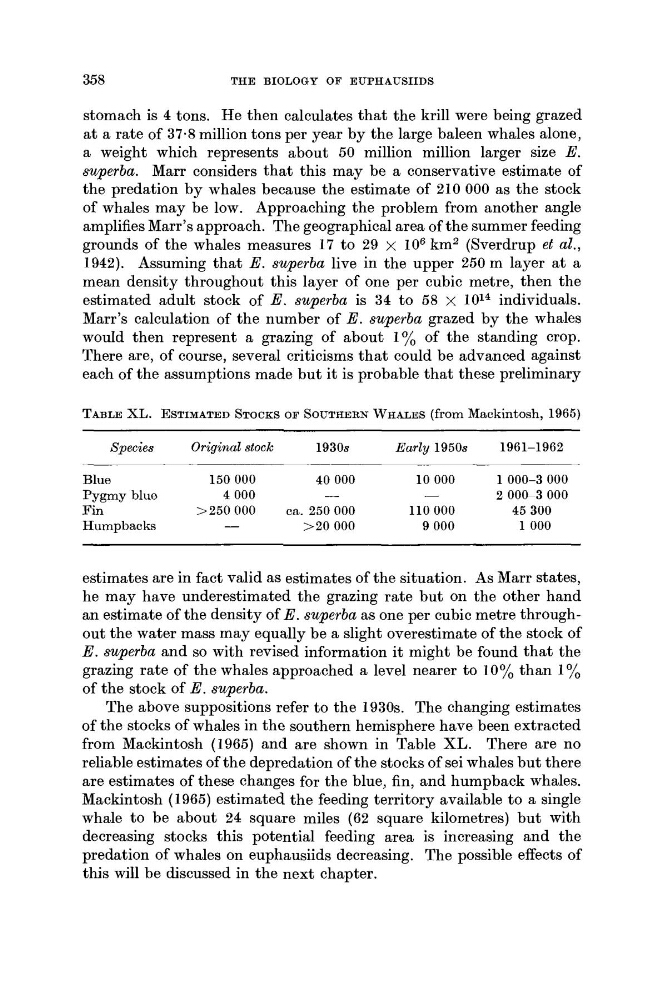
TABLE XL. ESTIMATED STOCKS OF SOUTHERN WHALES (from Mackintosh, 1965)
Species
Original stock
1930s
Early 1950s
1961-1962
Blue
150 000
40 000
10 000
1 000-3 000
Pygmy blue
4 000
-
-
2 000-3 000
Fin
>250 000
ca. 250 000
110 000
45 300
Humpbacks
-
>20 000
9 000
1 0 0 0
estimates are in fact valid as estimates of the situation. As Marr states,
he may have underestimated the grazing rate but on the other hand
an estimate of the density of E . superba as one per cubic metre throughout the water mass may equally be a slight overestimate of the stock of
E. superba and so with revised information it might be found that the
grazing rate of the whales approached a level nearer to 10% than 1%
of the stock of E. superba.
The above suppositions refer to the 1930s. The changing estimates
of the stocks of whales in the southern hemisphere have been extracted
from Mackintosh (1965) and are shown in Table XL. There are no
reliable estimates of the depredation of the stocks of sei whales but there
are estimates of these changes for the blue, fin, and humpback whales.
Mackintosh (1965) estimated the feeding territory available to a single
whale to be about 24 square miles (62 square kilometres) but with
decreasing stocks this potential feeding area is increasing and the
predation of whales on euphausiids decreasing. The possible effects of
this will be discussed in the next chapter.
THE BIOLOGY OF EUPHAUSIIDS
stomach is 4 tons. He then calculates that the krill were being grazed
at a rate of 37.8 million tons per year by the large baleen whales alone,
a weight which represents about 50 million million larger size E.
superba. Marr considers that this may be a conservative estimate of
the predation by whales because the estimate of 210 000 as the stock
of whales may be low. Approaching the problem from another angle
amplifies Marr’s approach. The geographical area of the summer feeding
grounds of the whales measures 17 to 29 x lo6 km2 (Sverdrup et al.,
1942). Assuming that E. superba live in the upper 2 5 0 m layer a t a
mean density throughout this layer of one per cubic metre, then the
estimated adult stock of E. superba is 34 to 58 x 1014 individuals.
M a d s calculation of the number of E . superba grazed by the whales
would then represent a grazing of about 1% of the standing crop.
There are, of course, several criticisms that could be advanced against
each of the assumptions made but it is probable that these preliminary
TABLE XL. ESTIMATED STOCKS OF SOUTHERN WHALES (from Mackintosh, 1965)
Species
Original stock
1930s
Early 1950s
1961-1962
Blue
150 000
40 000
10 000
1 000-3 000
Pygmy blue
4 000
-
-
2 000-3 000
Fin
>250 000
ca. 250 000
110 000
45 300
Humpbacks
-
>20 000
9 000
1 0 0 0
estimates are in fact valid as estimates of the situation. As Marr states,
he may have underestimated the grazing rate but on the other hand
an estimate of the density of E . superba as one per cubic metre throughout the water mass may equally be a slight overestimate of the stock of
E. superba and so with revised information it might be found that the
grazing rate of the whales approached a level nearer to 10% than 1%
of the stock of E. superba.
The above suppositions refer to the 1930s. The changing estimates
of the stocks of whales in the southern hemisphere have been extracted
from Mackintosh (1965) and are shown in Table XL. There are no
reliable estimates of the depredation of the stocks of sei whales but there
are estimates of these changes for the blue, fin, and humpback whales.
Mackintosh (1965) estimated the feeding territory available to a single
whale to be about 24 square miles (62 square kilometres) but with
decreasing stocks this potential feeding area is increasing and the
predation of whales on euphausiids decreasing. The possible effects of
this will be discussed in the next chapter.