

346
THE BIOLOGY O F EUPHAUSIIDS
Baker (1965) found it in greatest quantity north of the Subtropical
Convergence ; obviously more information is required about this species.
The separate distributions of Thysanoessa macrura and T . vicina are
not as well known as they might be. Rustad (1934) found that T . vicina
had a distributional range like that of Euphausia frigida while
Thysanoessa macrura penetrated further south ; more information on
these species is also required.
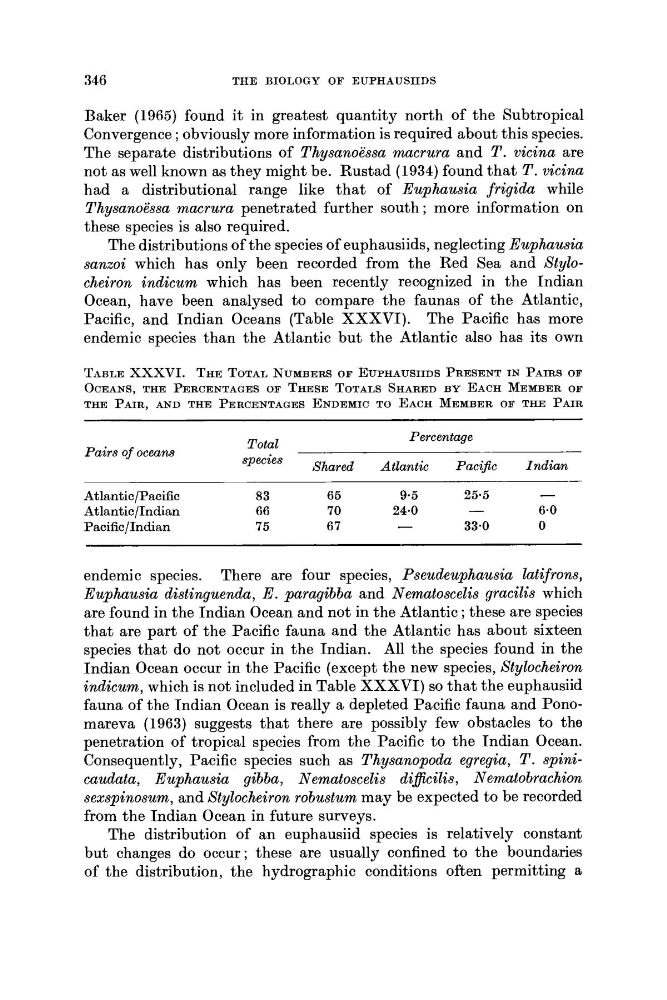
The distributions of the species of euphausiids, neglecting Euphausia
sanzoi which has only been recorded from the Red Sea and Stylocheiron indicum which has been recently recognized in the Indian
Ocean, have been analysed to compare the faunas of the Atlantic,
Pacific, and Indian Oceans (Table XXXVI). The Pacific has more
endemic species than the Atlantic but the Atlantic also has its own
TABLE XXXVI. THE TOTAL NUMBERS OF EUPHAUSIIDS PRESENT IN PAIRS OF
OCEANS, THE PERCENTAGES OF THESE TOTALS SHARED BY EACH MEMBER OF
THE PAIR, AND THE PERCENTAGES ENDEMIC TO EACH MEMBER OF THE PAIR
Pairs
Percentage
Shared
Atlantic
Paci$c
Indian
Total
species
of oceans
Atlantic/Pacific
83
65
9.5
25.5
-
Pacific/Indian
75
67
-
33.0
0
Atlantic/Indian
66
70
24.0
-
6.0
endemic species. There are four species, Pseudeuphausia latifrons,
Euphausia distinguenda, E. paragibba and Nematoscelis gracilis which
are found in the Indian Ocean and not in the Atlantic ; these are species
that are part of the Pacific fauna and the Atlantic has about sixteen
species that do not occur in the Indian. All the species found in the
Indian Ocean occur in the Pacific (except the new species, Stylocheiron
indicum, which is not included in Table XXXVI) so that the euphausiid
fauna of the Indian Ocean is really a depleted Pacific fauna and Ponomareva (1963) suggests that there are possibly few obstacles to the
penetration of tropical species from the Pacific to the Indian Ocean.
Consequently, Pacific species such as Thysanopoda egregia, T . spinicaudata, Euphausia gibba, Nematoscelis dificilis, Nematobrachion
sexspinosum, and Stylocheiron robustum may be expected to be recorded
from the Indian Ocean in future surveys.
The distribution of an euphausiid species is relatively constant
but changes do occur; these are usually confined to the boundaries
of the distribution, the hydrographic conditions often permitting a
THE BIOLOGY O F EUPHAUSIIDS
Baker (1965) found it in greatest quantity north of the Subtropical
Convergence ; obviously more information is required about this species.
The separate distributions of Thysanoessa macrura and T . vicina are
not as well known as they might be. Rustad (1934) found that T . vicina
had a distributional range like that of Euphausia frigida while
Thysanoessa macrura penetrated further south ; more information on
these species is also required.
The distributions of the species of euphausiids, neglecting Euphausia
sanzoi which has only been recorded from the Red Sea and Stylocheiron indicum which has been recently recognized in the Indian
Ocean, have been analysed to compare the faunas of the Atlantic,
Pacific, and Indian Oceans (Table XXXVI). The Pacific has more
endemic species than the Atlantic but the Atlantic also has its own
TABLE XXXVI. THE TOTAL NUMBERS OF EUPHAUSIIDS PRESENT IN PAIRS OF
OCEANS, THE PERCENTAGES OF THESE TOTALS SHARED BY EACH MEMBER OF
THE PAIR, AND THE PERCENTAGES ENDEMIC TO EACH MEMBER OF THE PAIR
Pairs
Percentage
Shared
Atlantic
Paci$c
Indian
Total
species
of oceans
Atlantic/Pacific
83
65
9.5
25.5
-
Pacific/Indian
75
67
-
33.0
0
Atlantic/Indian
66
70
24.0
-
6.0
endemic species. There are four species, Pseudeuphausia latifrons,
Euphausia distinguenda, E. paragibba and Nematoscelis gracilis which
are found in the Indian Ocean and not in the Atlantic ; these are species
that are part of the Pacific fauna and the Atlantic has about sixteen
species that do not occur in the Indian. All the species found in the
Indian Ocean occur in the Pacific (except the new species, Stylocheiron
indicum, which is not included in Table XXXVI) so that the euphausiid
fauna of the Indian Ocean is really a depleted Pacific fauna and Ponomareva (1963) suggests that there are possibly few obstacles to the
penetration of tropical species from the Pacific to the Indian Ocean.
Consequently, Pacific species such as Thysanopoda egregia, T . spinicaudata, Euphausia gibba, Nematoscelis dificilis, Nematobrachion
sexspinosum, and Stylocheiron robustum may be expected to be recorded
from the Indian Ocean in future surveys.
The distribution of an euphausiid species is relatively constant
but changes do occur; these are usually confined to the boundaries
of the distribution, the hydrographic conditions often permitting a