

330
THE BIOLOGY OF EUPHAUSIIDS
southwest Iceland, Faroes/Shetland, off More in Norway (62'-63'N)
southeastwards to Skagerrak and southwestwards to the Shetland
Islands, off southwest Ireland, the Bay of Cadiz, and in regions of the
Mediterranean. Eggs and young produced in these breeding areas are
a t the mercy of the prevailing water currents and Einarsson suggests
how regions such as west and east Greenland and northern Norway and
the Barents Sea are populated by stocks produced in more southern
areas (Fig. 122). Jones (1968) has recently suggested that M . norvegicu
may, in some years, breed in the waters west of Greenland. The Barents
0
"
0
0
0
0
500 -
0
0
~
"un
0
n
~O.O<
: 1000 I
5 a
n
0
0
0
0
0
0
0
0
lo o o 0 0 0
0
0
0
n
O n
O
O
Troschii
o T inerrnis
A M norveqico
U
"
0 0 -
n
1 0 Tlonyicoudoto ' A
0
0
"
E i T acutifrons
I T cornufa
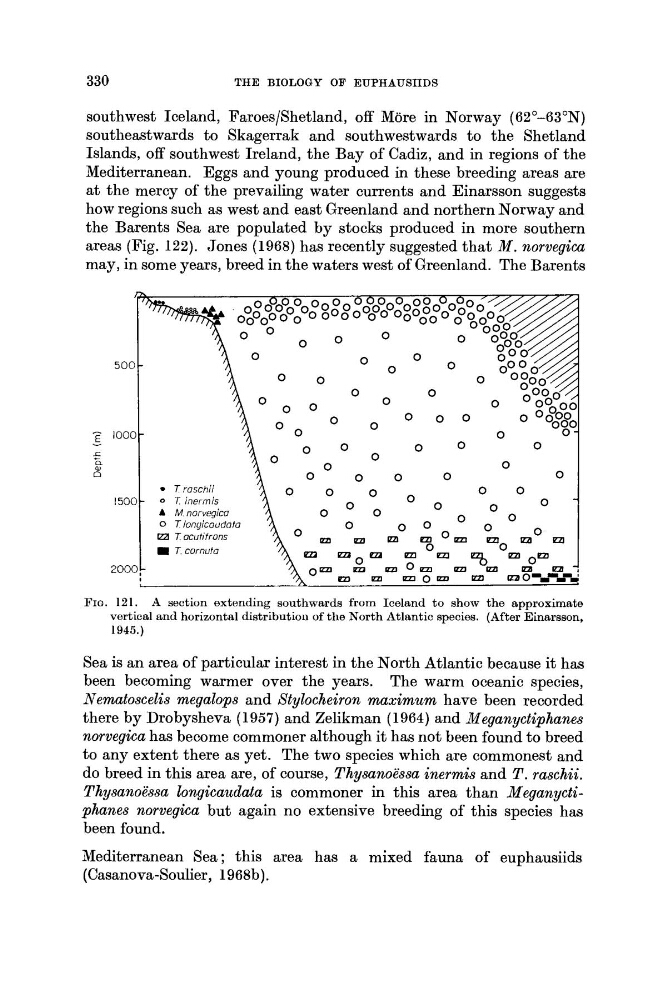
FIG. 121. A section extending southwards from Iceland to show the approximate
vertical and horizontal distribution of the North Atlantic species. (After Einarsson,
1945.)
Sea is an area of particular interest in the North Atlantic because it has
been becoming warmer over the years. The warm oceanic species,
Nematoscelis megalops and Stylocheiron maximum have been recorded
there by Drobysheva (1957) and Zelikman (1964) and Zeganyctiphunes
norvegica has become commoner although it has not been found to breed
to any extent there as yet. The two species which are commonest and
do breed in this area are, of course, Thysanoessa inermis and T . raschii.
Thysanoessa longicaudata is commoner in this area than Meganyctiphanes norvegica but again no extensive breeding of this species has
been found.
Mediterranean Sea; this area has a mixed fauna of euphausiids
(Casanova-Soulier, 1968b).
THE BIOLOGY OF EUPHAUSIIDS
southwest Iceland, Faroes/Shetland, off More in Norway (62'-63'N)
southeastwards to Skagerrak and southwestwards to the Shetland
Islands, off southwest Ireland, the Bay of Cadiz, and in regions of the
Mediterranean. Eggs and young produced in these breeding areas are
a t the mercy of the prevailing water currents and Einarsson suggests
how regions such as west and east Greenland and northern Norway and
the Barents Sea are populated by stocks produced in more southern
areas (Fig. 122). Jones (1968) has recently suggested that M . norvegicu
may, in some years, breed in the waters west of Greenland. The Barents
0
"
0
0
0
0
500 -
0
0
~
"un
0
n
~O.O<
: 1000 I
5 a
n
0
0
0
0
0
0
0
0
lo o o 0 0 0
0
0
0
n
O n
O
O
Troschii
o T inerrnis
A M norveqico
U
"
0 0 -
n
1 0 Tlonyicoudoto ' A
0
0
"
E i T acutifrons
I T cornufa
FIG. 121. A section extending southwards from Iceland to show the approximate
vertical and horizontal distribution of the North Atlantic species. (After Einarsson,
1945.)
Sea is an area of particular interest in the North Atlantic because it has
been becoming warmer over the years. The warm oceanic species,
Nematoscelis megalops and Stylocheiron maximum have been recorded
there by Drobysheva (1957) and Zelikman (1964) and Zeganyctiphunes
norvegica has become commoner although it has not been found to breed
to any extent there as yet. The two species which are commonest and
do breed in this area are, of course, Thysanoessa inermis and T . raschii.
Thysanoessa longicaudata is commoner in this area than Meganyctiphanes norvegica but again no extensive breeding of this species has
been found.
Mediterranean Sea; this area has a mixed fauna of euphausiids
(Casanova-Soulier, 1968b).