

304
THE BIOLOGY OF EUPHAUSIIDS
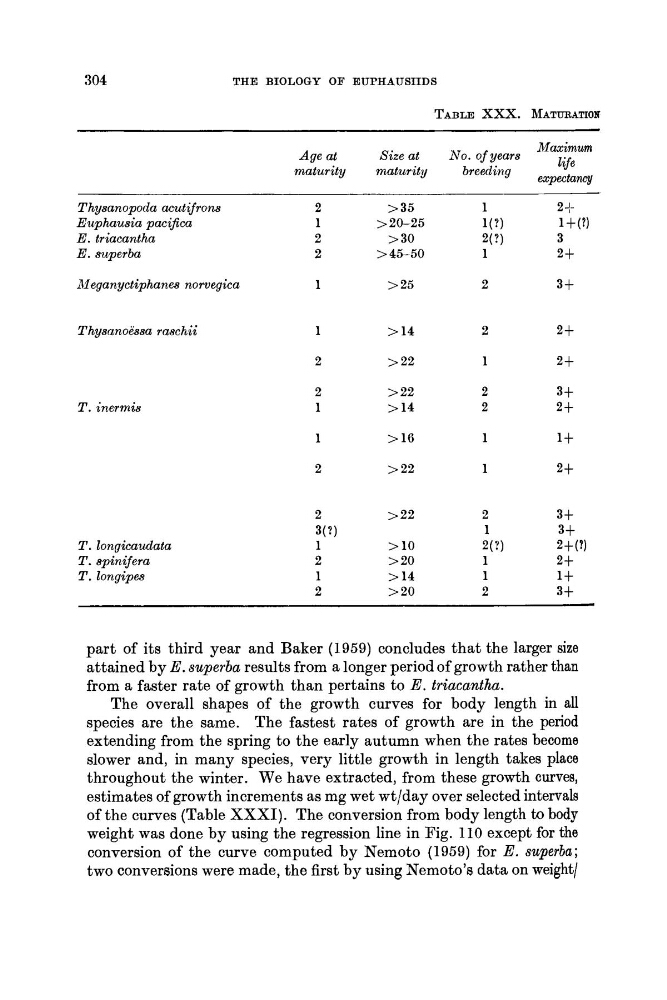
TABLE XXX. MATURATIOX
Maximum
life
expectancy
A g e at
Size at
N o . of years
maturity
maturity
breedkg
Thysanopoda acutifrons
2
> 35
1
2 -jEuphausia paci$ca
1
>20-25
1(?)
1i-U)
E. triacantha
2
> 30
2(?)
3
E . superba
2
>45-50
1
2 t
Aleganyctiphanes norvegica
1
> 25
2
3 t
Thysanoessa raschii
T. inermis
T . longicaudata
T. spinifera
T . longipes
1
> 14
2
2 t
2
> 22
1
2 t
2
> 22
2
3 t
1
> 14
2
2t
1
> 16
1
It
2
> 22
1
2t
2
> 22
2
3t
3(?)
1
3t
1
> 10
2(?)
2 t ( V
2
> 20
1
2 t
1
> 14
1
It
2
>20
2
3t
part of its third year and Baker (1959) concludes that the larger size
attained by E. superba results from a longer period of growth rather than
from a faster rate of growth than pertains to E . triacantha.
The overall shapes of the growth curves for body length in all
species are the same. The fastest rates of growth are in the period
extending from the spring to the early autumn when the rates become
slower and, in many species, very little growth in length takes place
throughout the winter. We have extracted, from these growth curves,
estimates of growth increments as mg wet wt/day over selected intervals
of the curves (Table XXXI). The conversion from body length to body
weight was done by using the regression line in Fig. 110 except for the
conversion of the curve computed by Nemoto (1959) for E. superba;
two conversions were made, the first by using Nemoto’s data on weight/
THE BIOLOGY OF EUPHAUSIIDS
TABLE XXX. MATURATIOX
Maximum
life
expectancy
A g e at
Size at
N o . of years
maturity
maturity
breedkg
Thysanopoda acutifrons
2
> 35
1
2 -jEuphausia paci$ca
1
>20-25
1(?)
1i-U)
E. triacantha
2
> 30
2(?)
3
E . superba
2
>45-50
1
2 t
Aleganyctiphanes norvegica
1
> 25
2
3 t
Thysanoessa raschii
T. inermis
T . longicaudata
T. spinifera
T . longipes
1
> 14
2
2 t
2
> 22
1
2 t
2
> 22
2
3 t
1
> 14
2
2t
1
> 16
1
It
2
> 22
1
2t
2
> 22
2
3t
3(?)
1
3t
1
> 10
2(?)
2 t ( V
2
> 20
1
2 t
1
> 14
1
It
2
>20
2
3t
part of its third year and Baker (1959) concludes that the larger size
attained by E. superba results from a longer period of growth rather than
from a faster rate of growth than pertains to E . triacantha.
The overall shapes of the growth curves for body length in all
species are the same. The fastest rates of growth are in the period
extending from the spring to the early autumn when the rates become
slower and, in many species, very little growth in length takes place
throughout the winter. We have extracted, from these growth curves,
estimates of growth increments as mg wet wt/day over selected intervals
of the curves (Table XXXI). The conversion from body length to body
weight was done by using the regression line in Fig. 110 except for the
conversion of the curve computed by Nemoto (1959) for E. superba;
two conversions were made, the first by using Nemoto’s data on weight/