

270
THE BIOLOQY OF EUPHAUSIIDS
of a single E . pacijica when the temperature of the water was artificially.
raised and found (Fig. 104) that increased temperature reduced the time
between moults. Twelve specimens were maintained a t temperatures
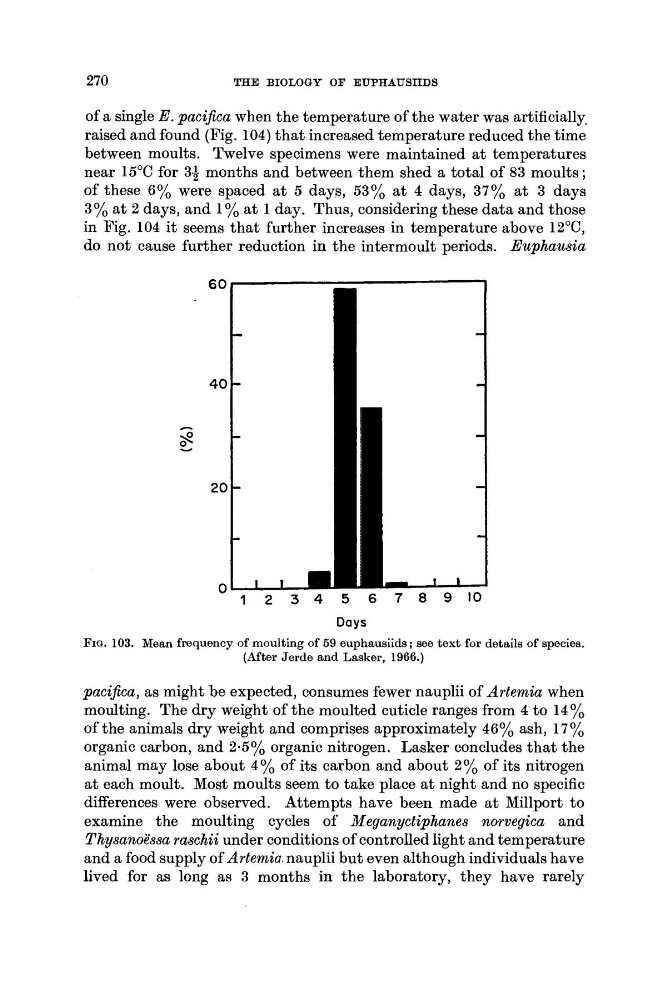
near 15OC for 3+ months and between them shed a total of 83 moults ;
of these 6% were spaced at 5 days, 53% a t 4 days, 37% a t 3 days
3% a t 2 days, and 1 yo a t 1 day. Thus, considering these data and those
in Fig. 104 it seems that further increases in temperature above 12"C,
do not cause further reduction in the intermoult periods. Euphausia
Days
FIG 103. Mean frequency of moulting of 59 euphausiids; see text for details of species.
(After Jerde and Lasker, 1966.)
pacijica, as might be expected, consumes fewer nauplii of Artemia when
moulting. The dry weight of the moulted cuticle ranges from 4 to 14%
of the animals dry weight and comprises approximately 46% ash, 17%
organic carbon, and 2.5% organic nitrogen. Lasker concludes that the
animal may lose about 4% of its carbon and about 2% of its nitrogen
a t each moult. Most moults seem to take place at night and no specific
differences were observed. Attempts have been made a t Millport to
examine the moulting cycles of Meganyctiphanes norvegica and
ThysanoZssa raschii under conditions of controlled light and temperature
and a food supply of Artemia nauplii but even although individuals have
lived for as long as 3 months in the laboratory, they have rarely
THE BIOLOQY OF EUPHAUSIIDS
of a single E . pacijica when the temperature of the water was artificially.
raised and found (Fig. 104) that increased temperature reduced the time
between moults. Twelve specimens were maintained a t temperatures
near 15OC for 3+ months and between them shed a total of 83 moults ;
of these 6% were spaced at 5 days, 53% a t 4 days, 37% a t 3 days
3% a t 2 days, and 1 yo a t 1 day. Thus, considering these data and those
in Fig. 104 it seems that further increases in temperature above 12"C,
do not cause further reduction in the intermoult periods. Euphausia
Days
FIG 103. Mean frequency of moulting of 59 euphausiids; see text for details of species.
(After Jerde and Lasker, 1966.)
pacijica, as might be expected, consumes fewer nauplii of Artemia when
moulting. The dry weight of the moulted cuticle ranges from 4 to 14%
of the animals dry weight and comprises approximately 46% ash, 17%
organic carbon, and 2.5% organic nitrogen. Lasker concludes that the
animal may lose about 4% of its carbon and about 2% of its nitrogen
a t each moult. Most moults seem to take place at night and no specific
differences were observed. Attempts have been made a t Millport to
examine the moulting cycles of Meganyctiphanes norvegica and
ThysanoZssa raschii under conditions of controlled light and temperature
and a food supply of Artemia nauplii but even although individuals have
lived for as long as 3 months in the laboratory, they have rarely