

CHAPTER 9
INTERNAL ANATOMY AND PHYSIOLOGY
The internal anatomy of euphausiids is quite well known and
relatively constant, as would be expected, from species to species. No
chapter in this book has been wholly devoted to fhis subject because it
is felt that a more synthetic approach to the study of euphausiids is
gained if several anatomical systems are described directly in relation
to their function. Consequently, the reproductive systems, male and
female, have been described in Chapter 4 while examining the production
of spermatozoa and eggs, the histology of the gut in Chapter 6 during
the examination of the food and feeding methods of these animals, and
the structure and function of the eyes and photophores are described in
Chapter 8. It is necessary, however, to review present knowledge of the
circulatory, nervous, and muscular systems before going any ‘further.
Arteries ramify throughout the body ; euphausiids, like other
crustaceans, have no venous system, but instead, the arteries open
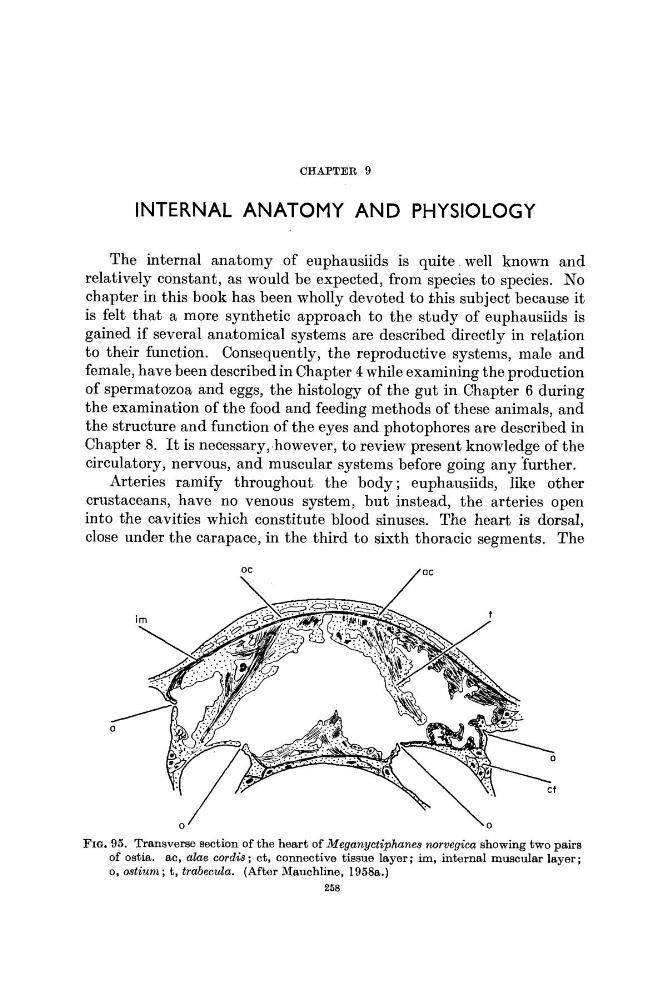
into the cavities which constitute blood sinuses. The heart is dorsal,
close under the carapace, in the third to sixth thoracic segments. The
0’
‘ 0
FIG. 95. Transverse section of the heart of Meganyctiphanes norwegica showing two pairs
of ostia. ac, alae cordis ; ct, connective tissue layer ; im, internal muscular layer ;
0 , ostium ; t, trabecula. (After Mauchline, 1958a.)
258
INTERNAL ANATOMY AND PHYSIOLOGY
The internal anatomy of euphausiids is quite well known and
relatively constant, as would be expected, from species to species. No
chapter in this book has been wholly devoted to fhis subject because it
is felt that a more synthetic approach to the study of euphausiids is
gained if several anatomical systems are described directly in relation
to their function. Consequently, the reproductive systems, male and
female, have been described in Chapter 4 while examining the production
of spermatozoa and eggs, the histology of the gut in Chapter 6 during
the examination of the food and feeding methods of these animals, and
the structure and function of the eyes and photophores are described in
Chapter 8. It is necessary, however, to review present knowledge of the
circulatory, nervous, and muscular systems before going any ‘further.
Arteries ramify throughout the body ; euphausiids, like other
crustaceans, have no venous system, but instead, the arteries open
into the cavities which constitute blood sinuses. The heart is dorsal,
close under the carapace, in the third to sixth thoracic segments. The
0’
‘ 0
FIG. 95. Transverse section of the heart of Meganyctiphanes norwegica showing two pairs
of ostia. ac, alae cordis ; ct, connective tissue layer ; im, internal muscular layer ;
0 , ostium ; t, trabecula. (After Mauchline, 1958a.)
258