

25G
THE BIOLOGY OF EUPHAUSIIDS
required before it is possible to accept that they form an apposition
type, mosaic image, as Kampa (1965) suggests. Also, no information
exists on the threshold intensity of ambient light detected by the eyes
of euphausiids although Nicol (1959) found that the compound eye of
the mysid, Praunus neglectus (G. 0. Sars), responds to 2.9 x
p W /
cm2 of ambient illumination of spectral range 420-540 mp and maximal
emission a t 475 mp ; this is the value indicated in Fig. 93. Euphausiids
a t 600-800m depth appear to respond to diurnal changes in light
>
>
In c QJ v)
e
..- c
-
0 -
5 -
420
460
500
540 580
Wavelength in rnp
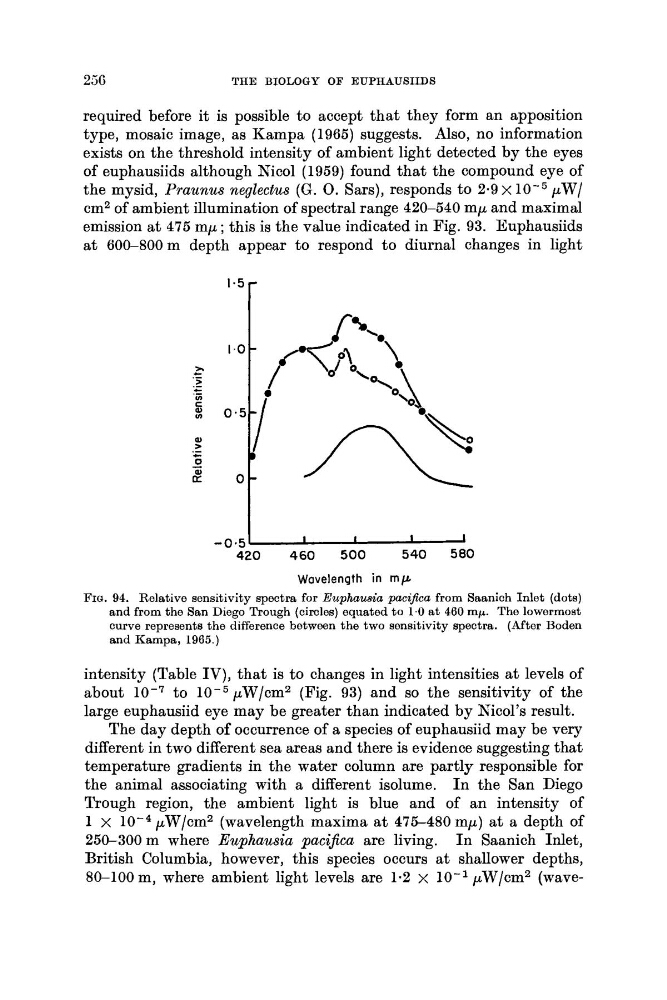
FIG. 94. Relative sensitivity spectra for Euphausia pacijca from Saanich Inlet (dots)
and from the San Diego Trough (circles) equated to 1.0 at 460 mp. The lowermost
curve represents the difference between the two sensitivity spectra. (After Boden
and Kampa, 1965.)
intensity (Table IV), that is to changes in light intensities a t levels of
about
to 10-5pWlcm2 (Fig. 93) and so the sensitivity of the
large euphausiid eye may be greater than indicated by Nicol’s result.
The day depth of occurrence of a species of euphausiid may be very
different in two different sea areas and there is evidence suggesting that
temperature gradients in the water column are partly responsible for
the animal associating with a different isolume. I n the San Diego
Trough region, the ambient light is blue and of an intensity of
1 x
pW/cm2 (wavelength maxima a t 475-480 mp) a t a depth of
250-300 m where Euphausia pacifica are living. I n Saanich Inlet,
British Columbia, however, this species occurs a t shallower depths,
80-100 m, where ambient light levels are 1-2 x 10⁻¹ pW/cm2 (wave-
THE BIOLOGY OF EUPHAUSIIDS
required before it is possible to accept that they form an apposition
type, mosaic image, as Kampa (1965) suggests. Also, no information
exists on the threshold intensity of ambient light detected by the eyes
of euphausiids although Nicol (1959) found that the compound eye of
the mysid, Praunus neglectus (G. 0. Sars), responds to 2.9 x
p W /
cm2 of ambient illumination of spectral range 420-540 mp and maximal
emission a t 475 mp ; this is the value indicated in Fig. 93. Euphausiids
a t 600-800m depth appear to respond to diurnal changes in light
>
>
In c QJ v)
e
..- c
-
0 -
5 -
420
460
500
540 580
Wavelength in rnp
FIG. 94. Relative sensitivity spectra for Euphausia pacijca from Saanich Inlet (dots)
and from the San Diego Trough (circles) equated to 1.0 at 460 mp. The lowermost
curve represents the difference between the two sensitivity spectra. (After Boden
and Kampa, 1965.)
intensity (Table IV), that is to changes in light intensities a t levels of
about
to 10-5pWlcm2 (Fig. 93) and so the sensitivity of the
large euphausiid eye may be greater than indicated by Nicol’s result.
The day depth of occurrence of a species of euphausiid may be very
different in two different sea areas and there is evidence suggesting that
temperature gradients in the water column are partly responsible for
the animal associating with a different isolume. I n the San Diego
Trough region, the ambient light is blue and of an intensity of
1 x
pW/cm2 (wavelength maxima a t 475-480 mp) a t a depth of
250-300 m where Euphausia pacifica are living. I n Saanich Inlet,
British Columbia, however, this species occurs a t shallower depths,
80-100 m, where ambient light levels are 1-2 x 10⁻¹ pW/cm2 (wave-