

254
THE BIOLOGY OF EUPHAUSIIDS
close to each other could expose light levels of the order of
to
10-2 pW/cm2 to each other. The point being made is that an animal
swimming 20m upwards will enter a layer with a t least twice the
ambient light of the one below while a euphausiid looking upwards
would probably look into light one hundred times more intense than if
it were looking downwards. There must, therefore, be behavioural and/
Light intensity ( p W / m 2 )
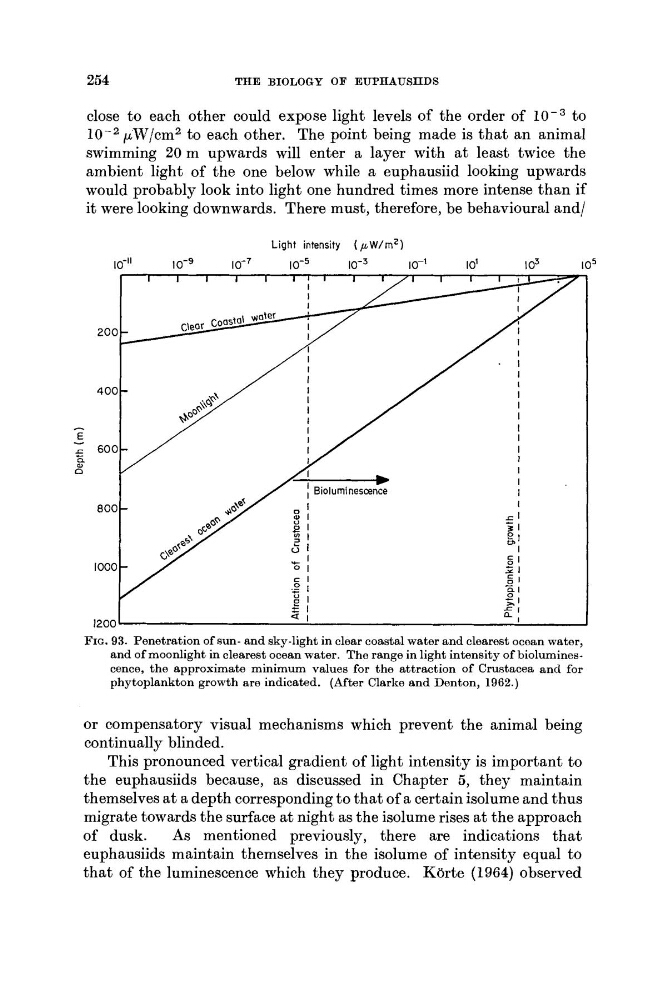
FIG. 93. Penetration of sun- and sky-light in clear coastal water and clearest ocoan water,
and of moonlight in clearest ocean water. The range in light intensity of bioluminescence, the approximate minimum values for the attraction of Crustacea and for
phytoplankton growth are indicated. (After Clarke and Denton, 1962.)
or compensatory visual mechanisms which prevent the animal being
continually blinded.
This pronounced vertical gradient of light intensity is important to
the euphausiids because, as discussed in Chapter 5, they maintain
themselves a t a depth corresponding to that of a certain isolume and thus
migrate towards the surface a t night as the isolume rises at the approach
of dusk.
As mentioned previously, there are indications that
euphausiids maintain themselves in the isolume of intensity equal to
that of the luminescence which they produce. Korte (1964) observed
THE BIOLOGY OF EUPHAUSIIDS
close to each other could expose light levels of the order of
to
10-2 pW/cm2 to each other. The point being made is that an animal
swimming 20m upwards will enter a layer with a t least twice the
ambient light of the one below while a euphausiid looking upwards
would probably look into light one hundred times more intense than if
it were looking downwards. There must, therefore, be behavioural and/
Light intensity ( p W / m 2 )
FIG. 93. Penetration of sun- and sky-light in clear coastal water and clearest ocoan water,
and of moonlight in clearest ocean water. The range in light intensity of bioluminescence, the approximate minimum values for the attraction of Crustacea and for
phytoplankton growth are indicated. (After Clarke and Denton, 1962.)
or compensatory visual mechanisms which prevent the animal being
continually blinded.
This pronounced vertical gradient of light intensity is important to
the euphausiids because, as discussed in Chapter 5, they maintain
themselves a t a depth corresponding to that of a certain isolume and thus
migrate towards the surface a t night as the isolume rises at the approach
of dusk.
As mentioned previously, there are indications that
euphausiids maintain themselves in the isolume of intensity equal to
that of the luminescence which they produce. Korte (1964) observed