

8. VISION AND BIOLUMINESCENCE
239
these two curves is indicative of the participation of euphausiopsin in
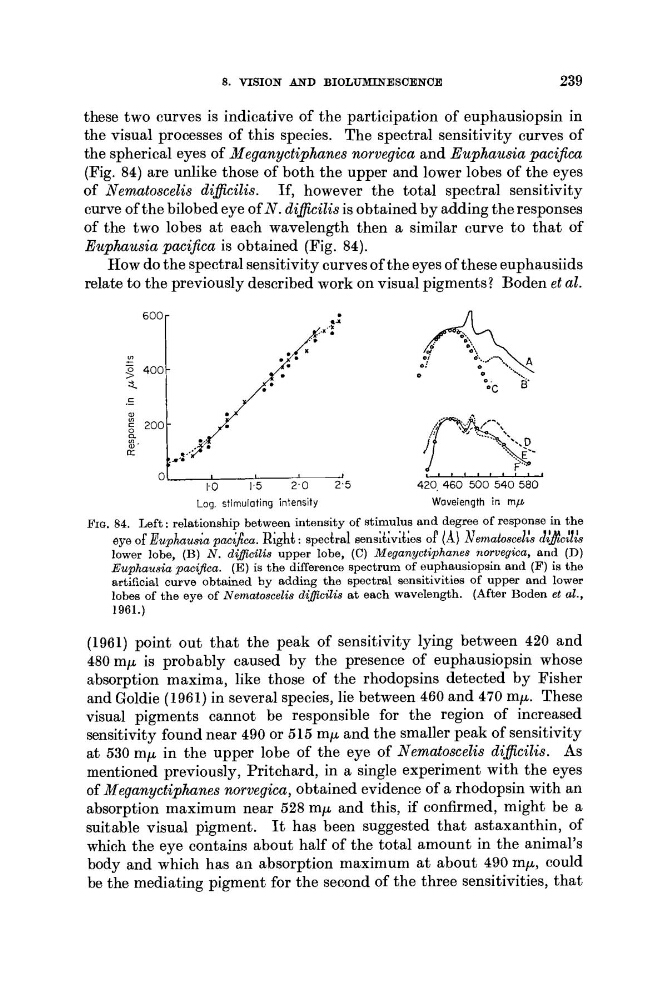
the visual processes of this species. The spectral sensitivity curves of
the spherical eyes of Meganyctiphanes norvegica and Euphausia pacijica
(Fig. 84) are unlike those of both the upper and lower lobes of the eyes
of Nematoscelis dificilis. If, however the total spectral sensitivity
curve of the bilobed eye of N . dificilis is obtained by adding the responses
of the two lobes a t each wavelength then a similar curve to that of
Euphausia paci$ca is obtained (Fig. 84).
How do the spectral sensitivity curves of the eyes of these euphausiids
relate to the previously described work on visual pigments? Boden et al.
m
p
,
,
$ 200
,
' J .....___
....
L
*..p
a
m .
e-.
"..... E"
.*..
E
F
0
1.0
1.5
2.0
2.5
420, 460 500 540 500
Log. stimulating intensity
Wavelength i n rnp
FIG. 84. Left : relationship between intensity of stimulus and degree of response in the
eye of Euphausia pac&a. Right : spectral aens;t;v;t;es of (A) Nernatoscelis &!ct!lt!s
lower lobe, (B) N . dificiicilis upper lobe, ( C ) Meganyctiphanes norvegica, and (D)
Euphausia paci$ca. (E) is the difference spectrum of euphausiopsin and (F) is the
artificial curve obtained by adding the spectral sensitivities of upper and lower
lobes of the eye of Nernatoscelis dificilis at each wavelength. (After Boden et al.,
1961.)
(1961) point out that the peak of sensitivity lying between 420 and
480 mp is probably caused by the presence of euphausiopsin whose
absorption maxima, like those of the rhodopsins detected by Fisher
and Goldie (1961) in several species, lie between 460 and 470 mp. These
visual pigments cannot be responsible for the region of increased
sensitivity found near 490 or 515 mp and the smaller peak of sensitivity
at 530 mp in the upper lobe of the eye of Nematoscelis dificilis. As
mentioned previously, Pritchard, in a single experiment with the eyes
of Meganyctiphanes norvegica, obtained evidence of a rhodopsin with an
absorption maximum near 528 mp and this, if confirmed, might be a
suitable visual pigment. It has been suggested that astaxanthin, of
which the eye contains about half of the total amount in the animal's
body and which has an absorption maximum a t about 490 mp, could
be the mediating pigment for the second of the three sensitivities, that
239
these two curves is indicative of the participation of euphausiopsin in
the visual processes of this species. The spectral sensitivity curves of
the spherical eyes of Meganyctiphanes norvegica and Euphausia pacijica
(Fig. 84) are unlike those of both the upper and lower lobes of the eyes
of Nematoscelis dificilis. If, however the total spectral sensitivity
curve of the bilobed eye of N . dificilis is obtained by adding the responses
of the two lobes a t each wavelength then a similar curve to that of
Euphausia paci$ca is obtained (Fig. 84).
How do the spectral sensitivity curves of the eyes of these euphausiids
relate to the previously described work on visual pigments? Boden et al.
m
p
,
,
$ 200
,
' J .....___
....
L
*..p
a
m .
e-.
"..... E"
.*..
E
F
0
1.0
1.5
2.0
2.5
420, 460 500 540 500
Log. stimulating intensity
Wavelength i n rnp
FIG. 84. Left : relationship between intensity of stimulus and degree of response in the
eye of Euphausia pac&a. Right : spectral aens;t;v;t;es of (A) Nernatoscelis &!ct!lt!s
lower lobe, (B) N . dificiicilis upper lobe, ( C ) Meganyctiphanes norvegica, and (D)
Euphausia paci$ca. (E) is the difference spectrum of euphausiopsin and (F) is the
artificial curve obtained by adding the spectral sensitivities of upper and lower
lobes of the eye of Nernatoscelis dificilis at each wavelength. (After Boden et al.,
1961.)
(1961) point out that the peak of sensitivity lying between 420 and
480 mp is probably caused by the presence of euphausiopsin whose
absorption maxima, like those of the rhodopsins detected by Fisher
and Goldie (1961) in several species, lie between 460 and 470 mp. These
visual pigments cannot be responsible for the region of increased
sensitivity found near 490 or 515 mp and the smaller peak of sensitivity
at 530 mp in the upper lobe of the eye of Nematoscelis dificilis. As
mentioned previously, Pritchard, in a single experiment with the eyes
of Meganyctiphanes norvegica, obtained evidence of a rhodopsin with an
absorption maximum near 528 mp and this, if confirmed, might be a
suitable visual pigment. It has been suggested that astaxanthin, of
which the eye contains about half of the total amount in the animal's
body and which has an absorption maximum a t about 490 mp, could
be the mediating pigment for the second of the three sensitivities, that