

8. VISION AND BIOLUMINESCENCE
237
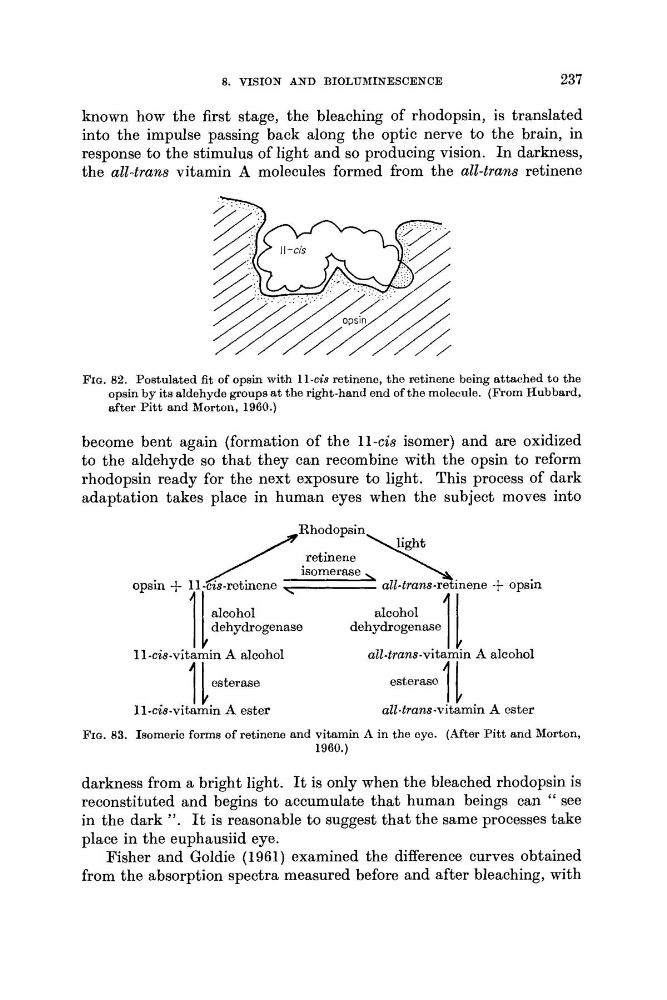
known how the first stage, the bleaching of rhodopsin, is translated
into the impulse passing back along the optic nerve to the brain, in
response to the stimulus of light and so producing vision. I n darkness,
the all-trans vitamin A molecules formed from the all-trans retinene
FIQ. 82. Postulated fit of opsin with 11-cis retinene, the retinene being attached to the
opsin by its aldehyde groups at the right-hand end of the molecule. (From Nubbard,
after Pitt and Morton, 1960.)
become bent again (formation of the 114s isomer) and are oxidized
to the aldehyde so that they can recombine with the opsin to reform
rhodopsin ready for the next exposure to light. This process of dark
adaptation takes place in human eyes when the subject moves into
Rhodopsin
isomerase
dehydrogenase
11
alcohol
dehydrogenaso
all-trans-vitamin A alcohol
esterase 1 1
11 &-vitamin A alcohol
1 1estera.e
11-cis-vitamin A ester
FIG. 83. Isomeric forms of retinene and vitamin A in the eye. (After Pitt and Morton,
all-trans-vitamin A ester
1960.)
darkness from a bright light. It is only when the bleached rhodopsin is
reconstituted and begins to accumulate that human beings can " see
in the dark ". It is reasonable to suggest that the same processes take
place in the euphausiid eye.
Fisher and Goldie (1961) examined the difference curves obtained
from the absorption spectra measured before and after bleaching, with
237
known how the first stage, the bleaching of rhodopsin, is translated
into the impulse passing back along the optic nerve to the brain, in
response to the stimulus of light and so producing vision. I n darkness,
the all-trans vitamin A molecules formed from the all-trans retinene
FIQ. 82. Postulated fit of opsin with 11-cis retinene, the retinene being attached to the
opsin by its aldehyde groups at the right-hand end of the molecule. (From Nubbard,
after Pitt and Morton, 1960.)
become bent again (formation of the 114s isomer) and are oxidized
to the aldehyde so that they can recombine with the opsin to reform
rhodopsin ready for the next exposure to light. This process of dark
adaptation takes place in human eyes when the subject moves into
Rhodopsin
isomerase
dehydrogenase
11
alcohol
dehydrogenaso
all-trans-vitamin A alcohol
esterase 1 1
11 &-vitamin A alcohol
1 1estera.e
11-cis-vitamin A ester
FIG. 83. Isomeric forms of retinene and vitamin A in the eye. (After Pitt and Morton,
all-trans-vitamin A ester
1960.)
darkness from a bright light. It is only when the bleached rhodopsin is
reconstituted and begins to accumulate that human beings can " see
in the dark ". It is reasonable to suggest that the same processes take
place in the euphausiid eye.
Fisher and Goldie (1961) examined the difference curves obtained
from the absorption spectra measured before and after bleaching, with