

230
THE BIOLOGY OF EUF'HAUSIIDS
A
8
C
D
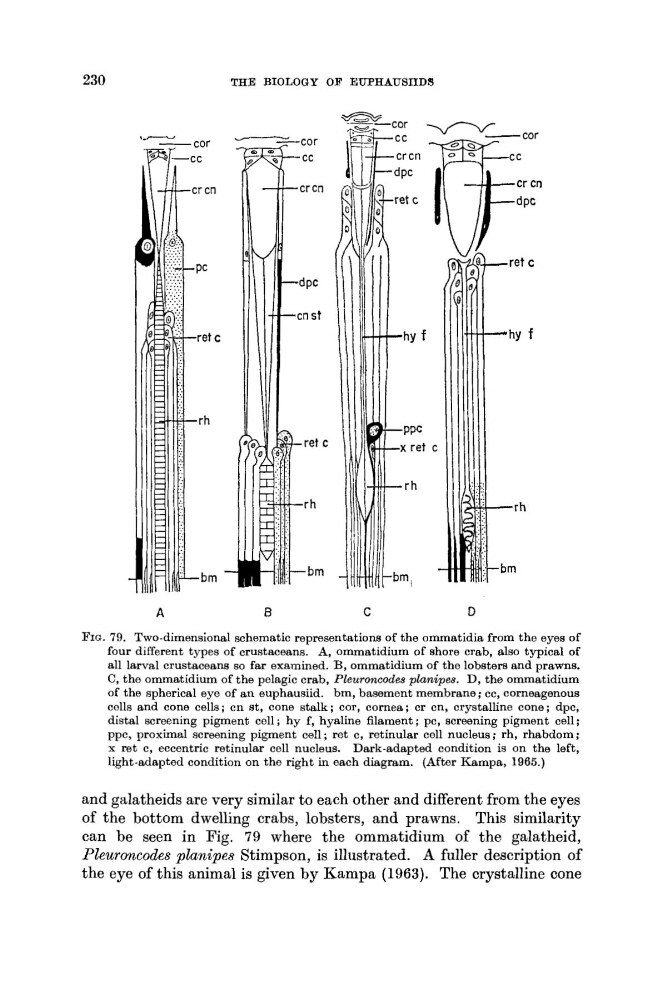
PIG. 79. Two-dimensional schematic representations of the ommatidia from the eyes of
four different types of crustaceans. A, ommatidium of shore crab, ttlso typical of
all larval crustaceans so far examined. B, ommatidium of the lobsters and prawns.
C, the ommatidium of the pelagic crab, Pleuroncodes planipes. D, the ommatidium
of the spherical eye of an euphausiid. bm, basement membrane; cc, corneagenous
colls and cone cells; cn st, cone stalk; cor, cornea; cr on, crystalline cone; dpc,
distal screening pigment cell ; hy f, hyaline filament ; pc, screening pigment cell ;
ppc, proximal screening pigment cell; ret c, retinular cell nucleus; rh, rhabdom;
x ret c, eccentric retinular cell nucleus. Dark-adapted condition is on the left,
light-adapted condition on the right in each diagram. (After Kampa, 1965.)
and galatheids are very similar to each other and different from the eyes
of the bottom dwelling crabs, lobsters, and prawns. This similarity
can be seen in Fig. 79 where the ommatidium of the galatheid,
Pleuroncodes planipes Stimpson, is illustrated. A fuller description of
the eye of this animal is given by Kampa (1963). The crystalline cone
THE BIOLOGY OF EUF'HAUSIIDS
A
8
C
D
PIG. 79. Two-dimensional schematic representations of the ommatidia from the eyes of
four different types of crustaceans. A, ommatidium of shore crab, ttlso typical of
all larval crustaceans so far examined. B, ommatidium of the lobsters and prawns.
C, the ommatidium of the pelagic crab, Pleuroncodes planipes. D, the ommatidium
of the spherical eye of an euphausiid. bm, basement membrane; cc, corneagenous
colls and cone cells; cn st, cone stalk; cor, cornea; cr on, crystalline cone; dpc,
distal screening pigment cell ; hy f, hyaline filament ; pc, screening pigment cell ;
ppc, proximal screening pigment cell; ret c, retinular cell nucleus; rh, rhabdom;
x ret c, eccentric retinular cell nucleus. Dark-adapted condition is on the left,
light-adapted condition on the right in each diagram. (After Kampa, 1965.)
and galatheids are very similar to each other and different from the eyes
of the bottom dwelling crabs, lobsters, and prawns. This similarity
can be seen in Fig. 79 where the ommatidium of the galatheid,
Pleuroncodes planipes Stimpson, is illustrated. A fuller description of
the eye of this animal is given by Kampa (1963). The crystalline cone