

7. CHEMICAL COMPOSITION
201
52-67% dry weight of E. superba (equivalent to about 12% wet
weight) and ash to be between 6.74 and 10% dry weight (equivalent to
about 2% wet weight). The water content of euphausiids ranges from
75 to 80% approximately and the ash content represents 1.5 to 4.3%
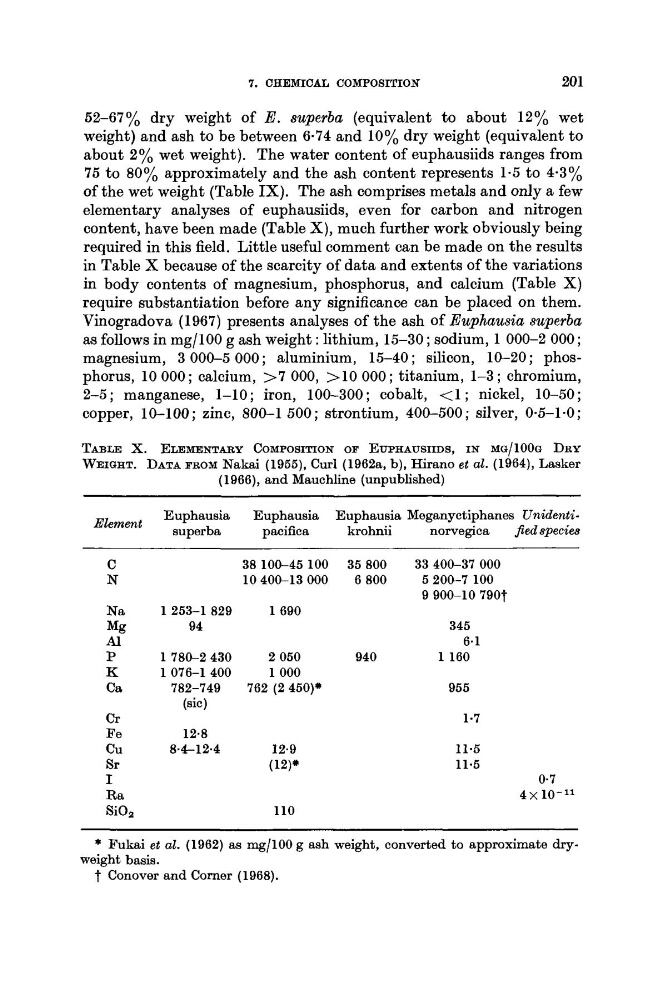
ofthe wet weight (Table IX). The ash comprises metals and only a few
elementary analyses of euphausiids, even for carbon and nitrogen
content, have been made (Table X), much further work obviously being
required in this field. Little useful comment can be made on the results
in Table X because of the scarcity of data and extents of the variations
in body contents of magnesium, phosphorus, and calcium (Table X)
require substantiation before any significance can be placed on them.
Vinogradova (1967) presents analyses of the ash of Euphuusia superba
as follows in mg/lOO g ash weight : lithium, 15-30 ; sodium, 1 000-2 000 ;
magnesium, 3 000-5 000 ; aluminium, 15-40 ; silicon, 10-20 ; phosphorus, 10 000; calcium, >7 000, >10 000; titanium, 1-3; chromium,
2-5; manganese, 1-10; iron, 100-300; cobalt, <1; nickel, 10-50;
copper, 10-100; zinc, 800-1 500 ; strontium, 400-500 ; silver, 0.5-1.0;
TABLE X. ELEMENTARY COMPOSITION OF EUPHAUSIIDS, IN M G / ~ O O G DRY
WEIGHT. DATA FROM Nakai (1955), Curl (1962a, b), Hirano et al. (1964), Lasker
(1966), and Mauchline (unpublished)
Euphausia
Euphausia Euphausia Meganyctiphanes Unidentisuperba
pacifica
krohnii
norvegica
fied species
C
N
38100-45100
10400-13000
35800
33400-37000
6 800
5 200-7 100
9900-10790t
Na
1253-1 829
1690
Mi 3
94
Al
P
1 780-2 430
2 050
K
1076-1 400
1 000
Ca
782-749
762 (2 450)*
(sic)
Cr
Fe
12.8
cu
84-12.4
12.9
I
Ra
Sr
(W*
SiOa
110
345
940
1160
6.1
955
1.7
11.5
11.5
0.7
4 x 10-l1
~~~
* Fukai et al. (1962) as mg/100 g ash weight, converted to approximate dryt Conover and Corner (1968).
weight basis.
201
52-67% dry weight of E. superba (equivalent to about 12% wet
weight) and ash to be between 6.74 and 10% dry weight (equivalent to
about 2% wet weight). The water content of euphausiids ranges from
75 to 80% approximately and the ash content represents 1.5 to 4.3%
ofthe wet weight (Table IX). The ash comprises metals and only a few
elementary analyses of euphausiids, even for carbon and nitrogen
content, have been made (Table X), much further work obviously being
required in this field. Little useful comment can be made on the results
in Table X because of the scarcity of data and extents of the variations
in body contents of magnesium, phosphorus, and calcium (Table X)
require substantiation before any significance can be placed on them.
Vinogradova (1967) presents analyses of the ash of Euphuusia superba
as follows in mg/lOO g ash weight : lithium, 15-30 ; sodium, 1 000-2 000 ;
magnesium, 3 000-5 000 ; aluminium, 15-40 ; silicon, 10-20 ; phosphorus, 10 000; calcium, >7 000, >10 000; titanium, 1-3; chromium,
2-5; manganese, 1-10; iron, 100-300; cobalt, <1; nickel, 10-50;
copper, 10-100; zinc, 800-1 500 ; strontium, 400-500 ; silver, 0.5-1.0;
TABLE X. ELEMENTARY COMPOSITION OF EUPHAUSIIDS, IN M G / ~ O O G DRY
WEIGHT. DATA FROM Nakai (1955), Curl (1962a, b), Hirano et al. (1964), Lasker
(1966), and Mauchline (unpublished)
Euphausia
Euphausia Euphausia Meganyctiphanes Unidentisuperba
pacifica
krohnii
norvegica
fied species
C
N
38100-45100
10400-13000
35800
33400-37000
6 800
5 200-7 100
9900-10790t
Na
1253-1 829
1690
Mi 3
94
Al
P
1 780-2 430
2 050
K
1076-1 400
1 000
Ca
782-749
762 (2 450)*
(sic)
Cr
Fe
12.8
cu
84-12.4
12.9
I
Ra
Sr
(W*
SiOa
110
345
940
1160
6.1
955
1.7
11.5
11.5
0.7
4 x 10-l1
~~~
* Fukai et al. (1962) as mg/100 g ash weight, converted to approximate dryt Conover and Corner (1968).
weight basis.