

6. FOOD AND FEEDING
195
consume bottom detritus during the winter and it seems probable that
Euphausia superba can utilize other sources of food when phytoplankton
is not available.
Ponomareva ( 1955) found that Thysanoessa raschii feeds predominantly on phytoplankton during the spring increase wherea,s no
Plonhton
food
Spring
4
. . . . . . . . .
. . . . . . . .
5
6
7
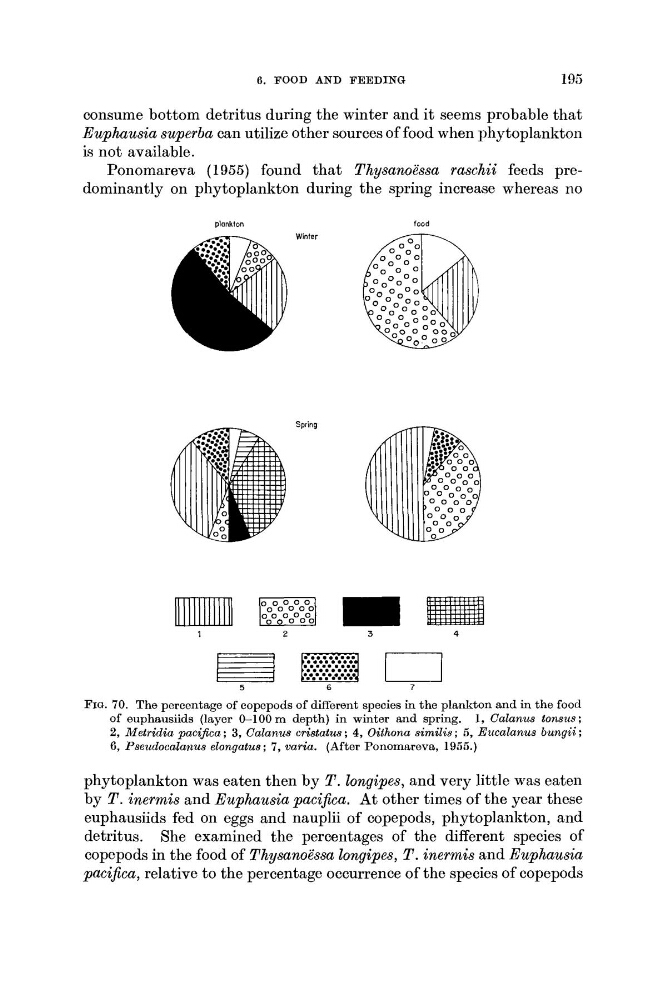
FIG. 70. The percentage of copepods of different species in the plankton and in the food
of euphausiids (layer 0-100m depth) in winter and spring. 1, Calanus tonsus;
2, Metridia pacijca ; 3, t h h U 8 cristatus ; 4, Oithona sirnilis ; 5, Ezicalanus bungii ;
6, Pseudocalanus elongatus ; 7, varia. (After Ponomareva, 1955.)
phytoplankton was eaten then by T . longipes, and very little was eaten
by T . inermis and Euphausia pacijica. At other times of the year these
euphausiids fed on eggs and nauplii of copepods, phytoplankton, and
detritus. She examined the percentages of the different species of
copepods in the food of Thysanoessa longipes, T . inermis and Euphausia
pacijka, relative to the percentage occurrence of the species of copepods
195
consume bottom detritus during the winter and it seems probable that
Euphausia superba can utilize other sources of food when phytoplankton
is not available.
Ponomareva ( 1955) found that Thysanoessa raschii feeds predominantly on phytoplankton during the spring increase wherea,s no
Plonhton
food
Spring
4
. . . . . . . . .
. . . . . . . .
5
6
7
FIG. 70. The percentage of copepods of different species in the plankton and in the food
of euphausiids (layer 0-100m depth) in winter and spring. 1, Calanus tonsus;
2, Metridia pacijca ; 3, t h h U 8 cristatus ; 4, Oithona sirnilis ; 5, Ezicalanus bungii ;
6, Pseudocalanus elongatus ; 7, varia. (After Ponomareva, 1955.)
phytoplankton was eaten then by T . longipes, and very little was eaten
by T . inermis and Euphausia pacijica. At other times of the year these
euphausiids fed on eggs and nauplii of copepods, phytoplankton, and
detritus. She examined the percentages of the different species of
copepods in the food of Thysanoessa longipes, T . inermis and Euphausia
pacijka, relative to the percentage occurrence of the species of copepods