

5. VERTICAL DISTRIBUTION AND MIGRATION
167
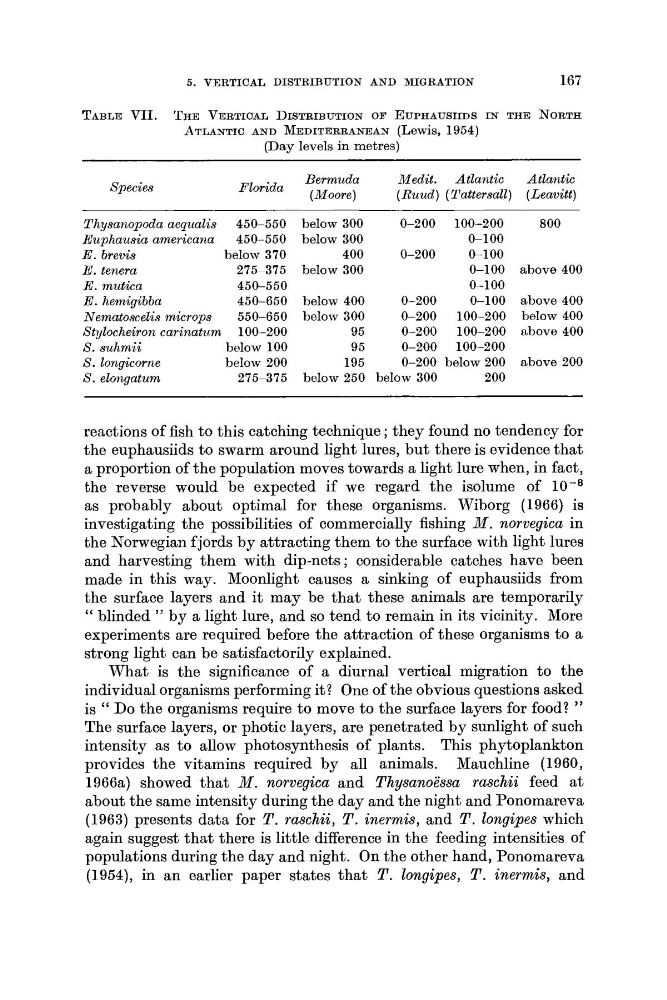
TABLE VII. THE VERTICAL DISTRIBUTION OF EUPHAUSIIDS IN THE NORTH
ATLANTIC AND MEDITERRANEAN (Lewis, 1954)
(Day levels in metres)
Bermuda
Medit. Atlantic
Atlantic
(Moore)
(Ruud) (Tattersall) (Leavitt)
Species
Thysanopoda aequalis 450-550
Euphausia americana
450-550
E. brevis
below 370
E. tenera
27 5-37 5
E. mutica
450-550
E . hemigibba
450-650
Nematoscelis microps
550-650
Stylocheiron carinatum 100-200
S. suhmii
below 100
S. longicorne
below 200
S. elongatum
27 5-37 5
below 300
below 300
400
below 300
below 400
below 300
95
95
195
below 250
0-200
100-200
800
0-100
0-200
0-100
0-100 above 400
0-100
0-200
0-100 above 400
0-200
100-200 below 400
0-200
100-200 above 400
0-200
100-200
0-200 below 200 above 200
below 300
200
reactions of fish to this catching technique ; they found no tendency for
the euphausiids to swarm around light lures, but there is evidence that
a proportion of the population moves towards a light lure when, in fact,
the reverse would be expected if we regard the isolume of
as probably about optimal for these organisms. Wiborg (1966) is
investigating the possibilities of commercially fishing M . norvegica in
the Norwegian fjords by attracting them to the surface with light lures
and harvesting them with dip-nets ; considerable catches have been
made in this way. Moonlight causes a sinking of euphausiids from
the surface layers and it may be that these animals are temporarily
" blinded " by a light lure, and so tend to remain in its vicinity. More
experiments are required before the attraction of these organisms to a
strong light can be satisfactorily explained.
What is the significance of a diurnal vertical migration to the
individual organisms performing it T One of the obvious questions asked
is " Do the organisms require to move to the surface layers for food? "
The surface layers, or photic layers, are penetrated by sunlight of such
intensity as to allow photosynthesis of plants. This phytoplankton
provides the vitamins required by all animals. Mauchline (1960,
1966a) showed that M . norvegica and Thysanoessa raschii feed at
about the same intensity during the day and the night and Ponomareva
(1963) presents data for T . raschii, T . inermis, and T . longipes which
again suggest that there is little difference in the feeding intensities of
populations during the day and night. On the other hand, Ponomareva
(1954)) in an earlier paper states that T . longipes, T . inermis, and
167
TABLE VII. THE VERTICAL DISTRIBUTION OF EUPHAUSIIDS IN THE NORTH
ATLANTIC AND MEDITERRANEAN (Lewis, 1954)
(Day levels in metres)
Bermuda
Medit. Atlantic
Atlantic
(Moore)
(Ruud) (Tattersall) (Leavitt)
Species
Thysanopoda aequalis 450-550
Euphausia americana
450-550
E. brevis
below 370
E. tenera
27 5-37 5
E. mutica
450-550
E . hemigibba
450-650
Nematoscelis microps
550-650
Stylocheiron carinatum 100-200
S. suhmii
below 100
S. longicorne
below 200
S. elongatum
27 5-37 5
below 300
below 300
400
below 300
below 400
below 300
95
95
195
below 250
0-200
100-200
800
0-100
0-200
0-100
0-100 above 400
0-100
0-200
0-100 above 400
0-200
100-200 below 400
0-200
100-200 above 400
0-200
100-200
0-200 below 200 above 200
below 300
200
reactions of fish to this catching technique ; they found no tendency for
the euphausiids to swarm around light lures, but there is evidence that
a proportion of the population moves towards a light lure when, in fact,
the reverse would be expected if we regard the isolume of
as probably about optimal for these organisms. Wiborg (1966) is
investigating the possibilities of commercially fishing M . norvegica in
the Norwegian fjords by attracting them to the surface with light lures
and harvesting them with dip-nets ; considerable catches have been
made in this way. Moonlight causes a sinking of euphausiids from
the surface layers and it may be that these animals are temporarily
" blinded " by a light lure, and so tend to remain in its vicinity. More
experiments are required before the attraction of these organisms to a
strong light can be satisfactorily explained.
What is the significance of a diurnal vertical migration to the
individual organisms performing it T One of the obvious questions asked
is " Do the organisms require to move to the surface layers for food? "
The surface layers, or photic layers, are penetrated by sunlight of such
intensity as to allow photosynthesis of plants. This phytoplankton
provides the vitamins required by all animals. Mauchline (1960,
1966a) showed that M . norvegica and Thysanoessa raschii feed at
about the same intensity during the day and the night and Ponomareva
(1963) presents data for T . raschii, T . inermis, and T . longipes which
again suggest that there is little difference in the feeding intensities of
populations during the day and night. On the other hand, Ponomareva
(1954)) in an earlier paper states that T . longipes, T . inermis, and