

5. VERTICAL DISTRIBUTION AND MIGRATION
159
O-group animals live higher in the water column than the I-group
(Table V). Ruud (1936), examining material from the Danish Oceanographic Expedition to the Mediterranean, calculated the mean body
length of Euphausia krohnii in hauls from different depths, and found
- E
-
Time of day
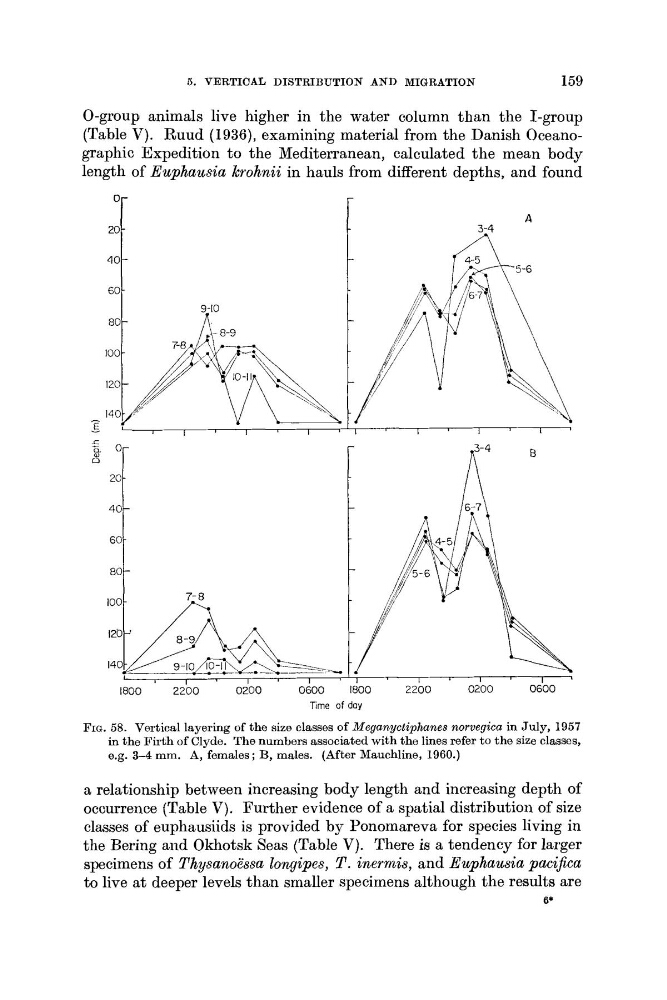
FIQ. 58. Vertical layering of the size classes of Msganyctiphartes norvegica in July, 1957
in the Firth of Clyde. The numbers associated with the lines refer to the size classes,
e.g. 3-4 mm. A, fomales; B, males. (After Mauchline, 1960.)
a relationship between increasing body length and increasing depth of
occurrence (Table V). Further evidence of a spatial distribution of size
classes of euphausiids is provided by Ponomareva for species living in
the Bering and Okhotsk Seas (Table V). There is a tendency for larger
specimens of Thysanoessa longipes, T . inermis, and Euphausia paci$ca
to live a t deeper levels than smaller specimens although the results are
6'
159
O-group animals live higher in the water column than the I-group
(Table V). Ruud (1936), examining material from the Danish Oceanographic Expedition to the Mediterranean, calculated the mean body
length of Euphausia krohnii in hauls from different depths, and found
- E
-
Time of day
FIQ. 58. Vertical layering of the size classes of Msganyctiphartes norvegica in July, 1957
in the Firth of Clyde. The numbers associated with the lines refer to the size classes,
e.g. 3-4 mm. A, fomales; B, males. (After Mauchline, 1960.)
a relationship between increasing body length and increasing depth of
occurrence (Table V). Further evidence of a spatial distribution of size
classes of euphausiids is provided by Ponomareva for species living in
the Bering and Okhotsk Seas (Table V). There is a tendency for larger
specimens of Thysanoessa longipes, T . inermis, and Euphausia paci$ca
to live a t deeper levels than smaller specimens although the results are
6'