

2. THE SPECIES OW KRILL
9
A further species, Thysanopoda raschii was named by him (Sars,
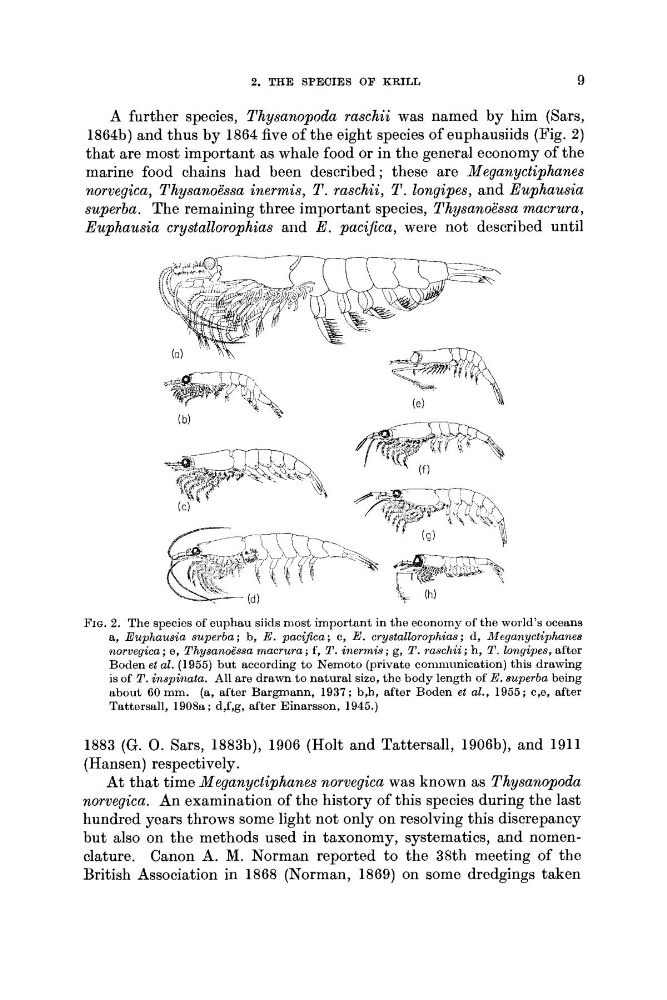
1864b) and thus by 1864 five of the eight species of euphausiids (Fig. 2)
that are most important as whale food or in the general economy of the
marine food chains had been described ; these are Meganyctiphanes
norvegica, ThysanoEssa inermis, T . raschii, T . longipes, and Euphausia
superba. The remaining three important species, Thysanoessa macrura,
Euphausia crystallorophias and E . pacijca, were not described until
FIG. 2. The species of euphau siids most important in the economy of the world’s oceans
a, Euphausia superba ; b, E. paci$ca ; c, E . crystallorophias ; d, Meganyctiphanes
norvegica ; 0, Thysanoessa macrura ; f, T . inermis ; g, T . ruschii ; h, T . longipes, after
Boden et al. (1955) but according to Nemoto (private communication) this drawing
is of T . inspinata. All are drawn to natural size, the body length of E. superba being
about 60 mm. (a, after Bargmann, 1937; b,h, after Boden et al., 1955; c,e, after
Tattersall, 1908a ; d,f,g, after Einarsson, 1945.)
1883 (G. 0. Sam, 1883b)) 1906 (Holt and Tattersall, 1906b)) and 1911
(Hansen) respectively.
At that time Meganyctiphanes norvegica was known as Thysanopoda
norvegica. An examination of the history of this species during the last
hundred years throws some light not only on resolving this discrepancy
but also on the methods used in taxonomy, systematics, and nomenclature. Canon A. M. Norman reported to the 38th meeting of the
British Association in 1868 (Norman, 1869) on some dredgings taken
9
A further species, Thysanopoda raschii was named by him (Sars,
1864b) and thus by 1864 five of the eight species of euphausiids (Fig. 2)
that are most important as whale food or in the general economy of the
marine food chains had been described ; these are Meganyctiphanes
norvegica, ThysanoEssa inermis, T . raschii, T . longipes, and Euphausia
superba. The remaining three important species, Thysanoessa macrura,
Euphausia crystallorophias and E . pacijca, were not described until
FIG. 2. The species of euphau siids most important in the economy of the world’s oceans
a, Euphausia superba ; b, E. paci$ca ; c, E . crystallorophias ; d, Meganyctiphanes
norvegica ; 0, Thysanoessa macrura ; f, T . inermis ; g, T . ruschii ; h, T . longipes, after
Boden et al. (1955) but according to Nemoto (private communication) this drawing
is of T . inspinata. All are drawn to natural size, the body length of E. superba being
about 60 mm. (a, after Bargmann, 1937; b,h, after Boden et al., 1955; c,e, after
Tattersall, 1908a ; d,f,g, after Einarsson, 1945.)
1883 (G. 0. Sam, 1883b)) 1906 (Holt and Tattersall, 1906b)) and 1911
(Hansen) respectively.
At that time Meganyctiphanes norvegica was known as Thysanopoda
norvegica. An examination of the history of this species during the last
hundred years throws some light not only on resolving this discrepancy
but also on the methods used in taxonomy, systematics, and nomenclature. Canon A. M. Norman reported to the 38th meeting of the
British Association in 1868 (Norman, 1869) on some dredgings taken