

4. THE LARVAE
121
one calyptopis in a plankton haul belongs but this becomes a little
easier during the next phase of development because specific differences
become enhanced.
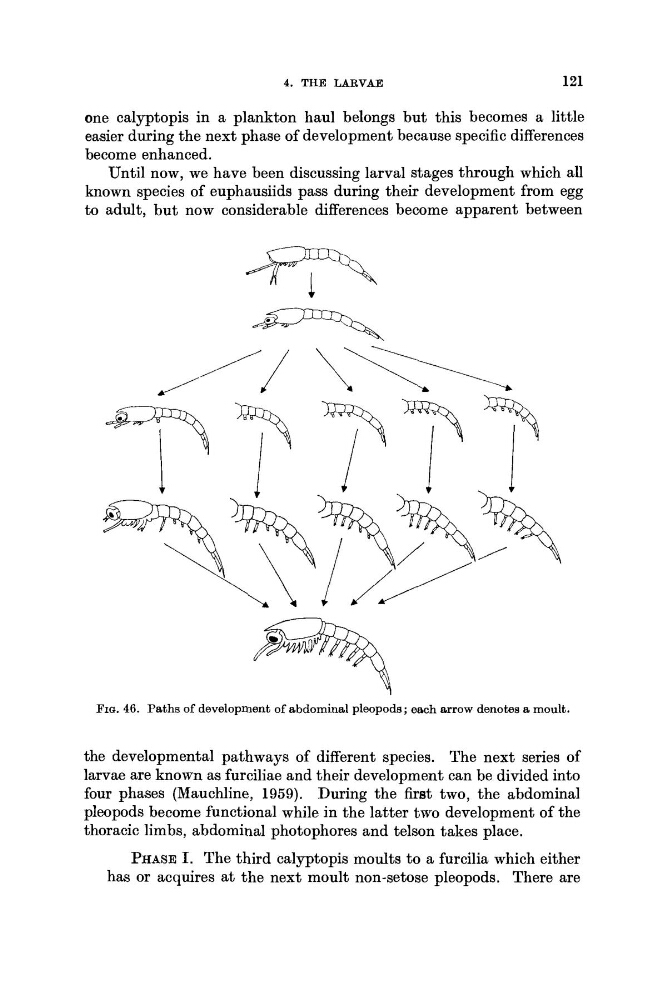
Until now, we have been discussing larval stages through which all
known species of euphausiids pass during their development from egg
to adult, but now considerable differences become apparent between
FIU. 46. Paths of development of abdominal pleopods; each arrow denotes a moult.
the developmental pathways of different species. The next series of
larvae are known as furciliae and their development can be divided into
four phases (Mauchline, 1959). During the first two, the abdominal
pleopods become functional while in the latter two development of the
thoracic limbs, abdominal photophores and telson takes place.
PHASE I. The third calyptopis moults to a furcilia which either
has or acquires a t the next moult non-setose pleopods. There are
121
one calyptopis in a plankton haul belongs but this becomes a little
easier during the next phase of development because specific differences
become enhanced.
Until now, we have been discussing larval stages through which all
known species of euphausiids pass during their development from egg
to adult, but now considerable differences become apparent between
FIU. 46. Paths of development of abdominal pleopods; each arrow denotes a moult.
the developmental pathways of different species. The next series of
larvae are known as furciliae and their development can be divided into
four phases (Mauchline, 1959). During the first two, the abdominal
pleopods become functional while in the latter two development of the
thoracic limbs, abdominal photophores and telson takes place.
PHASE I. The third calyptopis moults to a furcilia which either
has or acquires a t the next moult non-setose pleopods. There are