

4. THE LARVAE
111
environments, exists as regards the times of formation of the sexual
products, mating, and the laying of the fertilized eggs. There are also
large variations between and within species in the duration of the
breeding season. The length of the breeding season is directly related
to the length of time that females in the population are found with
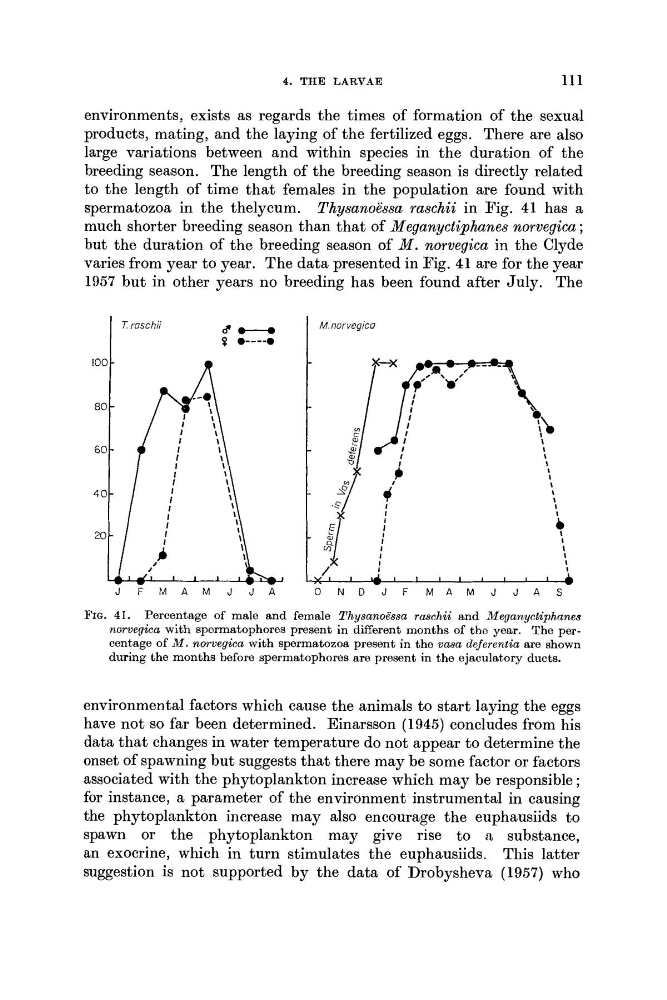
spermatozoa in the thelycum. Thysanoessa raschii in Fig. 41 has a
much shorter breeding season than that of Meganyctiphanes norvegica ;
but the duration of the breeding season of M . norvegica in the Clyde
varies from year to year. The data presented in Fig. 41 are for the year
1957 but in other years no breeding has been found after July. The
T roschii
M.norvegica
FIG. 41. Percentage of male and female Thysano9sa raschii and Meganyctiphanes
norwegica with spermatophores present in different months of t h e year. The percentage of M . norvegica with spermatozoa present in tho vasa deferentia are shown
during the months before spermatophores are present in the ejaculatory ducts.
environmental factors which cause the animals to start laying the eggs
have not so far been determined. Einarsson (1945) concludes from his
data that changes in water temperature do not appear to determine the
onset of spawning but suggests that there may be some factor or factors
associated with the phytoplankton increase which may be responsible ;
for instance, a parameter of the environment instrumental in causing
the phytoplankton increase may also encourage the euphausiids to
spawn or the phytoplankton may give rise to a substance,
an exocrine, which in turn stimulates the euphausiids. This latter
suggestion is not supported by the data of Drobysheva (1957) who
111
environments, exists as regards the times of formation of the sexual
products, mating, and the laying of the fertilized eggs. There are also
large variations between and within species in the duration of the
breeding season. The length of the breeding season is directly related
to the length of time that females in the population are found with
spermatozoa in the thelycum. Thysanoessa raschii in Fig. 41 has a
much shorter breeding season than that of Meganyctiphanes norvegica ;
but the duration of the breeding season of M . norvegica in the Clyde
varies from year to year. The data presented in Fig. 41 are for the year
1957 but in other years no breeding has been found after July. The
T roschii
M.norvegica
FIG. 41. Percentage of male and female Thysano9sa raschii and Meganyctiphanes
norwegica with spermatophores present in different months of t h e year. The percentage of M . norvegica with spermatozoa present in tho vasa deferentia are shown
during the months before spermatophores are present in the ejaculatory ducts.
environmental factors which cause the animals to start laying the eggs
have not so far been determined. Einarsson (1945) concludes from his
data that changes in water temperature do not appear to determine the
onset of spawning but suggests that there may be some factor or factors
associated with the phytoplankton increase which may be responsible ;
for instance, a parameter of the environment instrumental in causing
the phytoplankton increase may also encourage the euphausiids to
spawn or the phytoplankton may give rise to a substance,
an exocrine, which in turn stimulates the euphausiids. This latter
suggestion is not supported by the data of Drobysheva (1957) who