

CHAPTER 2
THE SPECIES OF KRILL
There are eighty-five valid species of euphausiids but, before
discussing their taxonomy, some general knowledge of their morphology
is required. They have a superficial resemblance to the shrimps and
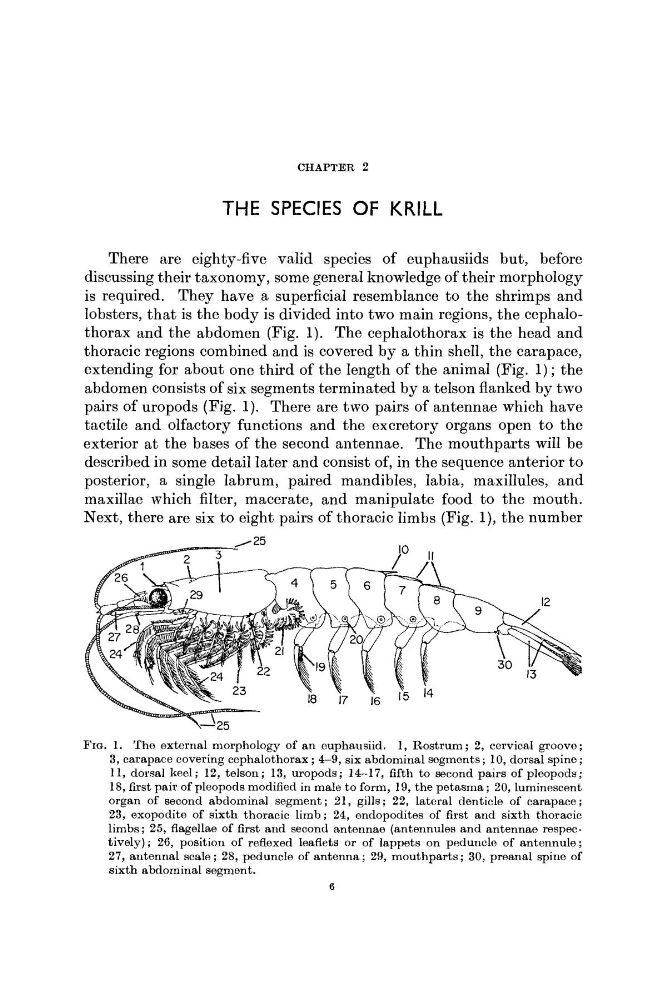
lobsters, that is the body is divided into two main regions, the cephalothorax and the abdomen (Fig. 1). The cephalothorax is the head and
thoracic regions combined and is covered by a thin shell, the carapace,
extending for about one third of the length of the animal (Fig. 1) ; the
abdomen consists of six segments terminated by a telson flanked by two
pairs of uropods (Fig. 1). There are two pairs of antennae which have
tactile and olfactory functions and the excretory organs open to the
exterior at the bases of the second antennae. The mouthparts will be
described in some detail later and consist of, in the sequence anterior to
posterior, a single labrum, paired mandibles, labia, maxilluIes, and
maxillae which filter, macerate, and manipulate food to the mouth.
Next, there are six to eight pairs of thoracic limbs (Fig. l), the number
FIG. 1. The external morphology of an euphausiid. 1, Rostrum; 2, cervical groove;
3, carapace covering cephalothorax ; 4-9, six abdominal segments; 10, dorsal spine ;
11, dorsal keel; 12, telson; 13, uropods; 14-17, fifth to second pairs of pleopods;
18, first pair of pleopods modified in male to form, 19, the petasma; 20, luminescent
organ of second abdominal segment; 21, gills; 22, lateral denticle of carapace;
23, exopodite of sixth thoracic limb; 24, endopodites of first and sixth thoracic
limbs ; 25, flagellae of first and second antennae (antennules and antennae respectively); 26, position of reflexed leaflets or of lappets on peduncle of antennule;
27, antenna1 scale; 28, peduncle of antenna; 29, mouthparts; 30, preanal spine of
sixth abdominal segment.
6
THE SPECIES OF KRILL
There are eighty-five valid species of euphausiids but, before
discussing their taxonomy, some general knowledge of their morphology
is required. They have a superficial resemblance to the shrimps and
lobsters, that is the body is divided into two main regions, the cephalothorax and the abdomen (Fig. 1). The cephalothorax is the head and
thoracic regions combined and is covered by a thin shell, the carapace,
extending for about one third of the length of the animal (Fig. 1) ; the
abdomen consists of six segments terminated by a telson flanked by two
pairs of uropods (Fig. 1). There are two pairs of antennae which have
tactile and olfactory functions and the excretory organs open to the
exterior at the bases of the second antennae. The mouthparts will be
described in some detail later and consist of, in the sequence anterior to
posterior, a single labrum, paired mandibles, labia, maxilluIes, and
maxillae which filter, macerate, and manipulate food to the mouth.
Next, there are six to eight pairs of thoracic limbs (Fig. l), the number
FIG. 1. The external morphology of an euphausiid. 1, Rostrum; 2, cervical groove;
3, carapace covering cephalothorax ; 4-9, six abdominal segments; 10, dorsal spine ;
11, dorsal keel; 12, telson; 13, uropods; 14-17, fifth to second pairs of pleopods;
18, first pair of pleopods modified in male to form, 19, the petasma; 20, luminescent
organ of second abdominal segment; 21, gills; 22, lateral denticle of carapace;
23, exopodite of sixth thoracic limb; 24, endopodites of first and sixth thoracic
limbs ; 25, flagellae of first and second antennae (antennules and antennae respectively); 26, position of reflexed leaflets or of lappets on peduncle of antennule;
27, antenna1 scale; 28, peduncle of antenna; 29, mouthparts; 30, preanal spine of
sixth abdominal segment.
6