

362
ELVEZIO GHIRARDELLI
represented by band A while the band I is particularly short. Also a
short band H is apparent, as well as a zone in t,he centre of band I
that can be compared with stria Z even if it shows a peculiar
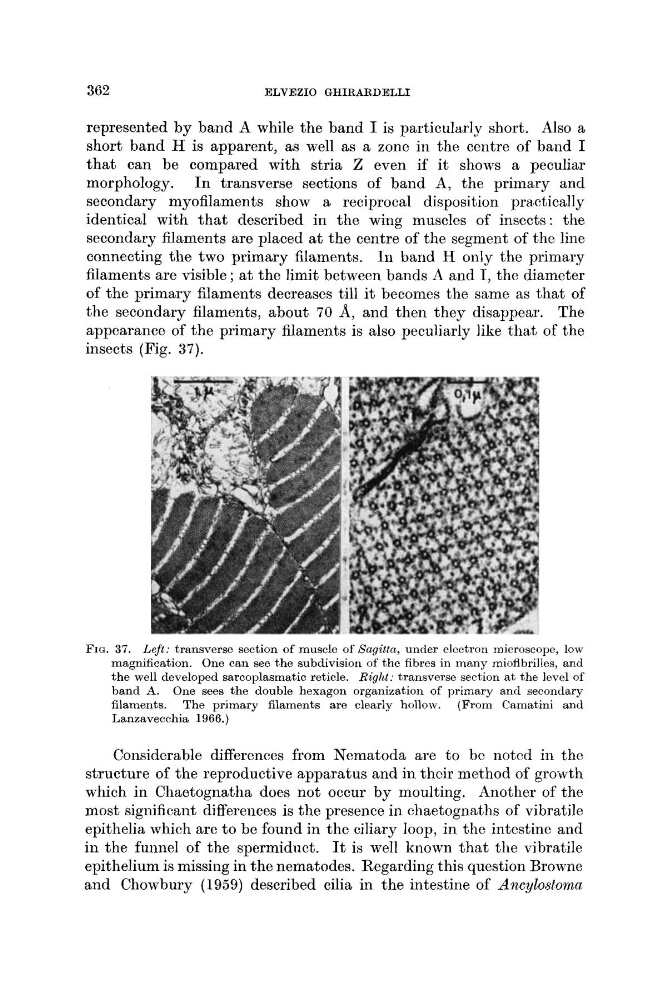
morphology. In transverse sections of band A, the primary and
secondary myofilaments show a reciprocal disposition practically
identical with that described in the wing muscles of insects: the
secondary filaments are placed at the centre of the segment of the line
connecting the two primary filaments. In band H only the primary
filaments are visible ; at the limit between bands A and I, the diameter
of the primary filaments decreases till it becomes the same as that of
the secondary filaments, about 70 a, and then they disappear. The
appearance of the primary filaments is also peculiarly like that of the
insects (Fig. 3 7 ) .
FIG. 37. Left; transverse section of muscle of Sagitta, under elcctron microscope, low
magnification. One can see the subdivision of thc fibres in many mioflbrilles, and
the well developed sarcoplasmatic reticle. Right; transverse section a t the level of
band A. One sees the double hexagon organization of primary and secondary
filaments. The primary filaments are clearly hollow. (From Camatini and
Lanzavecchia 1966.)
Considerable differences from Nematoda are to bc notcd in the
structure of the reproductive apparatus and in thcir method of growth
which in Chaetognatha does not occur by moulting. Another of the
most significant differences is the presence in chaetognaths of vibratile
epithelia which are to be found in the ciliary loop, in the intestine and
in the funnel of the spermiduct. It is well known that the vibratile
epithelium is missing in the nematodes. Regarding this question Browne
and Chowbury (1959) described cilia in the intestine of Ancylosfomu
ELVEZIO GHIRARDELLI
represented by band A while the band I is particularly short. Also a
short band H is apparent, as well as a zone in t,he centre of band I
that can be compared with stria Z even if it shows a peculiar
morphology. In transverse sections of band A, the primary and
secondary myofilaments show a reciprocal disposition practically
identical with that described in the wing muscles of insects: the
secondary filaments are placed at the centre of the segment of the line
connecting the two primary filaments. In band H only the primary
filaments are visible ; at the limit between bands A and I, the diameter
of the primary filaments decreases till it becomes the same as that of
the secondary filaments, about 70 a, and then they disappear. The
appearance of the primary filaments is also peculiarly like that of the
insects (Fig. 3 7 ) .
FIG. 37. Left; transverse section of muscle of Sagitta, under elcctron microscope, low
magnification. One can see the subdivision of thc fibres in many mioflbrilles, and
the well developed sarcoplasmatic reticle. Right; transverse section a t the level of
band A. One sees the double hexagon organization of primary and secondary
filaments. The primary filaments are clearly hollow. (From Camatini and
Lanzavecchia 1966.)
Considerable differences from Nematoda are to bc notcd in the
structure of the reproductive apparatus and in thcir method of growth
which in Chaetognatha does not occur by moulting. Another of the
most significant differences is the presence in chaetognaths of vibratile
epithelia which are to be found in the ciliary loop, in the intestine and
in the funnel of the spermiduct. It is well known that the vibratile
epithelium is missing in the nematodes. Regarding this question Browne
and Chowbury (1959) described cilia in the intestine of Ancylosfomu