

SOME ASPECTS O F T H E BIOLOGY O F THE CHAETOGNATHS
339
(1959d) in S. bipunctata and X. infzota have seen that the eggs enter
into the temporary oviduct by active movements. As the eggs pass out
to the exterior, the ovary reverts to its usual appearance, or rather to
one which recalls a younger ovary (Ghirardelli, 1960) : it may actually
appear shortened by two-thirds (Dallot, 1966, 1967). This contraction
does not last long for it is followed by an expansion phase, during which
the ovary becomes longer and the ovarian membrane detaches itself
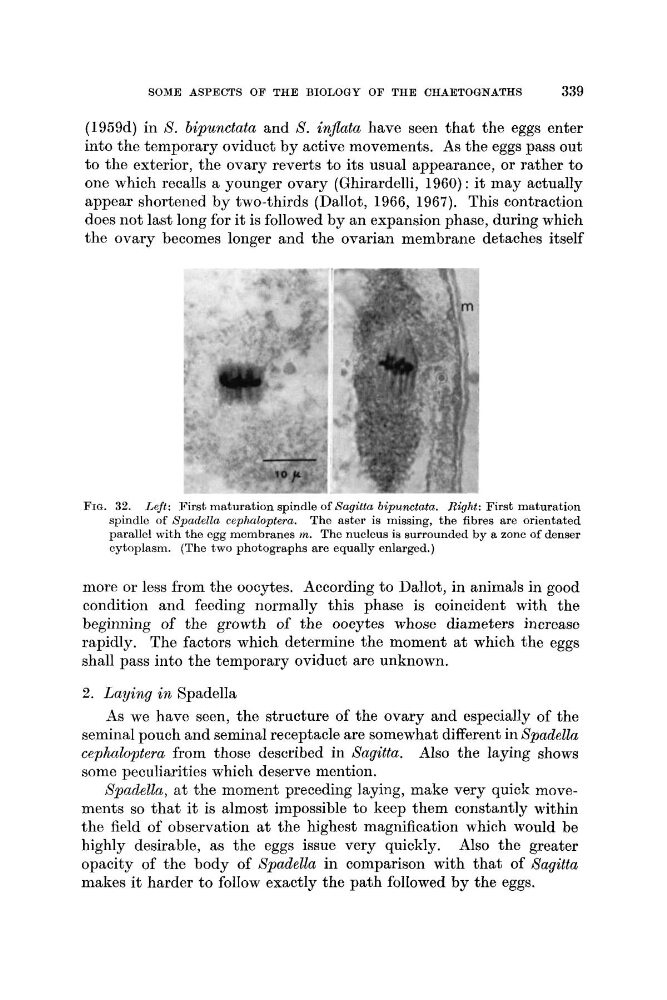
FIG. 32. Left: First maturation spindle of Sagitta bipunctata. Right: First maturation
spindle of Spadella cephaloptera. The aster is missing, the fibres are orientated
parallel with the egg membranes tn. The nucleus is surrounded by a zone of denser
cytoplasm. (The two photographs are equally enlarged.)
more or less from the oocytes. According to Dallot, in animals in good
condition and feeding normally this phase is coincident with the
beginning of the growth of the oocytes whose diameters increase
rapidly. The factors which determine the moment at which the eggs
shall pass into the temporary oviduct are unknown.
2. Laying in Spadella
As we have seen, the structure of the ovary and especially of the
seminal pouch and seminal receptacle are somewhat different in Spadella
cephaloptera from those described in Sagitta. Also the laying shows
some peculiarities which deserve mention.
Xpadella, a t the moment preceding laying, make very quick movements so that it is almost impossible t o keep them constantly within
the field of observation a t the highest magnification which would be
highly desirable, as the eggs issue very quickly. Also the greater
opacity of the body of Spadella in comparison with that of Xagitta
makes it harder to follow exactly the path followed by the eggs.
339
(1959d) in S. bipunctata and X. infzota have seen that the eggs enter
into the temporary oviduct by active movements. As the eggs pass out
to the exterior, the ovary reverts to its usual appearance, or rather to
one which recalls a younger ovary (Ghirardelli, 1960) : it may actually
appear shortened by two-thirds (Dallot, 1966, 1967). This contraction
does not last long for it is followed by an expansion phase, during which
the ovary becomes longer and the ovarian membrane detaches itself
FIG. 32. Left: First maturation spindle of Sagitta bipunctata. Right: First maturation
spindle of Spadella cephaloptera. The aster is missing, the fibres are orientated
parallel with the egg membranes tn. The nucleus is surrounded by a zone of denser
cytoplasm. (The two photographs are equally enlarged.)
more or less from the oocytes. According to Dallot, in animals in good
condition and feeding normally this phase is coincident with the
beginning of the growth of the oocytes whose diameters increase
rapidly. The factors which determine the moment at which the eggs
shall pass into the temporary oviduct are unknown.
2. Laying in Spadella
As we have seen, the structure of the ovary and especially of the
seminal pouch and seminal receptacle are somewhat different in Spadella
cephaloptera from those described in Sagitta. Also the laying shows
some peculiarities which deserve mention.
Xpadella, a t the moment preceding laying, make very quick movements so that it is almost impossible t o keep them constantly within
the field of observation a t the highest magnification which would be
highly desirable, as the eggs issue very quickly. Also the greater
opacity of the body of Spadella in comparison with that of Xagitta
makes it harder to follow exactly the path followed by the eggs.