

SOME ASPECTS O F THE BIOLOGY O F THE CHAETOGNATHS
32 1
is often surrounded by large yolk globules ; although it is not provided
with a membrane of its own, which would isolate it from the cytoplasm,
it shows a well-defined boundary (Fig. 20). At a greater magnification,
the germ cell determinant appears like a mass of irregularly shaped
threads, more or less branched, and of big grains and plaques, all
tangled together. These single constituents do not have a uniform
tissue, but form loops or even figures of eight that have not all the same
opacity; this might be due to the different nature of the formations.
The single constituents of the determinant are immersed in the
cytoplasm which at a certain magnification shows between the formations of the determinant itself some sack-like cavities, often more
crowded in some regions of the determinant than in others. These
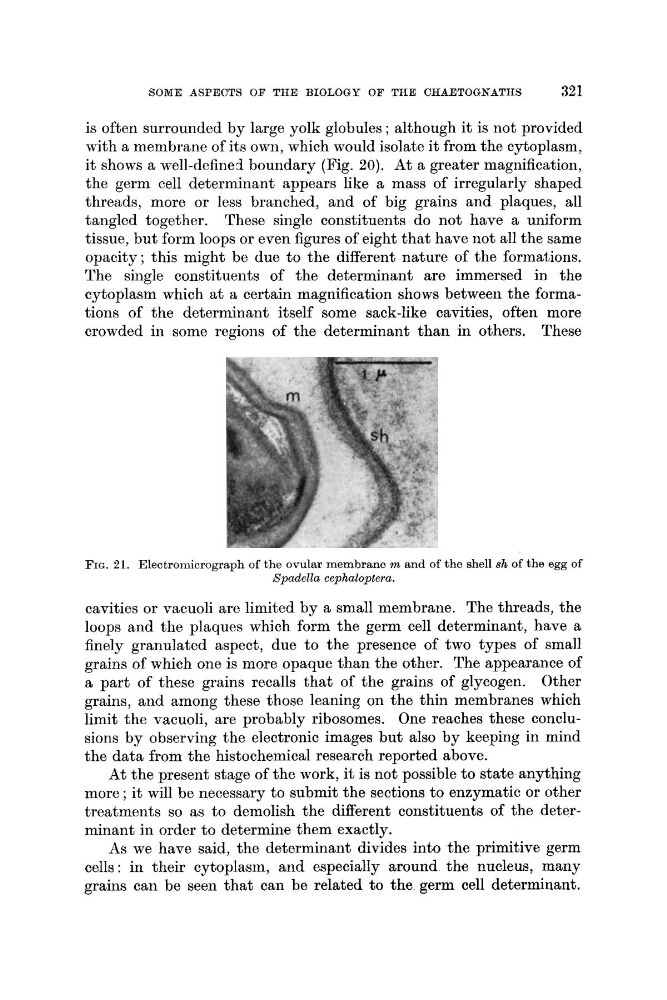
FIG. 21. Electromicrograph of the ovular membrane m and of the shell sh of the egg of
Spadella cephaloptera.
cavities or vacuoli are limited by a small membrane. The threads, the
loops and the plaques which form the germ cell determinant, have a
finely granulated aspect, due to the presence of two types of small
grains of which one is more opaque than the other. The appearance of
a part of these grains recalls that of the grains of glycogen. Other
grains, and among these those leaning on the thin membranes which
limit the vacuoli, are probably ribosomes. One reaches these conclusions by observing the electronic images but also by keeping in mind
the data from the histochemical research reported above.
At the present stage of the work, it is not possible to state anything
more ; it will be necessary to submit the sections to enzymatic or other
treatments so as to demolish the different constituents of the determinant in order to determine them exactly.
As we have said, the determinant divides into the primitive germ
cells: in their cytoplasm, and especially around the nucleus, many
grains can be seen that can be related to the germ cell determinant.
32 1
is often surrounded by large yolk globules ; although it is not provided
with a membrane of its own, which would isolate it from the cytoplasm,
it shows a well-defined boundary (Fig. 20). At a greater magnification,
the germ cell determinant appears like a mass of irregularly shaped
threads, more or less branched, and of big grains and plaques, all
tangled together. These single constituents do not have a uniform
tissue, but form loops or even figures of eight that have not all the same
opacity; this might be due to the different nature of the formations.
The single constituents of the determinant are immersed in the
cytoplasm which at a certain magnification shows between the formations of the determinant itself some sack-like cavities, often more
crowded in some regions of the determinant than in others. These
FIG. 21. Electromicrograph of the ovular membrane m and of the shell sh of the egg of
Spadella cephaloptera.
cavities or vacuoli are limited by a small membrane. The threads, the
loops and the plaques which form the germ cell determinant, have a
finely granulated aspect, due to the presence of two types of small
grains of which one is more opaque than the other. The appearance of
a part of these grains recalls that of the grains of glycogen. Other
grains, and among these those leaning on the thin membranes which
limit the vacuoli, are probably ribosomes. One reaches these conclusions by observing the electronic images but also by keeping in mind
the data from the histochemical research reported above.
At the present stage of the work, it is not possible to state anything
more ; it will be necessary to submit the sections to enzymatic or other
treatments so as to demolish the different constituents of the determinant in order to determine them exactly.
As we have said, the determinant divides into the primitive germ
cells: in their cytoplasm, and especially around the nucleus, many
grains can be seen that can be related to the germ cell determinant.