

SOME ASPECTS O F T H E BIOLOGY OF THE CHAETOGNATHS
319
of the female apparatus (accessory fertilization cells, seminal pouch,
involucres and stroma of the gonad) have a different origin, i.e. they
derive from mesodermic cells (Ghirardelli, 1959d). The primitive germ
cells in the gastrula and in the larvae are also easily recognizable in
vivo in Sngitta because of their larger dimensions and the typical
appearance of their nuclei which are very voluminous. On the contrary, the germ cell determinant has never yet been seen in living cells,
not even under a phase contrast microscope in the eggs of Sagitta inJlata
which are the most transparent we know.
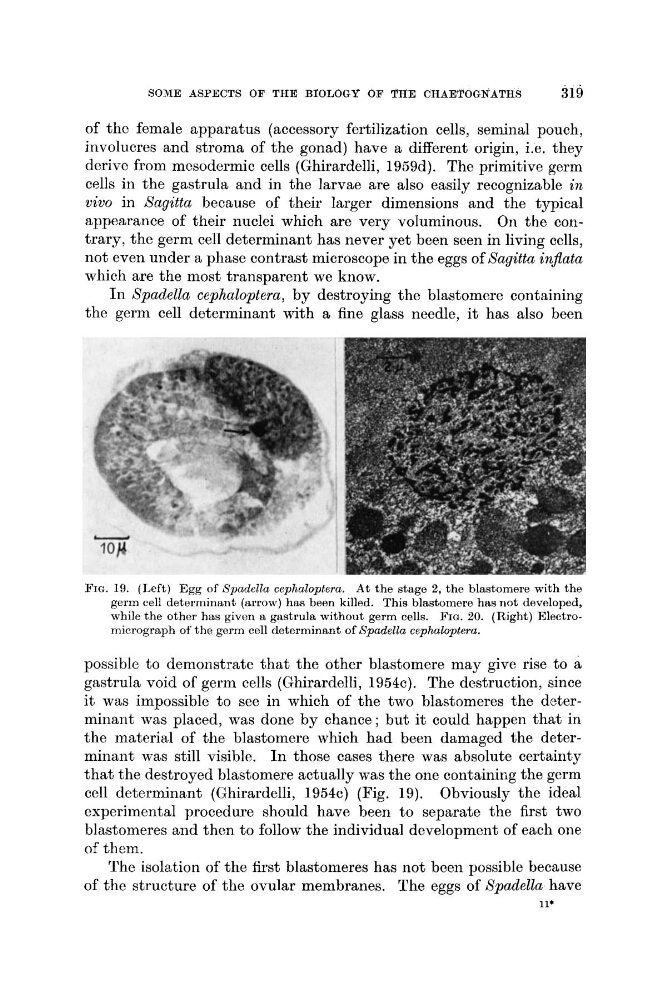
I n Xpndella cephaloptera, by destroying the blastomere containing
the germ cell determinant with a fine glass needle, it has also been
FIG. 19. (Left) Egg of Spadella cephaloptera. A t the stage 2, the blastomere with the
germ cell determinant (arrow) has been killed. This blastomere has not developed,
while the other has given a gastrula without germ cells. FIG. 20. (Right) Electromicrograph of the germ cell determinant of Spadella cephaloptera.
possible to demonstrate that the other blastomere may give rise to a
gastrula void of germ cells (Ghirardelli, 1954~). The destruction, since
it was impossible to see in which of the two blastomeres the dcterminant was placed, was done by chance ; but it could happen that in
the material of the blastomere which had been damaged the determinant was still visible. I n those cases there was absolute certainty
that the destroyed blastomere actually was the one containing the germ
cell determinant (Ghirardelli, 1954c) (Fig. 19). Obviously the ideal
experimental procedure should have been to separate the first two
blastomeres and then to follow the individual development of each one
of them.
The isolation of the first blastomeres has not been possible because
of the structure of the ovular membranes. The eggs of Spadella have
11'
319
of the female apparatus (accessory fertilization cells, seminal pouch,
involucres and stroma of the gonad) have a different origin, i.e. they
derive from mesodermic cells (Ghirardelli, 1959d). The primitive germ
cells in the gastrula and in the larvae are also easily recognizable in
vivo in Sngitta because of their larger dimensions and the typical
appearance of their nuclei which are very voluminous. On the contrary, the germ cell determinant has never yet been seen in living cells,
not even under a phase contrast microscope in the eggs of Sagitta inJlata
which are the most transparent we know.
I n Xpndella cephaloptera, by destroying the blastomere containing
the germ cell determinant with a fine glass needle, it has also been
FIG. 19. (Left) Egg of Spadella cephaloptera. A t the stage 2, the blastomere with the
germ cell determinant (arrow) has been killed. This blastomere has not developed,
while the other has given a gastrula without germ cells. FIG. 20. (Right) Electromicrograph of the germ cell determinant of Spadella cephaloptera.
possible to demonstrate that the other blastomere may give rise to a
gastrula void of germ cells (Ghirardelli, 1954~). The destruction, since
it was impossible to see in which of the two blastomeres the dcterminant was placed, was done by chance ; but it could happen that in
the material of the blastomere which had been damaged the determinant was still visible. I n those cases there was absolute certainty
that the destroyed blastomere actually was the one containing the germ
cell determinant (Ghirardelli, 1954c) (Fig. 19). Obviously the ideal
experimental procedure should have been to separate the first two
blastomeres and then to follow the individual development of each one
of them.
The isolation of the first blastomeres has not been possible because
of the structure of the ovular membranes. The eggs of Spadella have
11'