

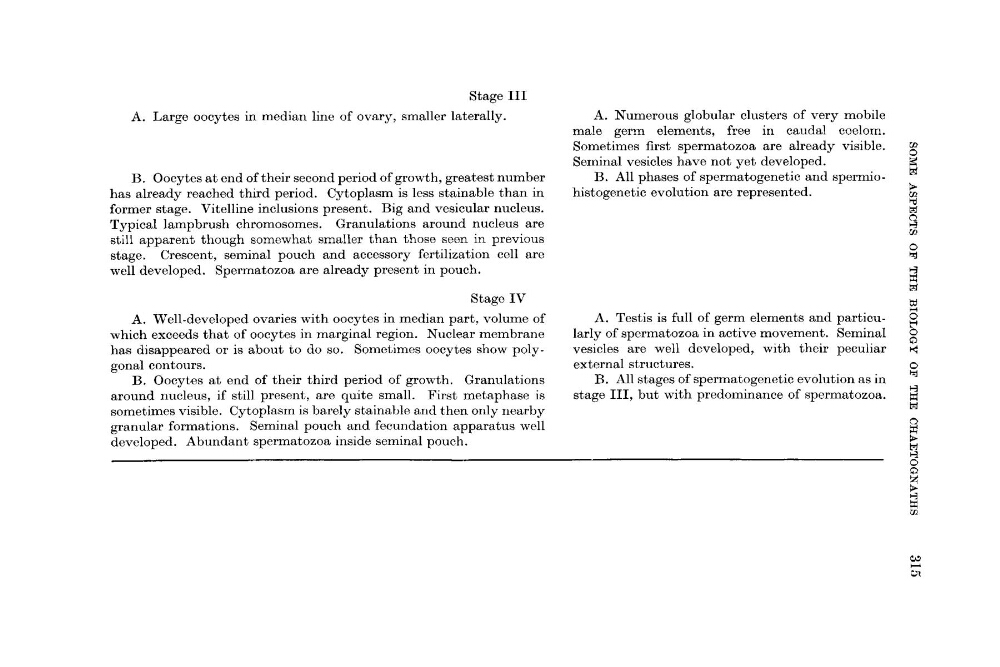
Stage I11
A. Large oocytes in median line of ovary, smaller laterally.
B. Oocytes at end of their second period of growth, greatest number
has already reached third period. Cytoplasm is less stainable than in
former stage. Vitelline inclusions present. Big and vesicular nucleus.
Typical lampbrush chromosomes. Granulations around nucleus are
still apparent though somewhat smaller than those seen in previous
stage. Crescent, seminal pouch and accessory fertilization cell are
well developed. Spermatozoa are already present in pouch.
Stage I V
A. Well-developed ovaries with oocytes in median part, volume of
which exceeds that of oocytes in marginal region. Nuclear membrane
has disappeared or is about to do so. Sometimes oocytes show polygonal contours.
Granulations
around nucleus, if still present, are quite small. First metaphase is
sometimes visible. Cytoplasm is barely stainable and then only nearby
granular formations. Seminal pouch and fecundation apparatus well
developed. Abundant spermatozoa inside seminal pouch.
B. Oocytes a t end of their third period of growth.
A. Numerous globular clusters of very mobile
male germ elements, free in caudal coelom.
Sometimes first spermatozoa are already visible.
Seminal vesicles have not yet developed.
B. All phases of spermatogenetic and spermiohistogenetic evolution are represented.
A. Testis is full of germ elements and particularly of spermatozoa in active movement. Seminal
vesicles are well developed, with their peculiar
external structures.
B. All stages of spermatogenetic evolution as in
stage 111, but with predominance of spermatozoa.
A. Large oocytes in median line of ovary, smaller laterally.
B. Oocytes at end of their second period of growth, greatest number
has already reached third period. Cytoplasm is less stainable than in
former stage. Vitelline inclusions present. Big and vesicular nucleus.
Typical lampbrush chromosomes. Granulations around nucleus are
still apparent though somewhat smaller than those seen in previous
stage. Crescent, seminal pouch and accessory fertilization cell are
well developed. Spermatozoa are already present in pouch.
Stage I V
A. Well-developed ovaries with oocytes in median part, volume of
which exceeds that of oocytes in marginal region. Nuclear membrane
has disappeared or is about to do so. Sometimes oocytes show polygonal contours.
Granulations
around nucleus, if still present, are quite small. First metaphase is
sometimes visible. Cytoplasm is barely stainable and then only nearby
granular formations. Seminal pouch and fecundation apparatus well
developed. Abundant spermatozoa inside seminal pouch.
B. Oocytes a t end of their third period of growth.
A. Numerous globular clusters of very mobile
male germ elements, free in caudal coelom.
Sometimes first spermatozoa are already visible.
Seminal vesicles have not yet developed.
B. All phases of spermatogenetic and spermiohistogenetic evolution are represented.
A. Testis is full of germ elements and particularly of spermatozoa in active movement. Seminal
vesicles are well developed, with their peculiar
external structures.
B. All stages of spermatogenetic evolution as in
stage 111, but with predominance of spermatozoa.