

310
ELVEZIO GIITRAHDELLI
maximum of two chiasmata for each bivalent and to demonstrate that
their terminalization continues until the metaphase. One pair of
chromosomes which Ghirardelli and Arnaud call chromosomes " m "
instead of " x " as Stevciis did (and this in order to avoid any confusion
with sexual chromosomes) must have their chiasmata in a distal
position. This facilitates a rapid terminalization and, as a consequence,
leads to a precocious division.
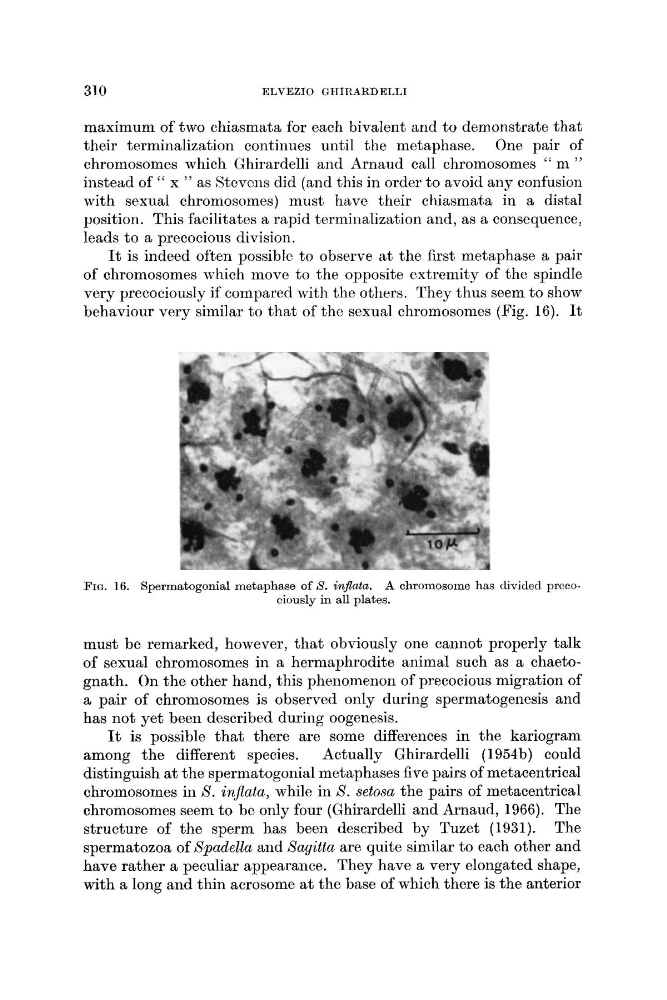
It is indeed often possible to observe at the first metaphase a pair
of chromosomes which move to the opposite extremity of the spindle
very precociously if compared with the others. They thus seem to show
behaviour very similar to that of the sexual chromosomes (Fig. 16). It
FIG. 16. Spermatogonial metaphase of S. in$ata.
A chromosome has divided prccociously in all plates.
must be remarked, however, that obviously one cannot properly talk
of sexual chromosomes in a hermaphrodite animal such as a chaetognath. On the other hand, this phenomenon of precocious migration of
a pair of chromosomes is observed only during spermatogenesis and
has not yet been described during oogenesis.
It is possible that there are some differences in the kariogram
among the different species. Actually Ghirardelli (195413) could
distinguish at the spermatogonial metaphases five pairs of metacentrical
chromosomes in X. in$ata, while in S. setosa the pairs of metacentrical
chromosomes seem to be only four (Ghirardelli and Arnaud, 1966). The
structure of the sperm has been described by Tuzet (1931). The
spermatozoa of Spadella and Sagitta are quite similar to each other and
have rather a peculiar appearance. They have a very elongated shape,
with a long and thin acrosome at the base of which there is the anterior
ELVEZIO GIITRAHDELLI
maximum of two chiasmata for each bivalent and to demonstrate that
their terminalization continues until the metaphase. One pair of
chromosomes which Ghirardelli and Arnaud call chromosomes " m "
instead of " x " as Stevciis did (and this in order to avoid any confusion
with sexual chromosomes) must have their chiasmata in a distal
position. This facilitates a rapid terminalization and, as a consequence,
leads to a precocious division.
It is indeed often possible to observe at the first metaphase a pair
of chromosomes which move to the opposite extremity of the spindle
very precociously if compared with the others. They thus seem to show
behaviour very similar to that of the sexual chromosomes (Fig. 16). It
FIG. 16. Spermatogonial metaphase of S. in$ata.
A chromosome has divided prccociously in all plates.
must be remarked, however, that obviously one cannot properly talk
of sexual chromosomes in a hermaphrodite animal such as a chaetognath. On the other hand, this phenomenon of precocious migration of
a pair of chromosomes is observed only during spermatogenesis and
has not yet been described during oogenesis.
It is possible that there are some differences in the kariogram
among the different species. Actually Ghirardelli (195413) could
distinguish at the spermatogonial metaphases five pairs of metacentrical
chromosomes in X. in$ata, while in S. setosa the pairs of metacentrical
chromosomes seem to be only four (Ghirardelli and Arnaud, 1966). The
structure of the sperm has been described by Tuzet (1931). The
spermatozoa of Spadella and Sagitta are quite similar to each other and
have rather a peculiar appearance. They have a very elongated shape,
with a long and thin acrosome at the base of which there is the anterior