

MANAGEMENT O F FISHERY RESOURCES
21
which the maximum occurs, and also the greater the catch at the
maximum, i.e. a t high fishing rates most fish will be caught, so that it
is worth waiting until the fish are well grown, while a t low fishing rates
it is better to start catching them when quite small as otherwise they
may not be caught at all. Equally, the relation between the amount of
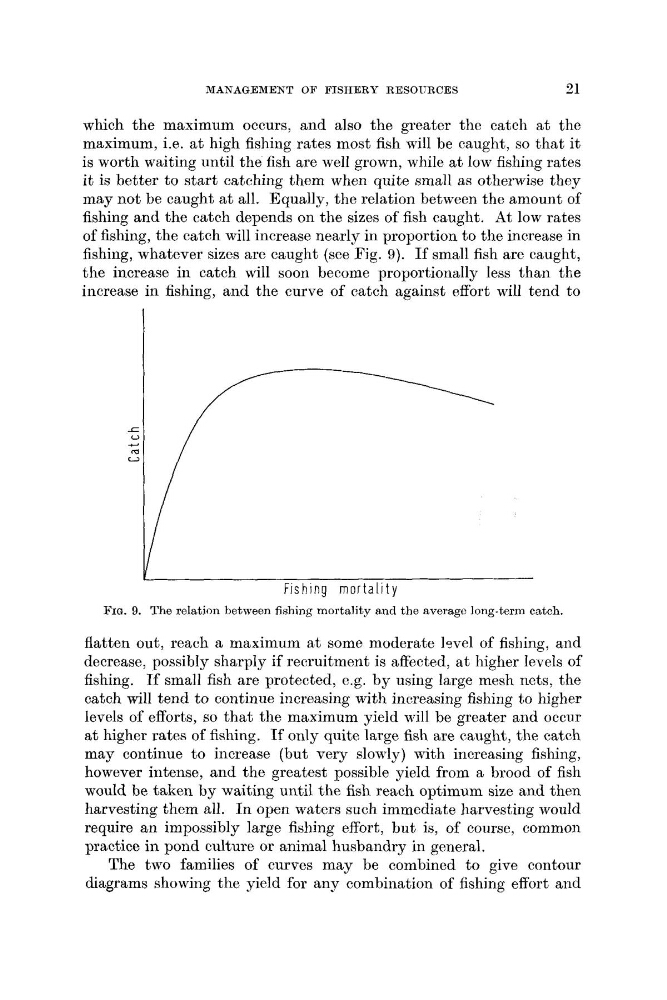
fishing and the catch depends on the sizes of fish caught. At low rates
of fishing, the catch will increase nearly in proportion to the increase in
fishing, whatever sizes are caught (see Fig. 9). If small fish are caught,
the increase in catch will soon become proportionally less than the
increase in fishing, and the curve of catch against effort will tend to
FIG. 9. The relation between fishing mortality and the averagc long-term catch.
flatten out, reach a maximum at some moderate level of fishing, and
decrease, possibly sharply if recruitment is affected, at higher levels of
fishing. If small fish are protected, e.g. by using large mesh nets, the
catch will tend to continue increasing with increasing fishing to higher
levels of efforts, so that the maximum yield will be greater and occur
at higher rates of fishing. If only quite large fish are caught, the catch
may continue to increase (but very slowly) with increasing fishing,
however intense, and the greatest possible yield from a brood of fish
would be taken by waiting until the fish reach optimum size and then
harvesting them all. I n open waters such immediate harvesting would
require an impossibly large fishing effort, but is, of course, common
practice in pond culture or animal husbandry in general.
The two families of curves may be combined to give contour
diagrams showing the yield for any combination of fishing effort and
21
which the maximum occurs, and also the greater the catch at the
maximum, i.e. a t high fishing rates most fish will be caught, so that it
is worth waiting until the fish are well grown, while a t low fishing rates
it is better to start catching them when quite small as otherwise they
may not be caught at all. Equally, the relation between the amount of
fishing and the catch depends on the sizes of fish caught. At low rates
of fishing, the catch will increase nearly in proportion to the increase in
fishing, whatever sizes are caught (see Fig. 9). If small fish are caught,
the increase in catch will soon become proportionally less than the
increase in fishing, and the curve of catch against effort will tend to
FIG. 9. The relation between fishing mortality and the averagc long-term catch.
flatten out, reach a maximum at some moderate level of fishing, and
decrease, possibly sharply if recruitment is affected, at higher levels of
fishing. If small fish are protected, e.g. by using large mesh nets, the
catch will tend to continue increasing with increasing fishing to higher
levels of efforts, so that the maximum yield will be greater and occur
at higher rates of fishing. If only quite large fish are caught, the catch
may continue to increase (but very slowly) with increasing fishing,
however intense, and the greatest possible yield from a brood of fish
would be taken by waiting until the fish reach optimum size and then
harvesting them all. I n open waters such immediate harvesting would
require an impossibly large fishing effort, but is, of course, common
practice in pond culture or animal husbandry in general.
The two families of curves may be combined to give contour
diagrams showing the yield for any combination of fishing effort and