

284
ELVEZIO GHIRARDELLI
12 days of age the cells of the " corona ciliata " tend to concentrate
on the inner edge, i.e. in the region which in the adult corresponds to
the glandular ring; however, they keep their character which is similar
to that of the cells of the ganglion. When the gonads begin to mature,
i.e. at about 20-30 days, the loop i s already completely separated from
the ventral ganglion which is now in its definitive position.
The cells of the outer ring and those of the inner ring begin to
differentiate at about 3 weeks of age. The former have nuclei that
stain more strongly, similar to those of the cells of the sensory prominences that arc to be found on the epidermis, and are less numerous
than the cells on the inner ring (Fig. 7 ) . The nuclei of the latter cells
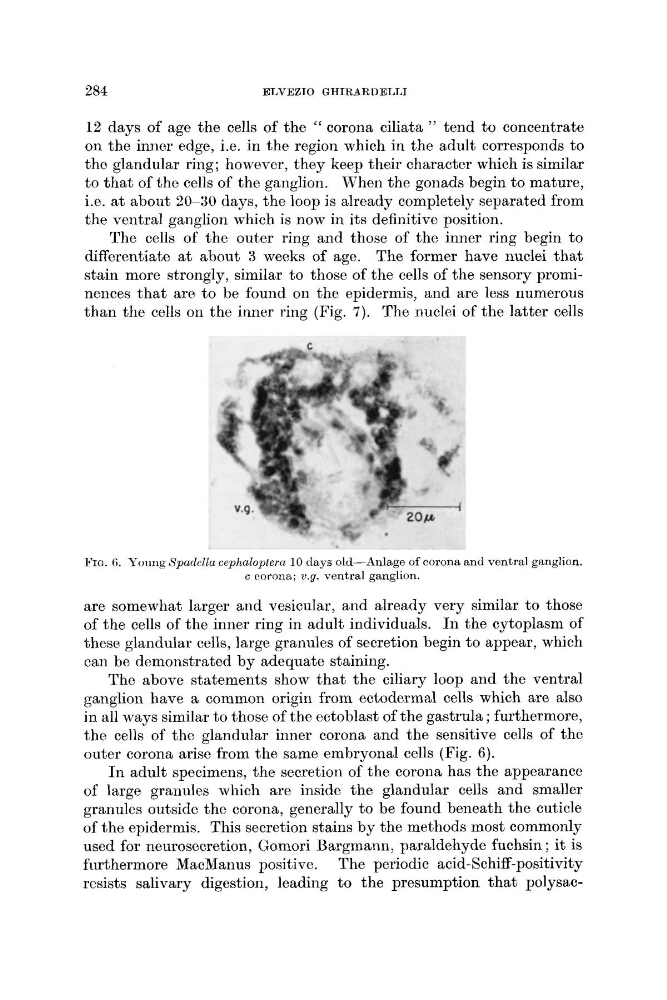
FIG. (i. Yoirrig Spudcllu cephuloptercr 10 days old-Anlage of corona and ventral ganglion.
c corona; c.9. ventral ganglion.
are somewhat larger and vesicular, and already very similar to those
of the cells of the inner ring in adult individuals. I n the cytoplasm of
these glandular cells, large granules of secretion begin to appear, which
can be demonstrated by adequate staining.
The above statements show that the ciliary loop and the ventral
ganglion have a common origin from ectodermal cells which are also
in all ways similar to those of the ectoblast of the gastrula ; furthermore,
the cells of the glandular inner corona and the sensitive cells of the
outer corona arise from the same embryonal cells (Fig. 6).
I n adult specimens, the secretion of the corona has the appearance
of large granules which are inside the glandular cells and smaller
granules outside the corona, generally to be found beneath the cuticle
of the epidermis. This secretion stains by the methods most commonly
used for neurosecretion, Gomori Bargmann, paraldehyde fuchsin ; it is
furthermore MacManus positive. The periodic acid-Schiff-positivity
resists salivary digestion, leading to the presumption that polysac-
ELVEZIO GHIRARDELLI
12 days of age the cells of the " corona ciliata " tend to concentrate
on the inner edge, i.e. in the region which in the adult corresponds to
the glandular ring; however, they keep their character which is similar
to that of the cells of the ganglion. When the gonads begin to mature,
i.e. at about 20-30 days, the loop i s already completely separated from
the ventral ganglion which is now in its definitive position.
The cells of the outer ring and those of the inner ring begin to
differentiate at about 3 weeks of age. The former have nuclei that
stain more strongly, similar to those of the cells of the sensory prominences that arc to be found on the epidermis, and are less numerous
than the cells on the inner ring (Fig. 7 ) . The nuclei of the latter cells
FIG. (i. Yoirrig Spudcllu cephuloptercr 10 days old-Anlage of corona and ventral ganglion.
c corona; c.9. ventral ganglion.
are somewhat larger and vesicular, and already very similar to those
of the cells of the inner ring in adult individuals. I n the cytoplasm of
these glandular cells, large granules of secretion begin to appear, which
can be demonstrated by adequate staining.
The above statements show that the ciliary loop and the ventral
ganglion have a common origin from ectodermal cells which are also
in all ways similar to those of the ectoblast of the gastrula ; furthermore,
the cells of the glandular inner corona and the sensitive cells of the
outer corona arise from the same embryonal cells (Fig. 6).
I n adult specimens, the secretion of the corona has the appearance
of large granules which are inside the glandular cells and smaller
granules outside the corona, generally to be found beneath the cuticle
of the epidermis. This secretion stains by the methods most commonly
used for neurosecretion, Gomori Bargmann, paraldehyde fuchsin ; it is
furthermore MacManus positive. The periodic acid-Schiff-positivity
resists salivary digestion, leading to the presumption that polysac-