

282
ELVEZIO GHIHABDELLI
total length to length of the tail section, and in the form of the teeth
which is quite peculiar in X. hexaptera. The ciliary loop of#. pulchra has
an elongated ellipsoid form, it begins before and between the eyes and
extends on to the head, the neck and part of the trunk. It may be
broken up into several segments, some of which may even be
missing so that the ciliary loop might be present only on the trunk
(Fig. 4). Several forms of corona ciliata were also observed in S. craSsa
(Kado and Hirota, 1957). Its structure and function will be dealt with
later (see p, 285).
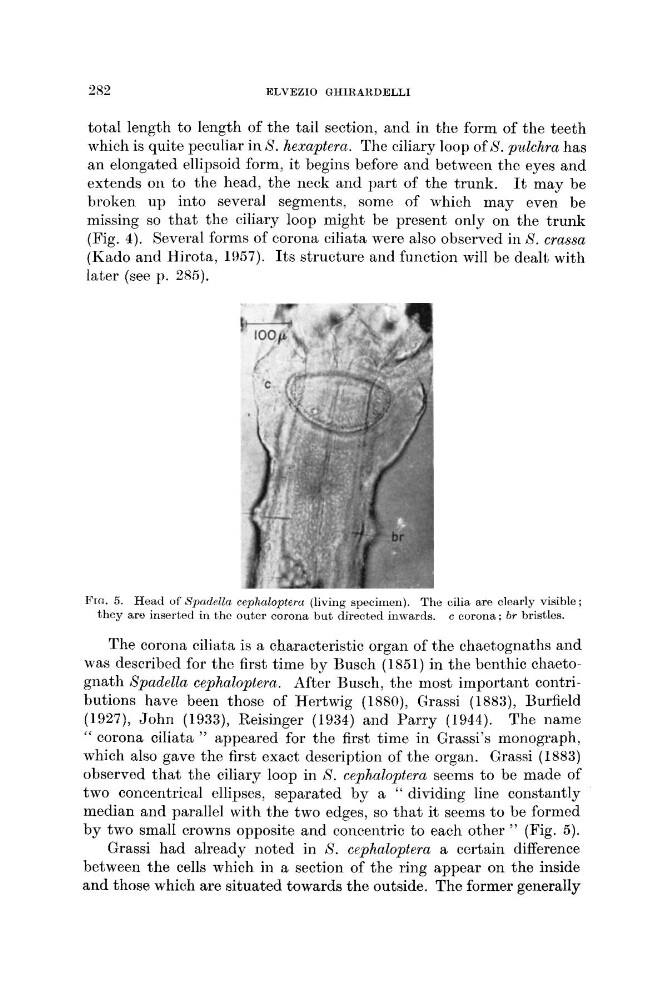
Fro. 5. Head of Spndellu ccpAuZopteru (living specimen). The ellla are clearly visible;
they arc inserted in thc outer corona but directed inwards. c corona: br bristles.
The corona ciliata is a characteristic organ of the chaetognaths and
was described for the first time by Busch (1851) in the benthic chaetognath Spadella cephaloptera. After Busch, the most important contributions have been those of Hertwig (1880), Grassi (1883), Burfield
(1927), John (1933), Reisinger (1934) and Parry (1944). The name
“ corona ciliata ” appeared for the first time in Grassi’s monograph.
which also gave the first exact description of the organ. Grassi (1853)
observed that the ciliary loop in 8. cephaloptera seems to be made of
two concentrical ellipses, separated by a “ dividing line constantly
median and parallel with the two edges, so that it seems to be formed
by two small crowns opposite and concentric to each other ” (Fig. 5).
Grassi had already noted in S. cephaloptera a certain difference
between the cells which in a section of the ring appear on the inside
and those which are situated towards the outside. The former generally
ELVEZIO GHIHABDELLI
total length to length of the tail section, and in the form of the teeth
which is quite peculiar in X. hexaptera. The ciliary loop of#. pulchra has
an elongated ellipsoid form, it begins before and between the eyes and
extends on to the head, the neck and part of the trunk. It may be
broken up into several segments, some of which may even be
missing so that the ciliary loop might be present only on the trunk
(Fig. 4). Several forms of corona ciliata were also observed in S. craSsa
(Kado and Hirota, 1957). Its structure and function will be dealt with
later (see p, 285).
Fro. 5. Head of Spndellu ccpAuZopteru (living specimen). The ellla are clearly visible;
they arc inserted in thc outer corona but directed inwards. c corona: br bristles.
The corona ciliata is a characteristic organ of the chaetognaths and
was described for the first time by Busch (1851) in the benthic chaetognath Spadella cephaloptera. After Busch, the most important contributions have been those of Hertwig (1880), Grassi (1883), Burfield
(1927), John (1933), Reisinger (1934) and Parry (1944). The name
“ corona ciliata ” appeared for the first time in Grassi’s monograph.
which also gave the first exact description of the organ. Grassi (1853)
observed that the ciliary loop in 8. cephaloptera seems to be made of
two concentrical ellipses, separated by a “ dividing line constantly
median and parallel with the two edges, so that it seems to be formed
by two small crowns opposite and concentric to each other ” (Fig. 5).
Grassi had already noted in S. cephaloptera a certain difference
between the cells which in a section of the ring appear on the inside
and those which are situated towards the outside. The former generally