

27G
ELVEZIO GHIRAHDELLI
the phase contrast microscope. They appear as a group of sensory
neurons each of which bears a non-motile cilium at the tip of the
dendrite. Experiments made by Horridge and Boulton showed an
accurate feeding movement toward any source vibrating a t 9-20 c/s
with an amplitude of 100-500 p at a distance of 1-3 mm. General
vibration is ineffective ; stimuli which are too close, too strong or very
close to the ciliary organ, cause an escape movement. Therefore the
nervous system of the chaetognaths must include some mechanism of
integration which discriminates the characteristic signal of typical
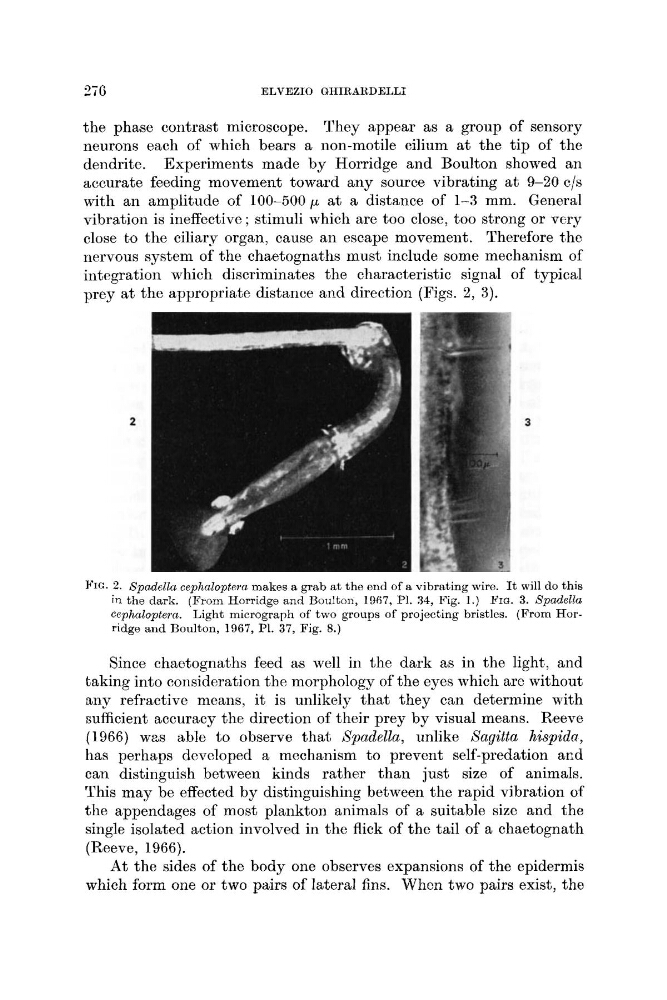
prey at the appropriate distance and direction (Figs. 2 , 3).
F I G . 2. Spadella cephaloptera makes a grab at the end of a vibrating wire. It will do this
in the dark. (From Horridge and Boulton, 1967, PI. 34, Fig. 1.) FIG. 3. Spadella
cephaloptera. Light micrograph of two groups of projecting bristles. (From Horridge and Boulton, 1967, P1. 37, Fig. 8.)
Since chaetognaths feed as well in the dark as in the light, and
baking into consideration the morphology of the eyes which arc without
m y refractive means, it is unlikely that they can determine with
sufficient accuracy the direction of their prey by visual means. Reevc
(1966) was able to observe that Xpadella, unlike Xagitta hispida,
has perhaps developed a mechanism to prevent self-predation and
can distinguish between kinds rather than just size of animals.
This may be effected by distinguishing between the rapid vibration of
the appendages o€ most plankton animals of a suitable size and the
single isolated action involved in the flick of the tail of a chaetognath
(Reeve, 1966).
A t the sides of the body one observes expansions of the epidermis
which form one or two pairs of lateral fins. When two pairs exist, the
ELVEZIO GHIRAHDELLI
the phase contrast microscope. They appear as a group of sensory
neurons each of which bears a non-motile cilium at the tip of the
dendrite. Experiments made by Horridge and Boulton showed an
accurate feeding movement toward any source vibrating a t 9-20 c/s
with an amplitude of 100-500 p at a distance of 1-3 mm. General
vibration is ineffective ; stimuli which are too close, too strong or very
close to the ciliary organ, cause an escape movement. Therefore the
nervous system of the chaetognaths must include some mechanism of
integration which discriminates the characteristic signal of typical
prey at the appropriate distance and direction (Figs. 2 , 3).
F I G . 2. Spadella cephaloptera makes a grab at the end of a vibrating wire. It will do this
in the dark. (From Horridge and Boulton, 1967, PI. 34, Fig. 1.) FIG. 3. Spadella
cephaloptera. Light micrograph of two groups of projecting bristles. (From Horridge and Boulton, 1967, P1. 37, Fig. 8.)
Since chaetognaths feed as well in the dark as in the light, and
baking into consideration the morphology of the eyes which arc without
m y refractive means, it is unlikely that they can determine with
sufficient accuracy the direction of their prey by visual means. Reevc
(1966) was able to observe that Xpadella, unlike Xagitta hispida,
has perhaps developed a mechanism to prevent self-predation and
can distinguish between kinds rather than just size of animals.
This may be effected by distinguishing between the rapid vibration of
the appendages o€ most plankton animals of a suitable size and the
single isolated action involved in the flick of the tail of a chaetognath
(Reeve, 1966).
A t the sides of the body one observes expansions of the epidermis
which form one or two pairs of lateral fins. When two pairs exist, the