

272
ELVEZIO GHIRARDELLI
especially in that by Kuhl, both the macroscopic and the microscopic
anatomy are thoroughly dealt with. I shall therefore limit myself in
the present work to some special characters which have a systematic or
adaptational value or on which recent contributions have thrown new
light.
Chaetognaths all have an elongated body, similar to an arrow, hence
the name “ arrow worms” (Slabber, 1769) and their generic name
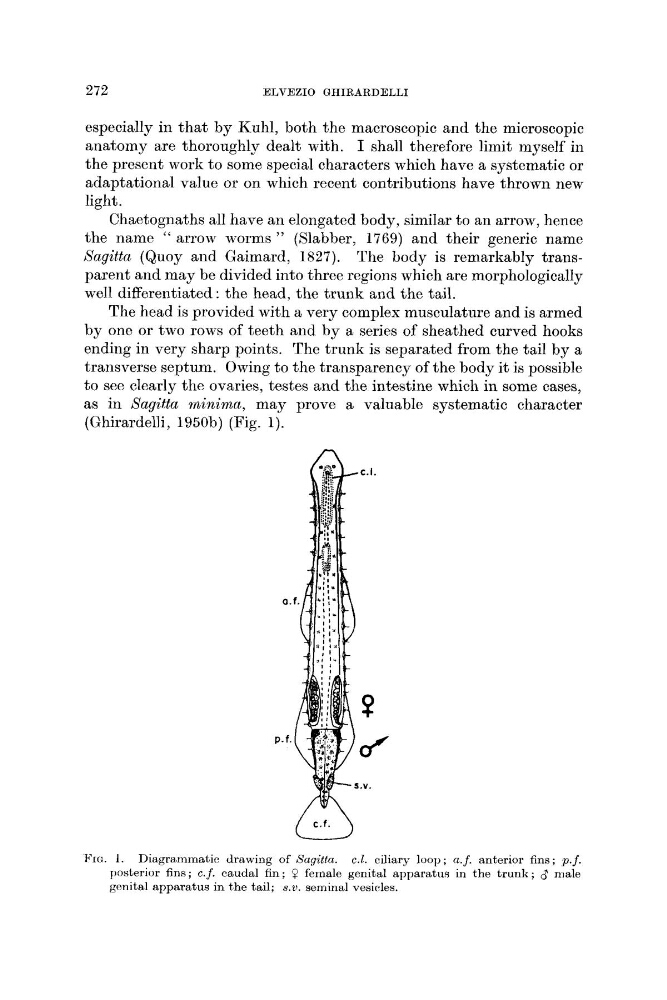
Xagitta (Quoy and Gaimard, 1827). The body is remarkably transparent and may be divided into three regions which are morphologically
well differentiated: the head, the trunk and the tail.
The head is provided with a very complex musculature and is armed
by one or two rows of teeth and by a series of sheathed curved hooks
ending in very sharp points. The trunk is separated from the tail by a
transverse septum. Owing to the transparency of the body it is possible
to see clearly the ovaries, testes and the intestine which in some cases,
as in Sagitta minima, may prove a valuable systematic character
(Ghirardelli, 1950b) (Fig. 1).
FIG. 1. Diagrammatic drawing of Saqitta. c.Z. ciliary loop; a.f. anterior fins; p.f.
posterior fins; c.f. caudal fin; Q female genital apparatus in the trunk; 6 nrale
genital apparatus in the tail; S.W. seminal vesicles.
ELVEZIO GHIRARDELLI
especially in that by Kuhl, both the macroscopic and the microscopic
anatomy are thoroughly dealt with. I shall therefore limit myself in
the present work to some special characters which have a systematic or
adaptational value or on which recent contributions have thrown new
light.
Chaetognaths all have an elongated body, similar to an arrow, hence
the name “ arrow worms” (Slabber, 1769) and their generic name
Xagitta (Quoy and Gaimard, 1827). The body is remarkably transparent and may be divided into three regions which are morphologically
well differentiated: the head, the trunk and the tail.
The head is provided with a very complex musculature and is armed
by one or two rows of teeth and by a series of sheathed curved hooks
ending in very sharp points. The trunk is separated from the tail by a
transverse septum. Owing to the transparency of the body it is possible
to see clearly the ovaries, testes and the intestine which in some cases,
as in Sagitta minima, may prove a valuable systematic character
(Ghirardelli, 1950b) (Fig. 1).
FIG. 1. Diagrammatic drawing of Saqitta. c.Z. ciliary loop; a.f. anterior fins; p.f.
posterior fins; c.f. caudal fin; Q female genital apparatus in the trunk; 6 nrale
genital apparatus in the tail; S.W. seminal vesicles.