

MANAGEMENT OF FISHERY RESOURCES
17
mediate stock level. This level may be achieved by some moderate
amount of fishing on all sizes of fish, or pssibbly quite heavy fishing
selectively applied to the larger fish.
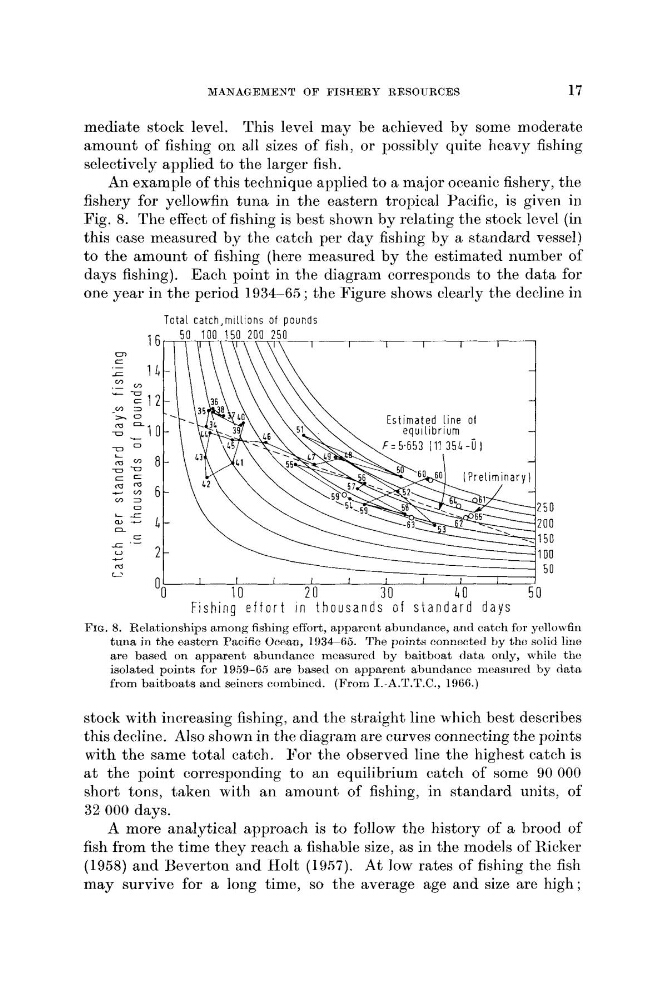
An example of this technique applied to a major oceanic fishery, the
fishery for yellowfin tuna in the eastern tropical Pacific, is given in
Fig. 8. The effect of fishing is best shown by relating the stock level (in
this case measured by the catch per day fishing by a standard vessel)
to the amount of fishing (here measured by the estimated number of
days fishing). Each point in the diagram corresponds to the data for
one year in the period 1934-65; the Figure shows clearly the decline in
T o t a l catch,millions of pounds
1
v ) 3
0
L Z
a -
a
c
L ' -
V
c
m
L'
F i s h i n g e f f o r t i n thousands o f s t a n d a r d d a y s
FIG. 8. Relationships among fishing effort, apparcnt abundance, and catch for yellowfin
tuna i n the eastcrn Pacific Ocean, 1034-66. The points connected by thc solid line
are based on apparent abundance mcasurcd by baitboat data only, while the
isolated points for 1959-66 are h s e t l on apparent abundancc measiired by data
from baitboats and seincrs combinctl. (From I.-A.T.T.C., i966.)
stock with increasing fishing, and the straight line which best describes
this decline. Also shown in the diagram are curves connecting the points
with the samc total catch. For the observed line the highest catch is
at the point corresponding to an equilibrium catch of some 90 000
short tons, taken with an amount of fishing, in standard units, of
32 000 days.
A more analytical approach is to follow the history of a brood of
fish from the time they reach a fishable size, as in the models of Ricker
(1958) and Beverton and Holt (1957). At low rates of fishing the fish
may survive for a long time, so the average age and size are high;
17
mediate stock level. This level may be achieved by some moderate
amount of fishing on all sizes of fish, or pssibbly quite heavy fishing
selectively applied to the larger fish.
An example of this technique applied to a major oceanic fishery, the
fishery for yellowfin tuna in the eastern tropical Pacific, is given in
Fig. 8. The effect of fishing is best shown by relating the stock level (in
this case measured by the catch per day fishing by a standard vessel)
to the amount of fishing (here measured by the estimated number of
days fishing). Each point in the diagram corresponds to the data for
one year in the period 1934-65; the Figure shows clearly the decline in
T o t a l catch,millions of pounds
1
v ) 3
0
L Z
a -
a
c
L ' -
V
c
m
L'
F i s h i n g e f f o r t i n thousands o f s t a n d a r d d a y s
FIG. 8. Relationships among fishing effort, apparcnt abundance, and catch for yellowfin
tuna i n the eastcrn Pacific Ocean, 1034-66. The points connected by thc solid line
are based on apparent abundance mcasurcd by baitboat data only, while the
isolated points for 1959-66 are h s e t l on apparent abundancc measiired by data
from baitboats and seincrs combinctl. (From I.-A.T.T.C., i966.)
stock with increasing fishing, and the straight line which best describes
this decline. Also shown in the diagram are curves connecting the points
with the samc total catch. For the observed line the highest catch is
at the point corresponding to an equilibrium catch of some 90 000
short tons, taken with an amount of fishing, in standard units, of
32 000 days.
A more analytical approach is to follow the history of a brood of
fish from the time they reach a fishable size, as in the models of Ricker
(1958) and Beverton and Holt (1957). At low rates of fishing the fish
may survive for a long time, so the average age and size are high;