

215
FAUNA AND FLORA O F MANGROVE SWAMPS
may be encountered in the landward fringe. Such burrows are easily
recognizable by the shape of the entrance and the quantity of soft mud
thrown out at the entrance. Along river banks these crabs are said to
ascend upstream well above saline influence, but one wonders if they
are really above the influence of the “ salt wedge ”.
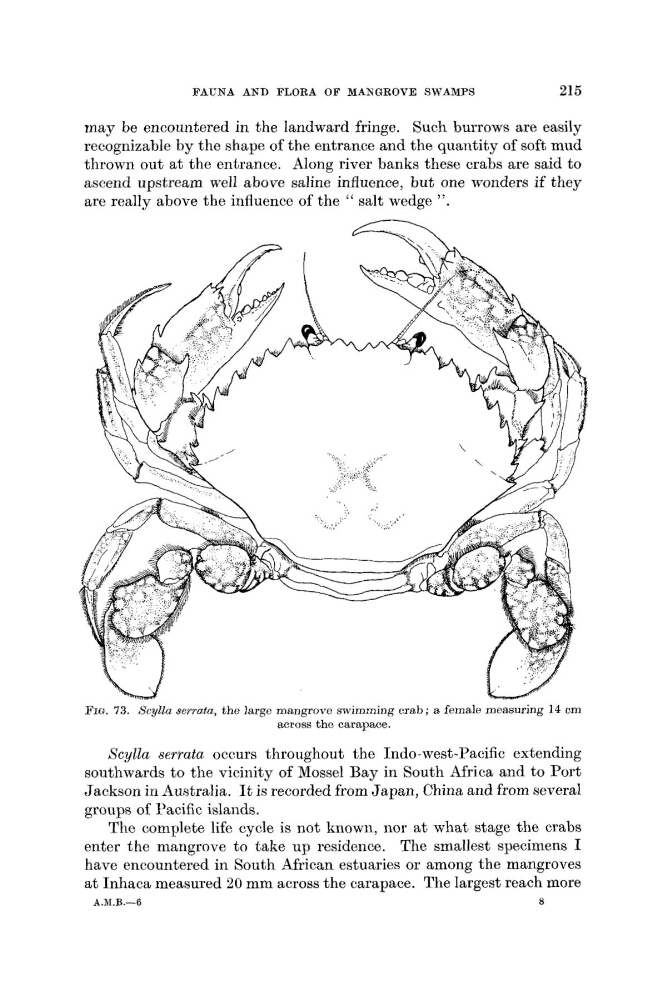
FIG. 73. Scylla serratu, the large mangrove swimming crab; a female measuring 14 cm
across the carapace.
Xcylla serrata occurs throughout the Indo-west-Pacific extending
southwards to the vicinity of Mossel Bay in South Africa and to Port
Jackson in Australia. It is recorded from Japan, China and from several
groups of Pacific islands.
The complete life cycle is not known, nor at what stage the crabs
enter the mangrove to take up residence. The smallest specimens I
have encountered in South African estuaries or among the mangroves
a t Inhaca measured 20 mm across the carapace. The largest reach more
8
A.II1.B.-G
FAUNA AND FLORA O F MANGROVE SWAMPS
may be encountered in the landward fringe. Such burrows are easily
recognizable by the shape of the entrance and the quantity of soft mud
thrown out at the entrance. Along river banks these crabs are said to
ascend upstream well above saline influence, but one wonders if they
are really above the influence of the “ salt wedge ”.
FIG. 73. Scylla serratu, the large mangrove swimming crab; a female measuring 14 cm
across the carapace.
Xcylla serrata occurs throughout the Indo-west-Pacific extending
southwards to the vicinity of Mossel Bay in South Africa and to Port
Jackson in Australia. It is recorded from Japan, China and from several
groups of Pacific islands.
The complete life cycle is not known, nor at what stage the crabs
enter the mangrove to take up residence. The smallest specimens I
have encountered in South African estuaries or among the mangroves
a t Inhaca measured 20 mm across the carapace. The largest reach more
8
A.II1.B.-G