

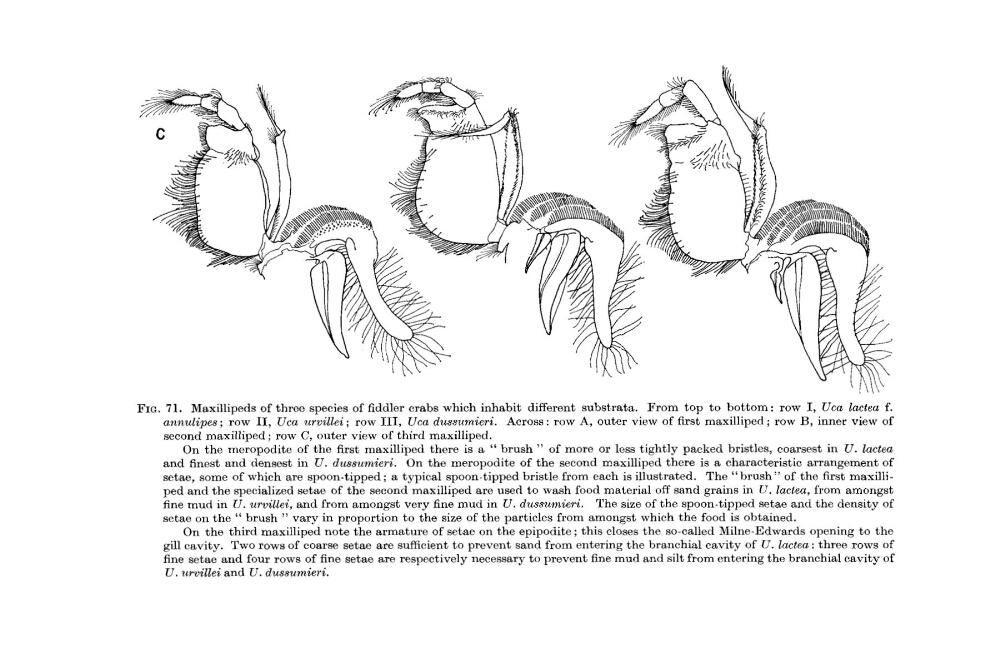
FIG. 71. Maxillipeds of three species of fiddler crabs which inhabit different subst,rata. From top to bottom: row I, Uea lactea f.
annulipes; row 11, Uea urvillei; row 111, Uca dussumieri. Across: row A, outer view of first maxilliped; row B, inner view of
second maxilliped ; row C, outer view of third maxilliped.
On the meropodite of the first maxilliped there is a ‘‘ brush ” of more or less tightly packed bristles, coarsest in U . lactea
and finest and densest in U . dussumieri. On the meropodite of the second maxilliped there is a characteristic arrangement of
setae, some of which are spoon-tipped; a typical spoon-tipped bristle from each is illustrated. The “brush ‘’ of the first maxilliped and the specialized setae of the second maxilliped are used to wash food material off sand grains in U . lactea, from amongst
fine mud in U . urvillei, and from amongst very fine mud in U . dussumieri. The size of the spoon-tipped setae and the density of
setae on the “ brush ” vary in proportion to the size of the particles from amongst which the food is obtained.
On the third maxilliped note the armature of setae on the epipodite ; this closes the so-called Milne-Edwards opening to the
gill cavity. Two rows of coarse setae are sufficient t o prevent sand from entering the branchial cavity of U . lactea : three rows of
fine setae and four rows of fine setae are respectively necessary to prevent fine mud and silt from entering the branchial cavity of
U . urvillei and U . dussumieri.
annulipes; row 11, Uea urvillei; row 111, Uca dussumieri. Across: row A, outer view of first maxilliped; row B, inner view of
second maxilliped ; row C, outer view of third maxilliped.
On the meropodite of the first maxilliped there is a ‘‘ brush ” of more or less tightly packed bristles, coarsest in U . lactea
and finest and densest in U . dussumieri. On the meropodite of the second maxilliped there is a characteristic arrangement of
setae, some of which are spoon-tipped; a typical spoon-tipped bristle from each is illustrated. The “brush ‘’ of the first maxilliped and the specialized setae of the second maxilliped are used to wash food material off sand grains in U . lactea, from amongst
fine mud in U . urvillei, and from amongst very fine mud in U . dussumieri. The size of the spoon-tipped setae and the density of
setae on the “ brush ” vary in proportion to the size of the particles from amongst which the food is obtained.
On the third maxilliped note the armature of setae on the epipodite ; this closes the so-called Milne-Edwards opening to the
gill cavity. Two rows of coarse setae are sufficient t o prevent sand from entering the branchial cavity of U . lactea : three rows of
fine setae and four rows of fine setae are respectively necessary to prevent fine mud and silt from entering the branchial cavity of
U . urvillei and U . dussumieri.