

FAUNA AND FLORA O F MANGROVE SWAMPS
101
season non-territorial individuals seem to be wanderers and it is these
which are likely to bc found in abnormal situations such as, for example.
rocky shores. They are usually to be seen skittering around the edges
of pools or along the water’s edge in creeks.
The most complete accounts available are for P. chrysospilos. The
following description is taken from a rcport prepared for an Honours
degree in Zoology at the University of Singapore by Khoo (196G),
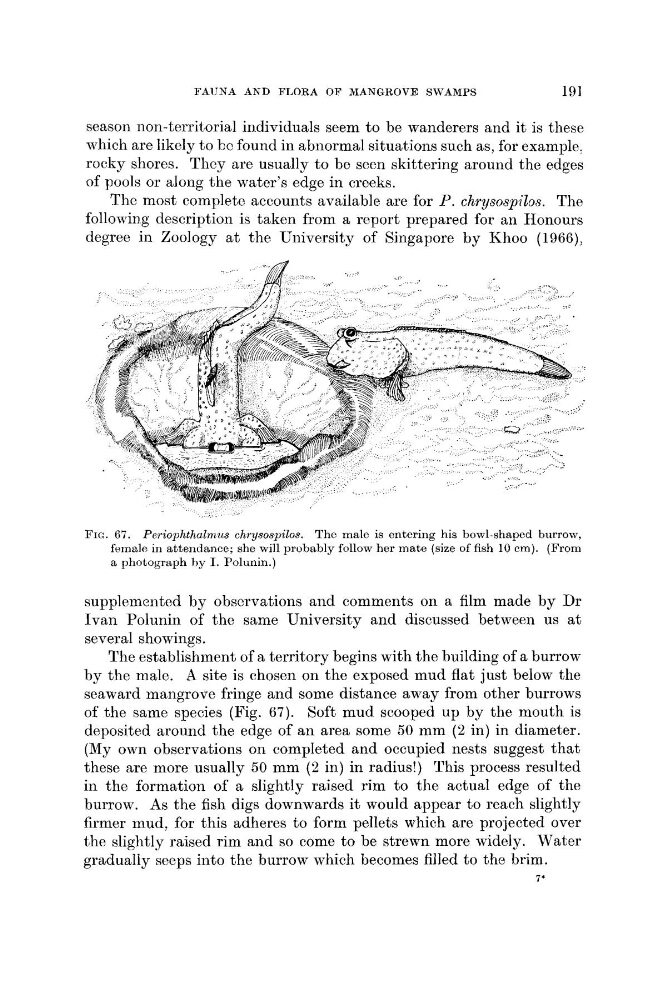
FIG. 67. Periophthalmus chrysospilos. The male is cntering his bowl-shaped burrow,
female in attendance; she will probably follow her mate (size of fish 10 em). (From
a photograph by I. Polunin.)
supplemented by observations and comments on a film made by Dr
Ivan Polunin of the same University and discussed between us at
several showings.
The establishment of a territory begins with the building of a burrow
by the male. A site is chosen on the exposed mud flat just below the
seaward mangrove fringe and some distance away from other burrows
of the same species (Fig. 67). Soft mud scooped up by the mouth is
deposited around the edge of an area some 50 mm ( 2 in) in diameter.
(My own observations on compIeted and occupied nests suggest that
these are more usually 50 mm ( 2 in) in radius!) This process resulted
in the formation of a slightly raised rim to the actual edge of the
burrow. As the fish digs downwards it would appear to reach slightly
firmer mud, for this adheres to form pellets which are projected over
the slightly raised rim and so come to be strewn more widely. Water
gradually seeps into the burrow which becomes filled to the brim.
7*
101
season non-territorial individuals seem to be wanderers and it is these
which are likely to bc found in abnormal situations such as, for example.
rocky shores. They are usually to be seen skittering around the edges
of pools or along the water’s edge in creeks.
The most complete accounts available are for P. chrysospilos. The
following description is taken from a rcport prepared for an Honours
degree in Zoology at the University of Singapore by Khoo (196G),
FIG. 67. Periophthalmus chrysospilos. The male is cntering his bowl-shaped burrow,
female in attendance; she will probably follow her mate (size of fish 10 em). (From
a photograph by I. Polunin.)
supplemented by observations and comments on a film made by Dr
Ivan Polunin of the same University and discussed between us at
several showings.
The establishment of a territory begins with the building of a burrow
by the male. A site is chosen on the exposed mud flat just below the
seaward mangrove fringe and some distance away from other burrows
of the same species (Fig. 67). Soft mud scooped up by the mouth is
deposited around the edge of an area some 50 mm ( 2 in) in diameter.
(My own observations on compIeted and occupied nests suggest that
these are more usually 50 mm ( 2 in) in radius!) This process resulted
in the formation of a slightly raised rim to the actual edge of the
burrow. As the fish digs downwards it would appear to reach slightly
firmer mud, for this adheres to form pellets which are projected over
the slightly raised rim and so come to be strewn more widely. Water
gradually seeps into the burrow which becomes filled to the brim.
7*