

1 SG
WILLIAM MACNAE
promontory between two mangals were all juveniles, and so were
wandering, they were certainly not " a t home ".
Of the mud-skippers listed above, only the P. kalolo group reaches
the African coasts. These fish are very difficult to identify accurately.
The most recent descriptions (Smith, 1959) recognize two species from
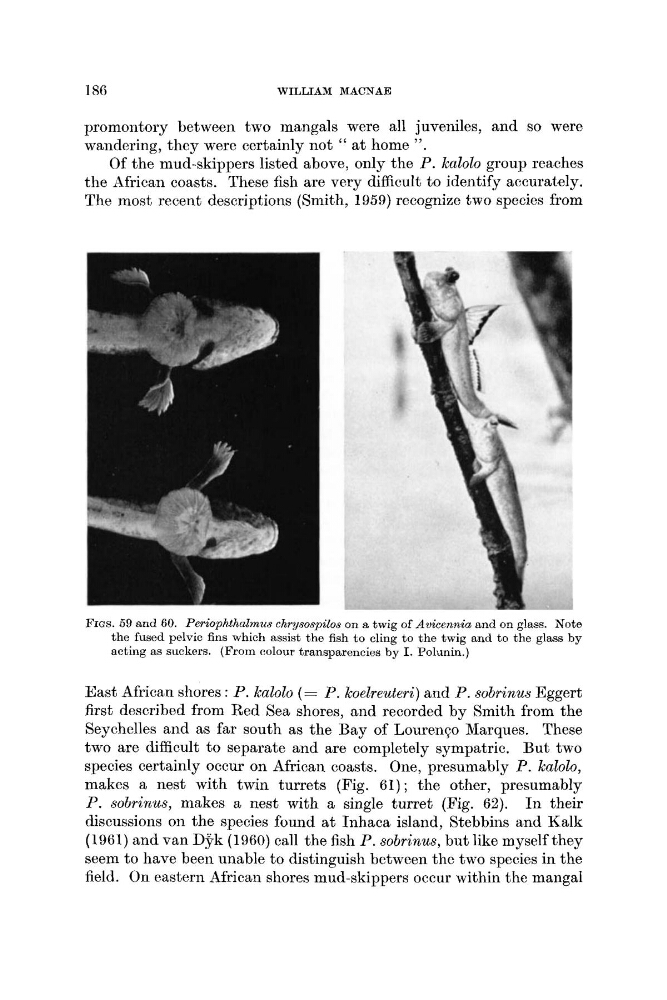
FIGS. 59 and 60. PeriopkthaZmus chrysospilos on a twig of Avicenlzia and on glass. Note
the fused pelvic fins which assist the fish to cling to the twig and t o the glass by
acting as suckers. (From colour transparencies by I. Polunin.)
East Afkican shores : P. kalolo (= P. koelreuteri) and P. sobrinus Eggert
first described from Red Sea shores, and recorded by Smith from the
Seychelles and as far south as the Bay of Lourengo Marques. These
two are difficult to separate and are completely sympatric. But two
species certainly occur on African coasts. One, presumably P. kalolo,
makes a nest with twin turrets (Fig. 61); the other, presumably
P. sobrinus, makes a nest with a single turret (Fig. 62). I n their
discussions on the species found a t Inhaca island, Stebbins and Kalk
(1961) and van Dyk (1960) call the fish P. sobrinus, but like myself they
seem to have been unable to distinguish between the two species in the
field. On eastern African shores mud-skippers occur within the mangal
WILLIAM MACNAE
promontory between two mangals were all juveniles, and so were
wandering, they were certainly not " a t home ".
Of the mud-skippers listed above, only the P. kalolo group reaches
the African coasts. These fish are very difficult to identify accurately.
The most recent descriptions (Smith, 1959) recognize two species from
FIGS. 59 and 60. PeriopkthaZmus chrysospilos on a twig of Avicenlzia and on glass. Note
the fused pelvic fins which assist the fish to cling to the twig and t o the glass by
acting as suckers. (From colour transparencies by I. Polunin.)
East Afkican shores : P. kalolo (= P. koelreuteri) and P. sobrinus Eggert
first described from Red Sea shores, and recorded by Smith from the
Seychelles and as far south as the Bay of Lourengo Marques. These
two are difficult to separate and are completely sympatric. But two
species certainly occur on African coasts. One, presumably P. kalolo,
makes a nest with twin turrets (Fig. 61); the other, presumably
P. sobrinus, makes a nest with a single turret (Fig. 62). I n their
discussions on the species found a t Inhaca island, Stebbins and Kalk
(1961) and van Dyk (1960) call the fish P. sobrinus, but like myself they
seem to have been unable to distinguish between the two species in the
field. On eastern African shores mud-skippers occur within the mangal