

FAUNA AND FLORA OF MANGROVE SWAMPS
179
of the animals found here seem to depend on a burrow, or where a
burrow cannot be dug, one finds forms capable of living in the soft
muds.
I n Malaya and adjacent regions in places where the mud, or at
least its surface layer, is semi-fluid two animals are conspicuous. These
are a mud-skipper Scarteluos viridis (H. Buchanan) and a crab Nacrophthalmus latreillei (Desm.).
At slightly higher levels, and among the most seaward trees where
the mud has a jelly-like or custard-like consistency, these two drop
out and are replaced by another mud-skipper Boleophthalnzus boddaerti
(Pallas) (Fig. 68), by a mud crab Metuplax crenulatus (Gerstaecker)
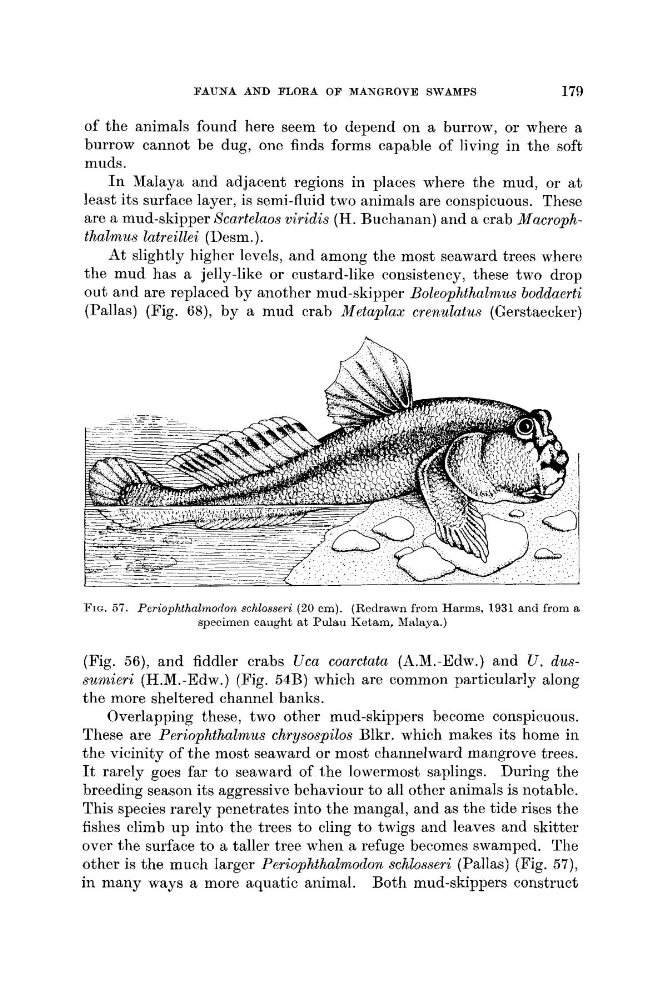
FIG. 57. Periophthalmodon schlosseri (20 em). (Redrawn from Harms, 1931 and from a
specimen caught at Pulau Ketam, blalaya.)
(Fig. 56), and fiddler crabs Uca courctuta (AM-Edw.) and U . dussumieri (H.M.-Edw.) (Fig. 54B) which are common particularly along
the more sheltered channel banks.
Overlapping these, two other mud-skippers become conspicuous.
These are Periophthalmus chrysospilos Blkr. which makes its home in
the vicinity of the most seaward or most channelward mangrove trees.
It rarely goes far to seaward of the lowermost saplings. During the
breeding season its aggressive behaviour to all other animals is notable.
This species rarely penetrates into the mangal, and as the tide rises the
fishes climb up into the trees to cling to twigs and leaves and skitter
over the surface to a taller tree when a refuge becomes swamped. The
other is the much Iarger Perio~hth~lmodon schlosseri (Pallas) (Fig. 5 7 ) ,
in many ways a more aquatic animal. Both mud-skippers construct
179
of the animals found here seem to depend on a burrow, or where a
burrow cannot be dug, one finds forms capable of living in the soft
muds.
I n Malaya and adjacent regions in places where the mud, or at
least its surface layer, is semi-fluid two animals are conspicuous. These
are a mud-skipper Scarteluos viridis (H. Buchanan) and a crab Nacrophthalmus latreillei (Desm.).
At slightly higher levels, and among the most seaward trees where
the mud has a jelly-like or custard-like consistency, these two drop
out and are replaced by another mud-skipper Boleophthalnzus boddaerti
(Pallas) (Fig. 68), by a mud crab Metuplax crenulatus (Gerstaecker)
FIG. 57. Periophthalmodon schlosseri (20 em). (Redrawn from Harms, 1931 and from a
specimen caught at Pulau Ketam, blalaya.)
(Fig. 56), and fiddler crabs Uca courctuta (AM-Edw.) and U . dussumieri (H.M.-Edw.) (Fig. 54B) which are common particularly along
the more sheltered channel banks.
Overlapping these, two other mud-skippers become conspicuous.
These are Periophthalmus chrysospilos Blkr. which makes its home in
the vicinity of the most seaward or most channelward mangrove trees.
It rarely goes far to seaward of the lowermost saplings. During the
breeding season its aggressive behaviour to all other animals is notable.
This species rarely penetrates into the mangal, and as the tide rises the
fishes climb up into the trees to cling to twigs and leaves and skitter
over the surface to a taller tree when a refuge becomes swamped. The
other is the much Iarger Perio~hth~lmodon schlosseri (Pallas) (Fig. 5 7 ) ,
in many ways a more aquatic animal. Both mud-skippers construct